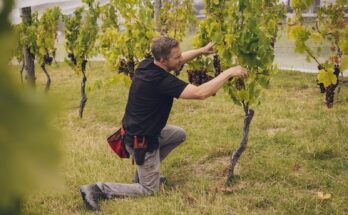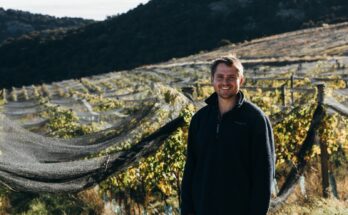
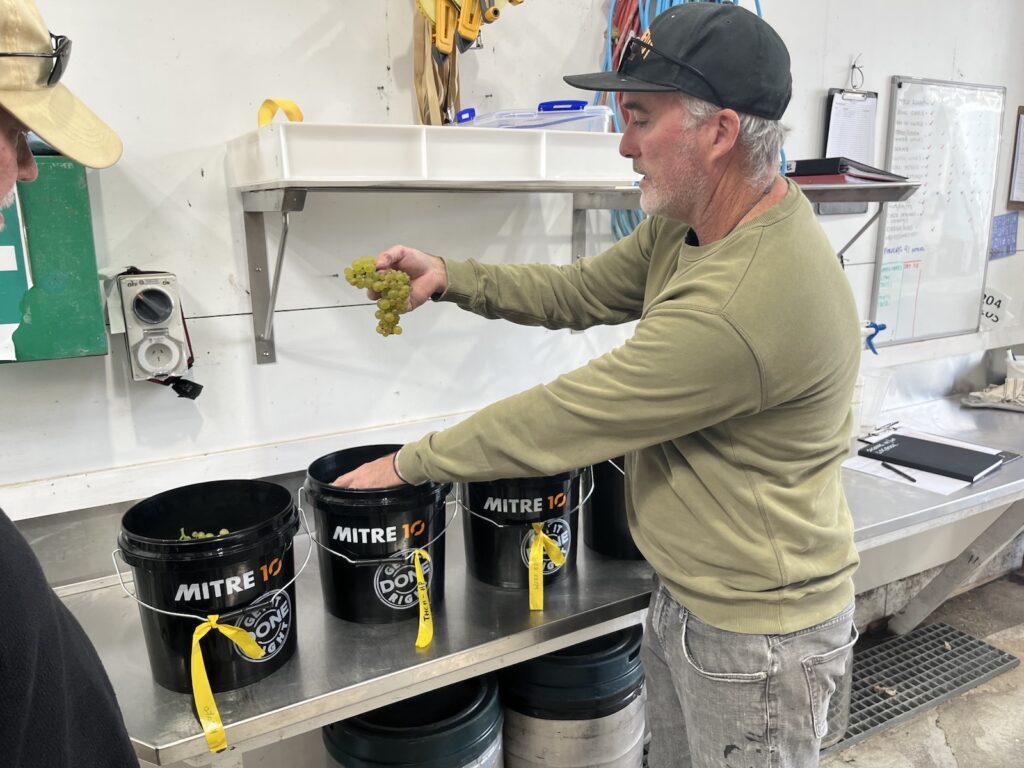
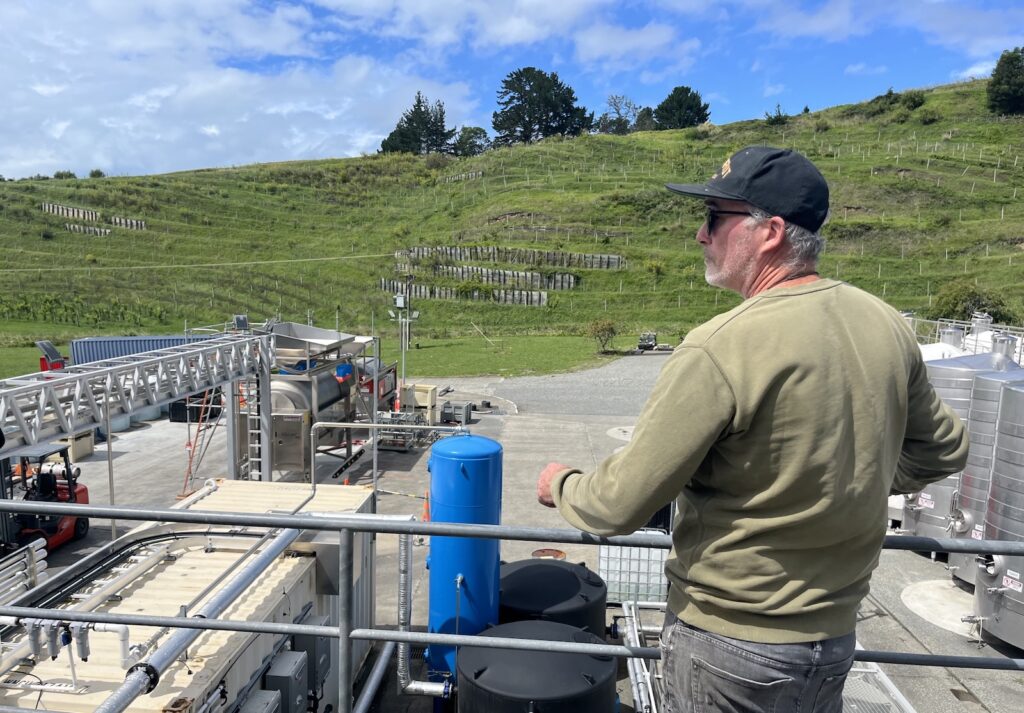
Arriving at the Cuvar winery – and we’re amazed that everywhere seems dry after a weekend of weather and rain warnings. Dave is out to see us (both Steven and I made the trip down) as well in. It’s my first time at what is the old Esk Valley site. It is a trip I’ve been planning to do for quite a while now. He ushers us inside and shows us a range of bunches of grapes on a bench.
Dave Mackintosh: We had 20mm which is pretty lucky considering the forecast. The grapes are really close. I already picked some for sparkling. That was two weeks ago and it has already finished ferment and will be going down to barrel today. I have some more Chardonnay that’s starting ferment – from Kokako Farms. We’re getting some 1066 clone, and it’s interesting just how early it is.
Have a look there’s no weight in that bunch – see that small little berry that it has – gives an intense flavour. And our Matapiro vineyard – this is Clone 95, and that’s what you can get. Dense and the bunches are much bigger, and solid. If you’ve got a bit of muck inside there, then botrytis comes on pretty quickly. I’ll show you around and we can try a few things out of barrel?
WineFolio: Thanks. It has taken a while to get down here. I know George (Fistonich) and we’d talked about meeting up down in Hawke’s Bay for a while. Then Michelle Richardson was at a do I organised and we said we would meet up – and then it was a question of checking with Karen (Fistonich).
DM: Yes, Ali said you knew George, and Karen’s great – she’s taken over the helm which is good. She comes down quite often.
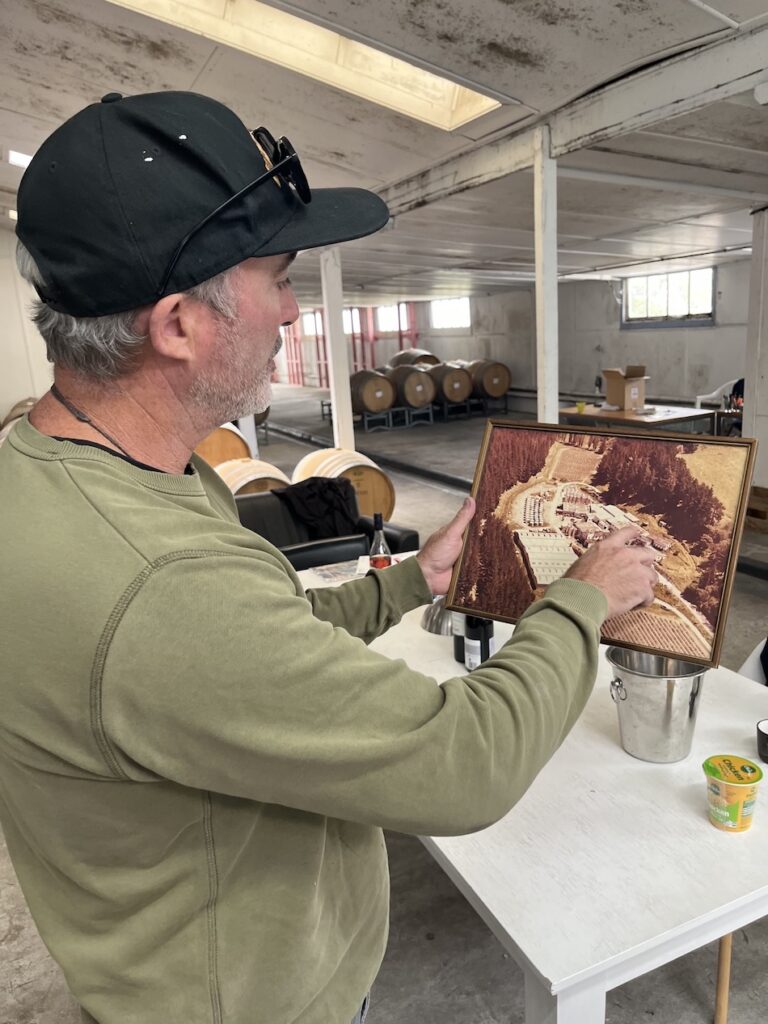
So, as you see… it’s still how the old Esk Valley site was – and before that it was Glenvale. Built around 1932, post-earthquake, making sherry, port and liquers. This is an old photo which we’re guessing is 1960 or so, and none of that part was planted in grapes then. But look how many tanks they’ve got. Just full-on. The amount of sherry that people were drinking was insane!
Then that dipped out and I think George bought it in 1986. Ripped out all these pines, and I believe the terraces were already there. Glendale originally planted it but they were unproductive and they put the trees in over the top. There’s quite a bit of trunk disease in the Malbec and the Merlot. There’s Syrah at the top and Cabernet Franc on the corner. We’re also looking at whether there are other varieties we could plant.
We’ve got here but also the Cornerstone Vineyard. For me that’s top 3 of the Bordeaux varietal vineyards in Hawke’s Bay for sure. Gordon used to work with it too – I think the Villa guys used to battle over it a bit. But supply is probably outstripping demand at the present time. Those Bordeaux reds is where the pressure is, and I think some of it is on us to start educating people on the ageability. Because there aren’t many wines in New Zealand that can do what the Hawke’s Bay Bordeaux varietals can do. I still drink stuff like old Unison’s and it’s a story we need to start telling.
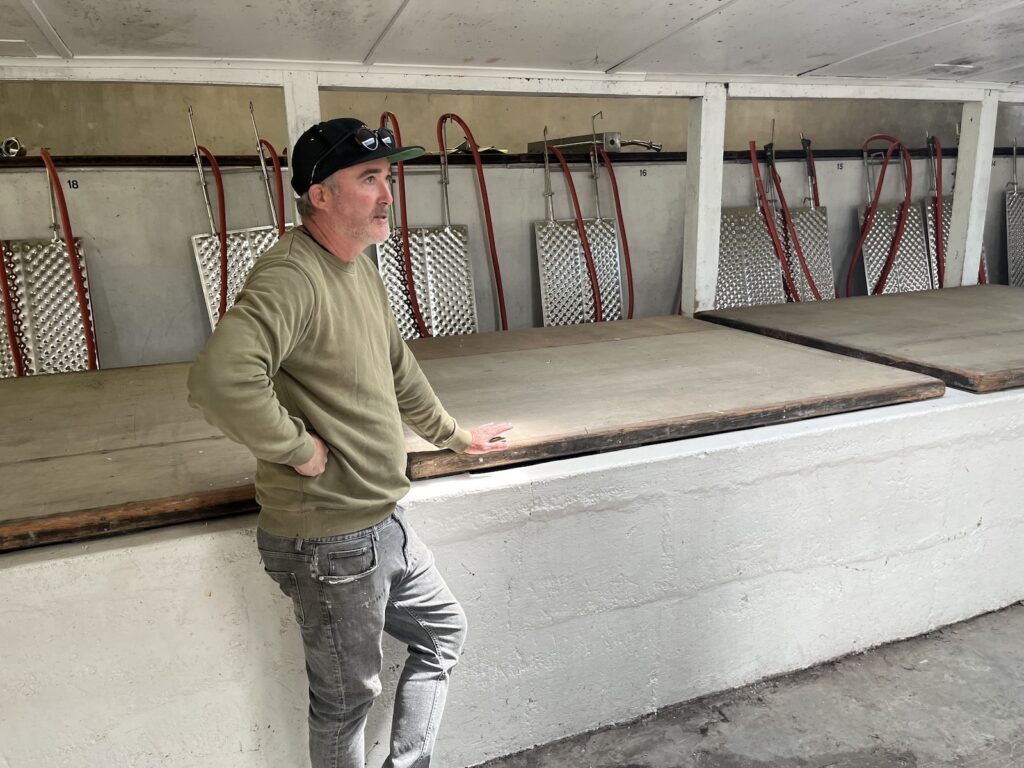
It’s cool to be still making wine in this place. There aren’t too many of this age – probably Te Mata and Mission… of the older sites. And right here is where Gordon did all of his work. Amazing to think you could get 2000 tonne through here. I think some of it was processed and shipped out to some of the other Villa places? He did all of his reds in these concrete fermenters here. This was his ‘Terraces’ one, and we’ll use this for the first time this year. Each one is about four tonne.
WF: Is it still well set-up for modern methods?
DM: Yeah – there’s a lot of forklifting goes on. This Pellenc de-stemmer is pretty amazing. We’ve got a couple of presses – so all the equipment is here. They’re both bag presses, and that one fits about five tonne of whole bunch Chardonnay in there, which is a nice volume. It’s pretty easy – sometimes a little too gentle actually. Down there are our barrels, which is where all our top reds and Chardonnay come and have some time. We can cool it and keep sulphur low.
We’ll have a look at some Chardonnay first. This is Guardians 2025 which has been in barrel for around an eleven month period. This has zero new wood. It’s a mixture of our Matapiro vineyard and the vineyard here. For old barrels it has good amazing texture and weight. I have put like for like together in tanks before I make the final blend.
WF: You let it go through malo?
DM: Yes. Around 60-70% I think. There’s quite a bit of Clone 95, and I don’t believe it needs as much malo. This second one should have more toast, more wood. I just picked the barrels – didn’t matter where they came from, I was just adding a bit more caramel sweetness. Still nice and fresh. A lot of places around the world – take Australia for example, have swung too far and are making ones like a Clare Riesling! For me a nice Chardonnay should be around 13% alcohol with nice acid but not where it dominates. I think I’ll be doing more time on lees for the Chardonnays – including the Iris.
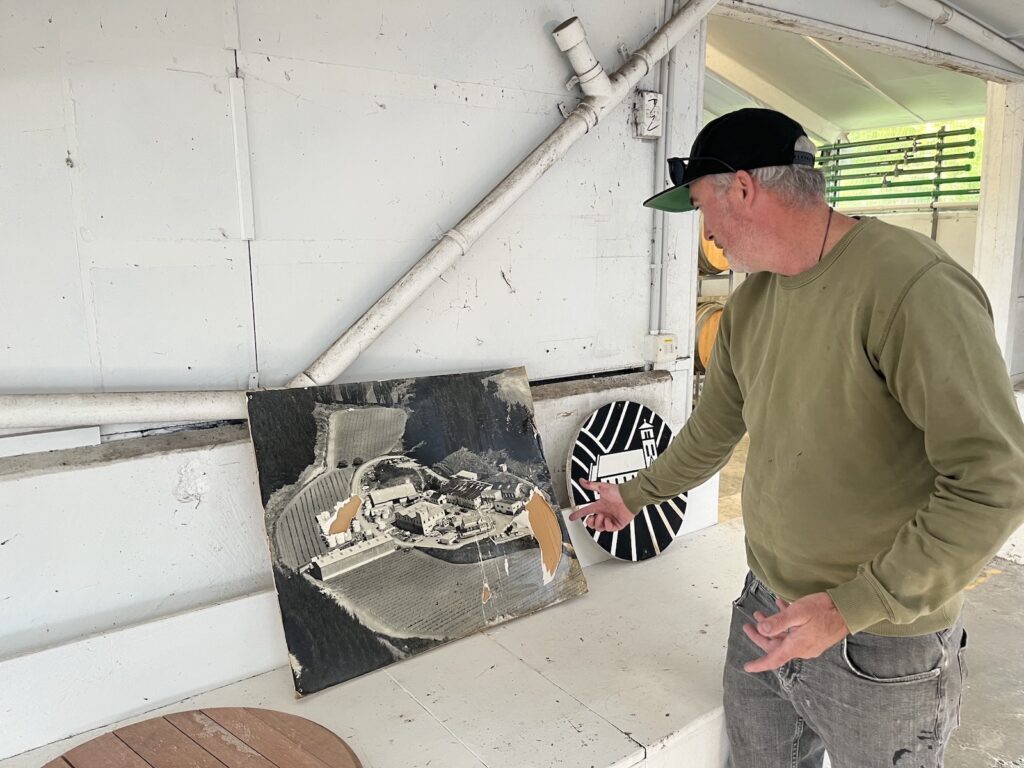
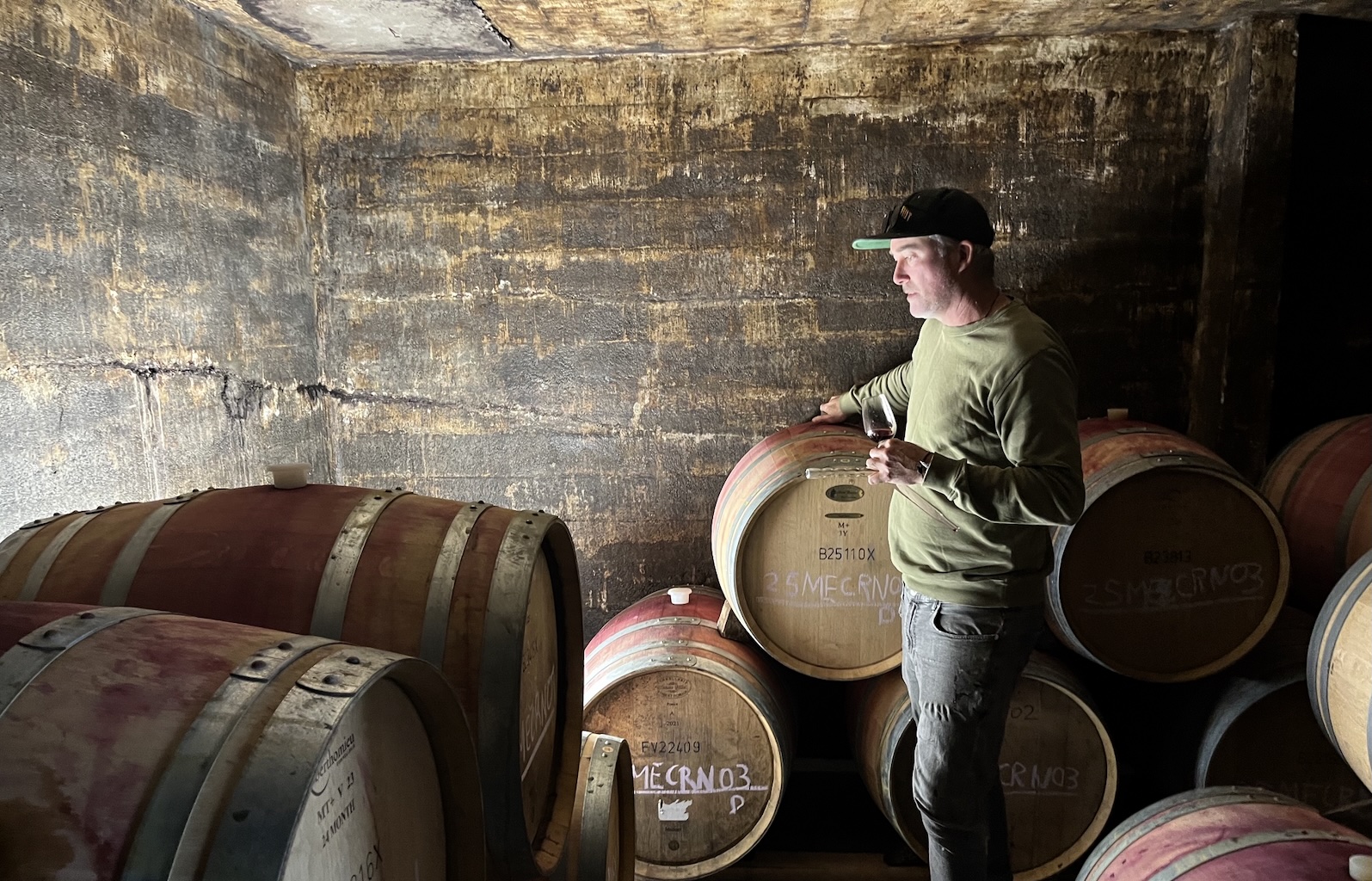
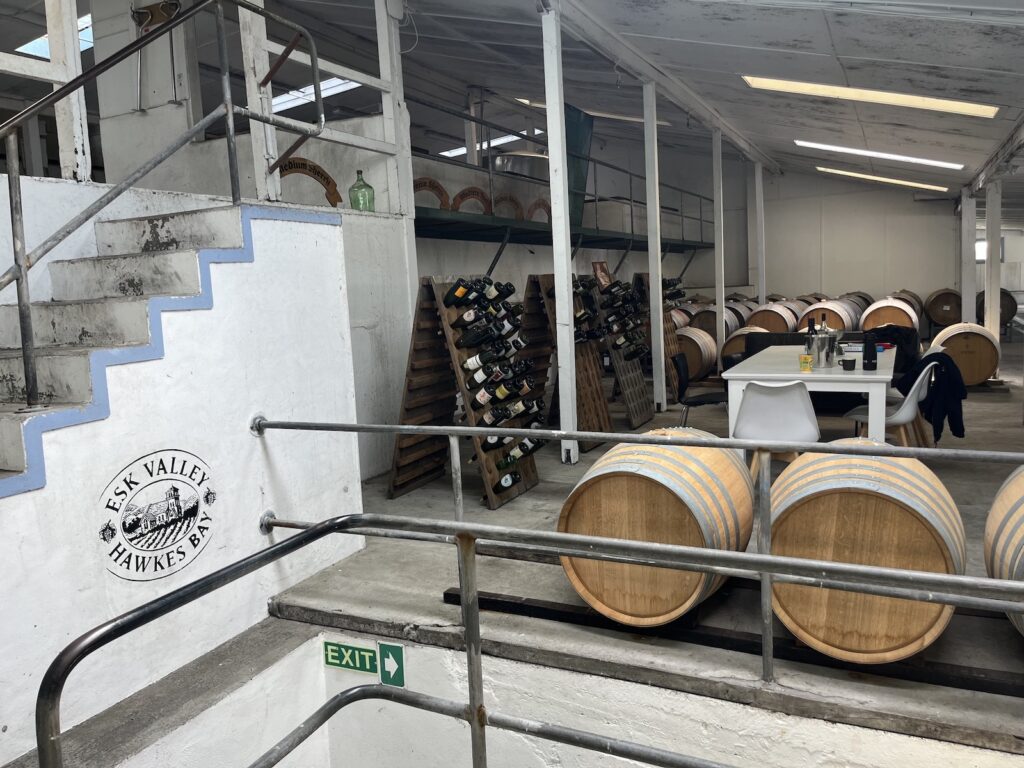
This is a cool barrel room – it was being used for storage, but what you’re standing in is actually part of an old sherry tank – the walls are waxed, if you feel them? Pretty amazing. This is Merlot and it is still pretty young. It will have another six months in here.
WF: My thoughts on Hawke’s Bay Merlot are well known – I’m a huge fan and have been since I tried them when I moved to New Zealand twenty years ago. I thought it was world class, but then it seemed to fall off the radar around 2010 a bit?
DM: I’m the same. Merlot is so strong here. It doesn’t have that hard tannin like Cabernet that people have a problem with. It’s just a nice, rounded wine. This still has a long way to go but it could be a straight Merlot. It could be a nice entry point for people to get onto other Bordeaux.
And Franc. I think that wants ‘less work’ and for me it is closer to Pinot Noir in how I process it. Cabernet can handle a bit more work, and extraction. But if you do that with Franc it gets a bit hard and a little disjointed. It does have that lifted herbal, and you have to kind of run towards it.
WF: It is one that can appeal to a younger market I think. Being a younger winemaker – do you think you are here to make wines that can capture their attention?
DM: Potentially. My winemaking naturally fits with that, but Çuvar has an authentic story, which is what younger generations want. We still want Guardians to be in that $50-60 a bottle market. Malbec is something we like – use it in the top Guardians red, so it is Cabernet, Malbec, Merlot. The blend we’ll taste upstairs is almost identical to what we’re looking at for 2024. With Malbec you can work it fairly hard, but when you see the berries the size and colour is insane! The birds love them – it gets sugar early. There’s a savouriness to it, and a chalky, salty kind of character. The Guardians red will mostly likely be a Cabernet-dominant blend but it needs everything else to make it the best it can be.
WF: And 2025 is going to be a great year?
DM: Yes. But 2024 was a great year too. It was almost perfect. I think the ’25 whites are potentially very strong. My personal observation is that the ’25 Chardonnays will be stronger then the ‘24s. And reds might be the other way. But after coming off ’22 and ’23 which were very tricky – it’s amazing to see the good wines that are out there from those vintages.
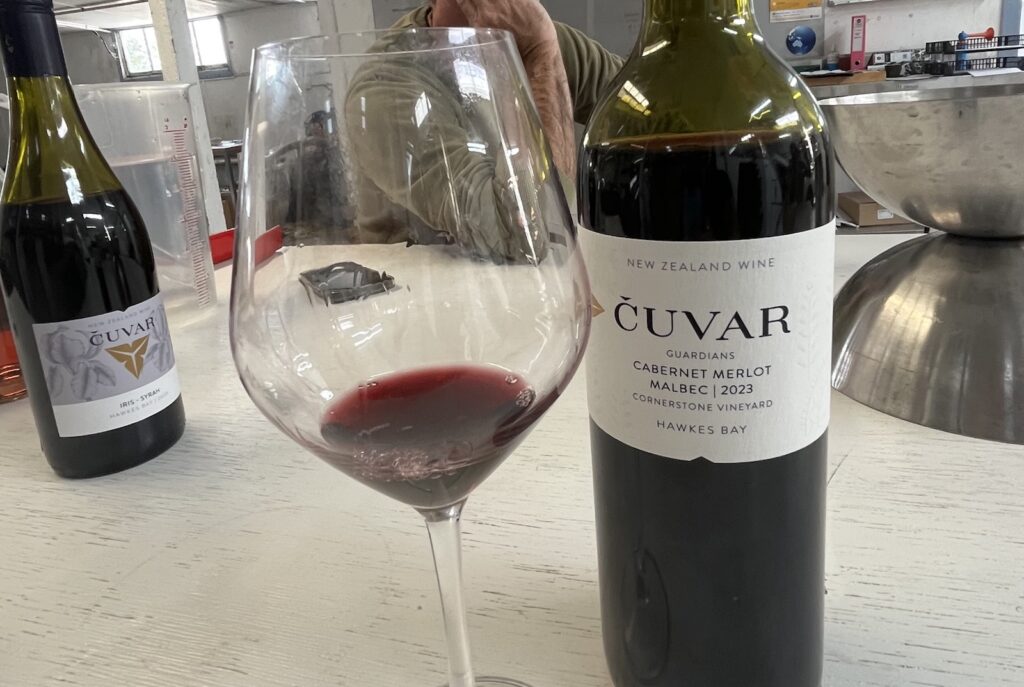
So, this is Cornerstone Cabernet. The vineyard is amazing. It can rain 20mm and it just goes. It’s on a slight rise where the land dips away just next door. I’ve always believed that a good old wine was good young too. I’ve done some judging over in Australia, and you taste some young wines, but you know that they’re good. But then, I’d be pretty uncomfortable if I was putting wines in the bottle and going “fingers crossed!”
WF: This is drinking so well though. It’s actually quite spectacular. A beautiful balance, and a fragrant lift. You say this will be blended?
DM: We’ve still got 6 months. There will be blending sessions, and is there chance of something above Guardians? We have a vineyard that should be able to make a bottle of wine that sells for $150. It’s that good. We’ll make that call around the benches when we’re tasting. This is a big thing that George says – “Nothing is set in stone”. The good problem to have is the Cabernet, because it always shines. It’s a privilege to work with it really.
I’ll show you some Cornerstone Syrah as well. This one is 100% de-stemmed, and next I’ll show you the whole bunch. What do you think about that? It needs a bit of time.
WF: It’s still quite tight. Great colour, nice white pepper, juicy and mouth-filling. It’s a nice Syrah. That hasn’t bowled me over though. Probably still thinking about that Cabernet.
DM: This is 100% whole bunch. The released wine will be a mix of those two.
WF: This is much more like it. Much more character. The other one is just a nice red wine. This has interest, perfume and seems more plush.
DM: The whole bunch gives you a higher pH and a sense of sweetness. I let it go carbonic for about four days and that starts it. And then you stomp it. It will be an interesting blending. We’ll come back and look at all of these barrels blind. It will just be numbers and I’ll mix them up, so there’s zero bias in your brain. And sometimes on the blending table, you’ll love that one, that one and that one – and you put them together and they don’t work! Generally it’s where all the art in wine comes from – I believe. The bones are there. It’s going to be a sharp Syrah I reckon.
We’ll have a look at a couple of current releases out of bottle. This is the 2023 Iris Chardonnay which comes from here and the Rivermere Vineyard. A mixture of barrel and tank fermentation. I think it’s looking pretty good, and Hawke’s Bay made some good wines out of ’23. Once the cyclone had passed we had a bit of poor weather, but then it just got fine. Especially the reds on the gravels that are free-draining. Most of them could hold on.
WF: It’s a pretty golden colour. This is full malo? It’s a nice, generous wine. Quite a big hit upfront. What’s the main difference between Iris and Guardians?
DM: It is a step up, but more in terms of subtlety, line and length. You get a more ‘complete’ palate all the way through. The days are gone when Reserve tier wines had to be bigger and bolder.
WF: Too often it just meant more wood. New oak became what defined a Reserve wine.
DM: The consumer of a $30 bottle of Chardonnay just wants their idea of what a Chardonnay is. Yes, it’s got good oak, some sweetness and flesh – and it’s not a Sauvignon! Whereas someone spending $60-70 and is hopefully more discerning; needs a bit more length and finish.
WF: I think they can cope with a bit more acidity as well, as that level. I know that’s key to a Sav, but if you give it some plushness as well, then I think it is acceptable to that customer.
DM: And at that price it is perhaps going to be drunk with dinner – so you need the acidity to cut through the fats and proteins. I will probably tighten them up a bit more – just my style. I do like a lick of acid and I do like a bit of malic. Not a lot, but with clones like 95. It can have a bit less and have that fineness. Some clones can get a little bit fat and soapy.
WF: Can you explain to me how the percentage of malo is arrived at? If someone says it is 70% malo – does that mean there were ten barrels and seven of them went through malo, and three didn’t? Or can you put a barrel through 70% on its own?
DM: With diacetyl, you want to leave wines post-malo until that goes away, gets degraded. If I sulphured a barrel when it was 70% through, I’d get 100% diacetyl. It would be full-on – right in that zone. So it has to be 100% malo and then blend. That’s how I do whole bunch too – 100% and then blend them with de-stemmed. If you were to go 20%, it would be too green as it’s got juice around the stems the whole time.
WF: And the effect of whole bunch is because the stems create gaps in the ferment? It’s not every berry pressed against each other?
DM: Yeah, totally. I’ll leave de-stemmed fruit on skins, no problem. But I’m not going to leave the whole bunch. Then when they start getting pretty full-on. There’s a lot of alcohol just sucking out everything.
Now, this is a Guardians Chardonnay 2020 – which is the first wine that George made under Çuvar. Hugh Crichton made the ’20 and the ’21.
WF: Gosh, that’s really quite good. Stunning quality for the money. I do love a good French Chardonnay – it’s a weak spot for me, although price is clearly an issue. But I do think that if you taste great French wines, there’s just something there that you don’t often see from New Zealand. But the kiwi wines are great bang for your buck.
DM: It’s only forty years, let’s say, of Chardonnay making in Hawke’s Bay. It’s not a lot of time to play around with your style. In the early days you were just making styles that appealed to the local consumer. That little bit richer and riper, maybe. Within the Chardonnay community it is quite collegiate, so you’re learning off each other. Asking “what did you do?” – more solids, higher toast on barrels… rather than lots of chocolate and vanilla medium toast barrels.
We’re going to let it peak out and work with the phenolics that we have. Not picking too late, so not looking for extreme ripeness. Looking for more leaf cover so you get greener berries, but then you oxidise it out. Wild fermentations – all of these things that Burgundy has been doing forever. But – not every technique works. Chardonnay’s my favourite variety. I love to make it and love drinking it. Made a lot of it in the Yarra too. I just like it – it’s so versatile. I’d still have it with red meats – I’ve got no problem with that sort of thing. It’s got enough weight and acid to cut through.
It’s a massive opportunity for Hawke’s Bay too. It is harder and harder to sell red wine anywhere now – especially big ones. It’s harder to sell Syrah and Cabernet now then ever before. Even in Australia it is harder to sell Syrah – or Shiraz. Chardonnay is not as uncool as it was ten years ago. It’s why we started that Chardonnay Symposium. I’m on the committee for that and work with Amy Hopkins-Styles and Hawke’s Bay Winegrowers on that, just to start highlighting that. We need to get from good – and we are good – to great. And how do we all just step up to the next level.
WF: Also, it’s getting it in front of people. I thought that the Annual Chardonnay Collection was a good idea and getting some traction. I keep an eye on what overseas media say about New Zealand for example. But then I didn’t even get sent it last year, so not sure what next?
DM: Once you start educating people, and now that there’s less wood and overt malo characters. That’s what people don’t like. At tastings some people’s initial reaction is to back off from Chardonnay. I think, texturally, it got a bit strange for people. We’ve got a thousand hectares of Chardonnay in Hawke’s Bay. Sauvignon is probably the next biggest planting for whites.
In New Zealand a lot of success is based on how Sauvignon has gone. But it can’t just be one thing – we have to diversify a bit. Let’s show the world what else we’ve got. Obviously Pinot is right up there too. The older wines story is important though. The other day I showed my daughter a Chardonnay I’d made in Aussie, from 2010. And I said to her “It’s as old as you – it’s sixteen!”. And I really enjoyed that – it’s a snapshot in time, and I remember making that wine.
But that’s the dynamic of wine. You don’t drink old beer. if we can educate people – wine is a different animal. And now with screwcaps – it’s going to last twice as long. You see with that Iris – it’s approachable, but with class and elegance. A lot of drinkers now need that softness, and wines that lean a bit more towards fruit than savoury. Not too much pepper.
And this – Cabernet, Merlot, Malbec. 100% Cornerstone. This wine, to me, shows the quality of that vineyard because it was a tough vintage. We had an indian summer after the cyclone and it held on. It’s got a little bit of leafiness that those cooler vintages do have, but when it comes to Cabernet I’m not afraid of that. It’s Cabernet Sauvignon you know? It has that blackberry leaf, so I still want to see it. The gravelly tannins and the great acid line – that’s going to last fifteen years. Maybe not as long as the great vintages, but pretty solid. When I was in Oz, we’d look at older vintages, from the ‘70s, and they age beautifully well.
I think with wine professionals, we can be be too technical when it comes to talking about wines. it’s like a mechanic or a lawyer – there’s certain language involved that people can’t connect with. So they get worried and they feel nervous talking about wine. It can’t seem stuffy and elitist. It doesn’t need to be like that.