Nick has been awarded ‘New Zealand Winemaker of the Year’ or ‘Winemaker of the Show’ on ten separate occasions between 2011-2020. One year at the New Zealand International Wine Show he was credited with 26 gold medals – an achievement that will probably never be beaten. With such a glittering array of awards I guess it was inevitable that I’d catch up with him at some point for the WineFolio ‘Winemaker series’.
WineFolio: I wanted to concentrate a little bit on where you’ve been to this point. You’re from here… was Villa Maria your first real position? It looked like it was almost like being at university, being at Villa. The people that were there, the people that were put together, the learning opportunities that were there were quite something.
Nick Picone: Yeah, Villa was very unique. I did spend pretty much my entire career at Villa Maria up until joining the Poulter family. And that was January ’22. I started with the Villa Group at Esk Valley, working with Gordon Russell. And he was pretty cool to have as a mentor, as an introduction to wine.
As a young person, I don’t think you could have a better mentor or have someone you were involved with early in your career – in terms of helping to just cement a passion for wine. Because Gordon was incredible in terms of his storytelling, and wearing his heart on his sleeve, and his passion for wine. It was really evident for everyone to see. And as a young person, that helps you get enthusiastic and it helps you grow.
WF: I think people have a romantic idea of wine -, that you’re reciting poetry in the vineyard. But there must be really hard days, really straightforward, working days. And to have somebody who’s been there, done that, and still has the passion. I mean, even now, he’s got a real twinkling in his eye when you talk about things that he’s interested in.
NP: Oh, yeah. I think he’s probably still, even to this day, one of the most passionate people you’ll come across in the industry. Gordon was great. And Esk Valley, it was great for me because my father lived only a couple of kilometres away from the winery.
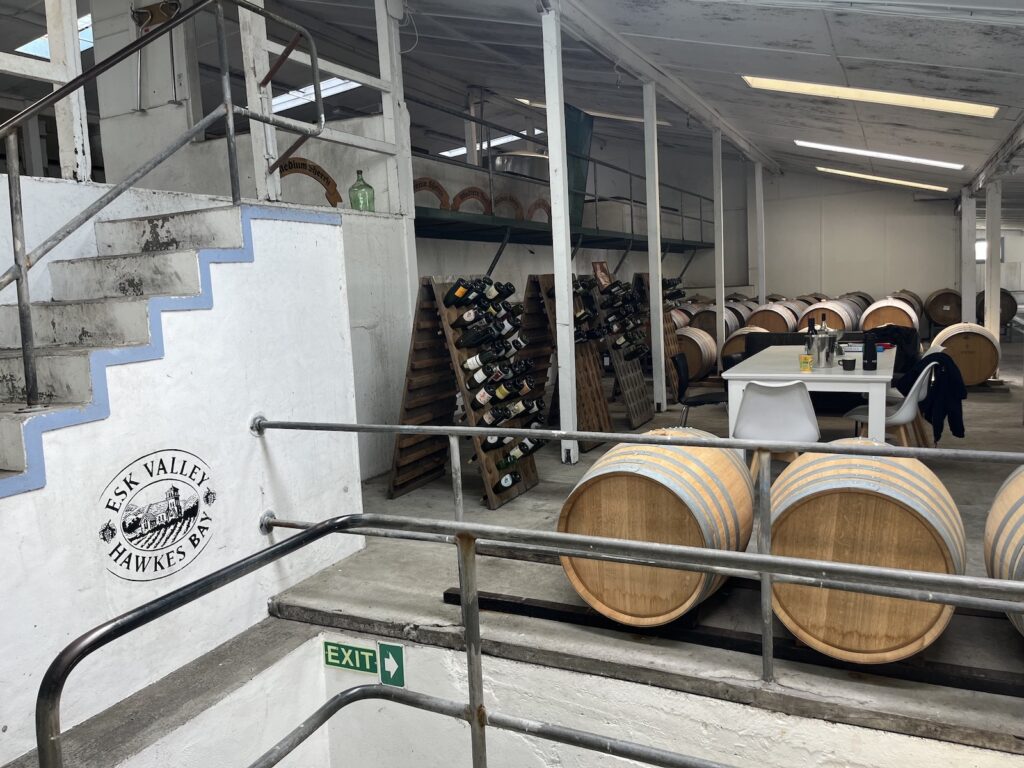
My father really cemented my drive to become involved in the in the wine industry. He used to conduct winery tours – he started a business back in the early ’90s called ‘Vinces Vineyard Tours’. He was the second tour operator in Hawke’s Bay to do organised Wine Cellar Door tours and visits. So Dad loved wine, and he always loved wine. Even going back to when he was young and playing club rugby – he told me a story where he would sit in the club rooms after playing rugby, and have a glass of red wine.
And his teammates would be giving him a sideways look while they had their jugs of beer, thinking, what are you up to? Because back then, I guess the blokey culture of rugby and beer was very much a thing. And for a bloke to sit there after a game of rugby and enjoy a glass of wine was definitely not the common thing. But Dad being Dad – he’s Italian – and he really didn’t give a shit. My passion for wine really came from Dad. We’d drink wine with dinner. And towards the end of high school, I was starting to think, ‘Shit, what am I going to do?’
WF: So you had wine at home? What things did you have back then? In terms of what bottles was he getting?
NP: Dad would pick up wines from the Cellar Doors that he was going to. And so, funnily enough, one of the very first wines I remember tasting with him was an Esk Valley Merlot. It was a 1987 vintage, I want to say. The black label, which was the standard Merlot from Esk Valley. But it had a few years bottle age on it. And it was a beautiful wine. It was the first wine that really made me sit up and take note. I thought the flavours are fantastic, and it’s matching the food. And I get what Dad is talking about here.
And so I don’t know if it was a coincidence, or maybe it was just the fate, but that I would end up working at Esk Valley and starting my career there, just a couple of years later. And that was it, really. I mean, once I got to know George, and he hired me. I did my first vintage at Esk Valley in ’97. And then I traveled to California and did a harvest there. And then I repeated that the following year with a vintage at Esk, another vintage in California.
And then, when I was in California, I realised that ‘I do love this… I do want to be a winemaker’. When I’d finished high school, I went and did a one-year certificate in Grape and wine production at EIT locally, here. And then I went straight into doing harvest at Esk Valley. And at that point, I thought, well, if I’m going to take this seriously, I probably need to go back and do the degree. So in ’99, I went back to EIT and did the degree course, which was in conjunction with Charles Sturt University, still at that time.
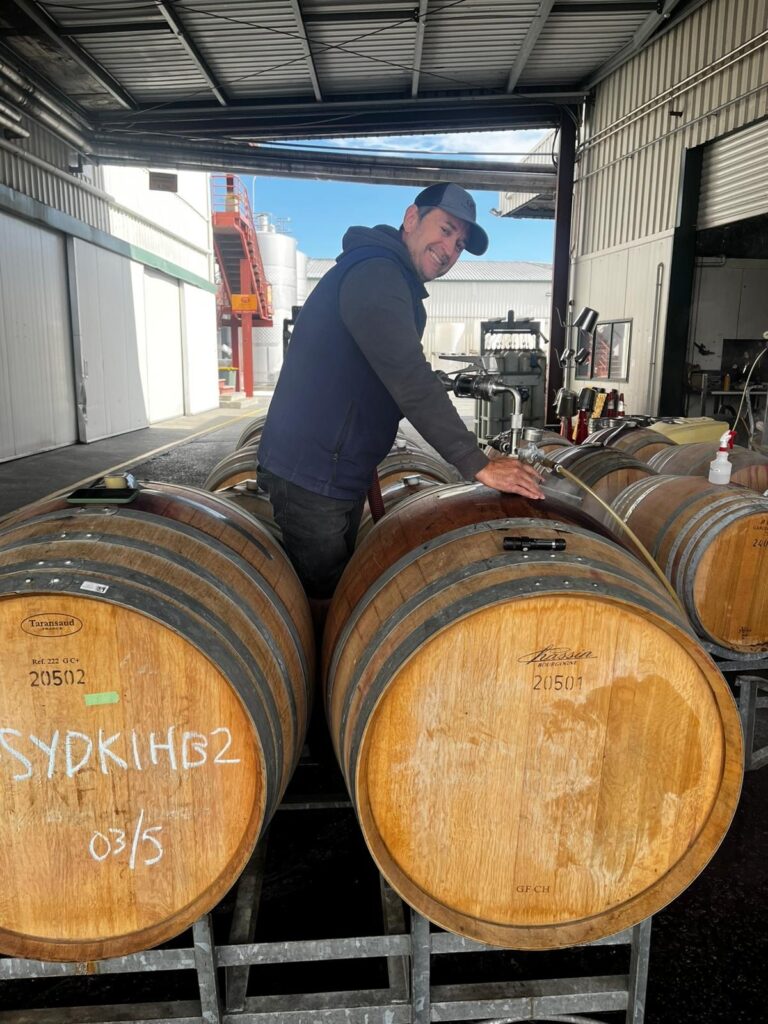
And I still managed to work at Esk Valley. My last vintage there was 2002, just before George hired me to go down to Blenheim in 2003 as assistant winemaker for Villa Maria. That was a bit of a turning point. Had my first full-time, permanent winemaker job, and moved to Marlborough, and moved down there with my partner, Mandy. It was quite a different operation, obviously, with a big focus on Sauvignon Blanc. But the winery back then was much smaller than what it is today. I think we were processing around 4,000 tonnes, which is only about a quarter of where that winery ended up by the time I finished up in ’21.
And that was great. Working down there under George Geris, who was the Senior Winemaker in Marlborough. Getting exposure to New Zealand’s key varietals, developing a passion for it, which was unexpected.
Coming from Hawke’s Bay, I was very much in love with Chardonnays and full-bodied reds, and moving down to Marlborough with the Sauvignon Blanc was part of a career development path – to go and learn about something. Earn your stripes.
But it very much turned around. I really understood what good Sauvignon Blanc was and what it meant to the industry and became very passionate about it very quickly. So it was great. It was a really interesting time in Marlborough back in the early 2000s, as we were only just starting to talk about sub-regions. The Awatere was becoming a thing. You had the Omaka Valley and the Lower and Upper Wairau were just starting to differentiate. Wine styles were starting to differentiate too, with single vineyard bottlings. There was a real spark in the industry down there.
WF: And Villa were very interested in trying out new things weren’t they? Maybe one of the criticisms was that they had too many variants?
NP: Villa was a magnet for good people to go to. You essentially had a winemaker (George Fistonich) at the helm of the company. In later years, some of that proliferation, with so many SKUs and the pricing may have come back to hurt us a little bit. But, I can tell you it was a wonderful place to work. A great place for a winemaker to learn their craft. The amount of quality people that have worked for George and gone on. For me it was like being a kid in a candy shop. Different regions and varietals and George’s dedication to quality.
The opportunity to explore single vineyard expressions with small bottling runs. Maybe some of that got lost in later years with the volume we were producing. But people were passionate – whether it was a 150-case bottling of Albarino, or whether it was 2 million cases of Private Bin Sauvignon Blanc. Things did grow very quickly. We were in over sixty countries.
WF: And how did you end up back in Hawke’s Bay? Because I think most people would consider you to be a Hawke’s Bay winemaker?
NP: I was in Marlborough for four years. But Mandy and I felt that Blenheim wasn’t going to be our long-term place. Villa Maria had a chat with me, because they were thinking of a succession plan for Corey Ryan finishing up. The deal was that we’d go on an OE for six months. And I got to do a vintage in Barolo, which was just something that I wanted to do. We didn’t get paid – the winery just fed us and gave us accommodation. And it was fantastic to be immersed in that culture, in a small village with very little English being spoken.
And then we moved back to Auckland at the end of 2006. Great experience working with Corey – another great winemaker. Intelligent, detailed and driven. I haven’t worked for too many winemakers as hard-working as Corey, so it was great to have that time with him before he finished up in 2008. Then I was appointed as Senior Winemaker for Villa Maria and mainly managing the North Island wine styles. We had Hawke’s Bay fruit and Gisborne fruit (and juice) coming in, and we were the bottling site for the whole country.
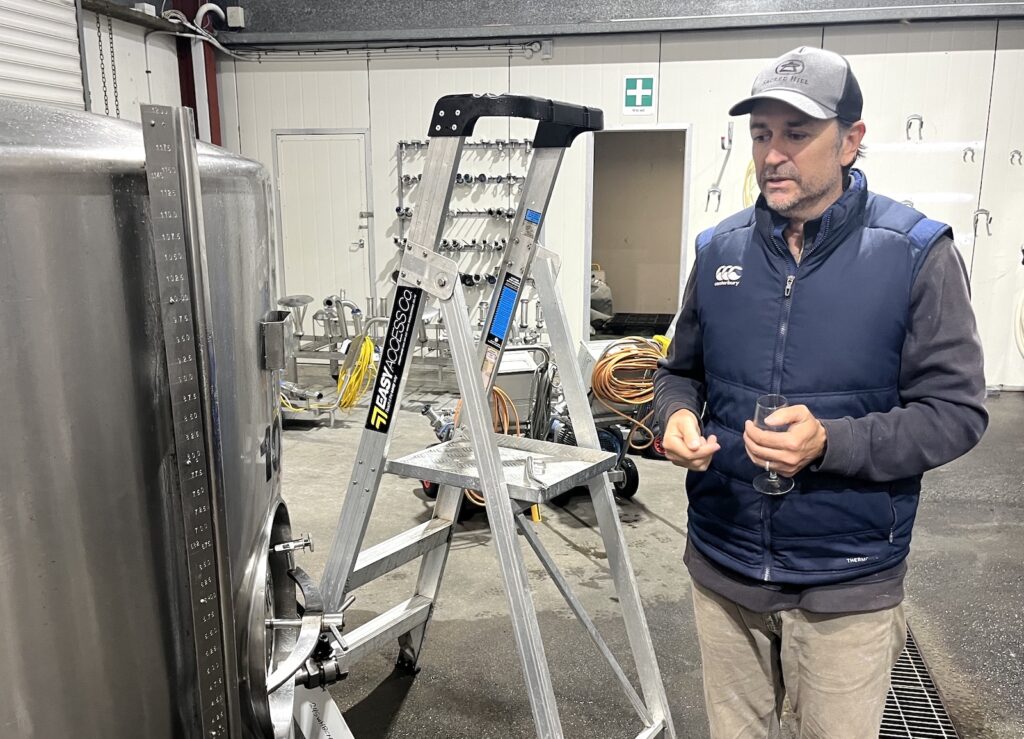
A steep learning curve, but one that I was ready for. And then of course the next big challenge that came along was when Alastair Maling finished up in 2015 and George made me Group Chief Winemaker. And moving back here to Hawke’s Bay the same year. That involved a lot of travel for a while because the new winery wouldn’t be built until 2018. That was a vision that George had had for many years.
And the last few years were a real blur. Things got embroiled around George and his position within the company. Eventually the banks got involved. Myself and Ollie were both on the Senior Leadership Team that was put in place. Me as Head of Winemaking, and Ollie as Head of Viticulture.
The last couple of years was all about Strategy; right-sizing the company; SKU-rationalisation and cost-saving measures. Really trying to steady the ship, but that took a toll on me personally, because I’m a winemaker and I’m spending less and less time doing what I love. And dealing with some pretty tough topics. Things that were very hard to go through at that time. Things like saying goodbye to colleagues. It stripped me out a bit to be honest.
And once the dust settled from that, the company was up for sale, and for me, that was the final straw. After putting so much into the last few years, trying to make things work, it became too much for me to handle at that point. I spent a couple of months really trying to get over that. It seemed like a marriage break-up – after over twenty years.
WF: Oooosh, that is a lot. So, how did you make it to Sacred Hill?
NP: A colleague of mine, Fabian Yukich, had been in conversation with Steve Poulter, who had said that he had purchased Sacred Hill and would be looking to get the winery up and running, and keep the brand going. It sounded like a great opportunity to be involved in resurrecting an iconic Hawke’s Bay label… and hey, I’ve got nothing else to do right now. So why not? And, to me, it was exciting to meet the Poulters! I actually met Steve for the first time at the West Shore Pub on a Sunday afternoon, in my jandals!
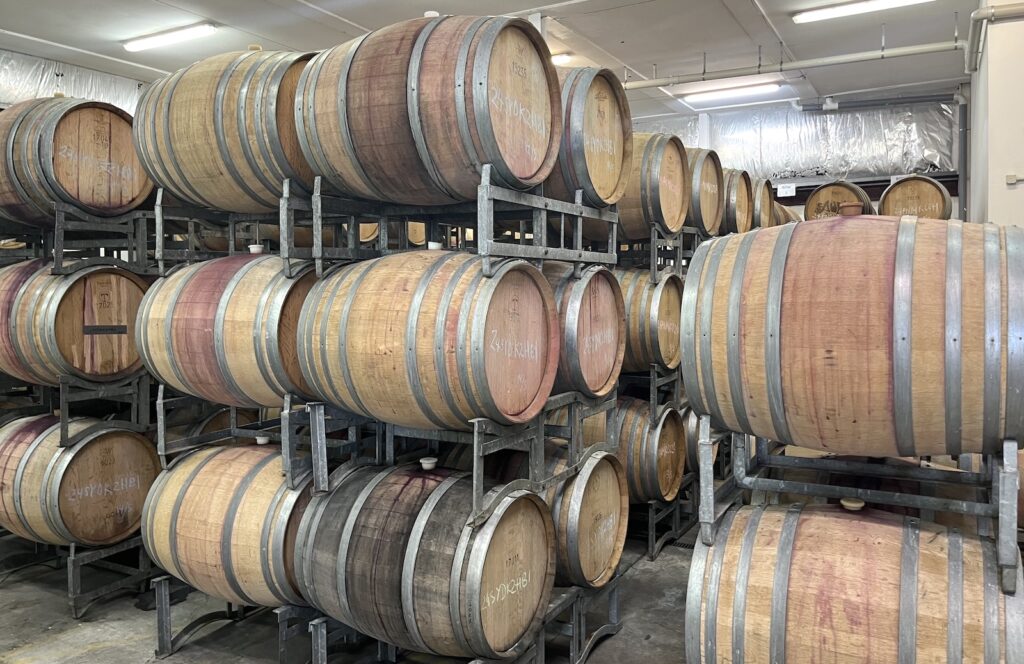
I thought this is exactly what I need. I need to get my hands dirty and throw myself at something. I need to move forward. It was an opportunity to put all that behind me and focus on making wine again. It was sort of like therapy in a way. Which sounds a bit over the top – but that’s exactly what it was. Coming in and focussing on this winery that had obviously been struggling. There was quite a bit of brettanomyces in the winery. Understanding where everything was at and what needed to be done. The first thing I did was buy a steam unit and an ozone machine. It was the perfect job. I have blisters again from digging out tanks! And I love that.
WF: Excellent. Loving what you do. Trust, family, happiness, having enough. It’s more important than having a bigger boat.
NP: I realised that there was parts of what i was doing at Villa that wasn’t me, as a person. And I struggled with.
WF: And you wouldn’t have been trained in it either – so you wouldn’t have had the skills to do what you were being asked to do? You might say ‘Well I’ll have a go”
NP: Because you feel a duty to do so. Because you don’t want to let people down. But you do. You come home and you’re a burnt-out shell. So I threw myself into this. All of a sudden it’s been four vintages here! It’s like “Shit – where did that go?” 2022, 23, 24 and 25. In ’22 when I arrived here it was just a skeleton crew, keeping the lights on. It ended up being about twice the amount of fruit that we were expecting. And it was a mean season, but we got through. Onwards and upwards and along comes Cyclone Gabriel.
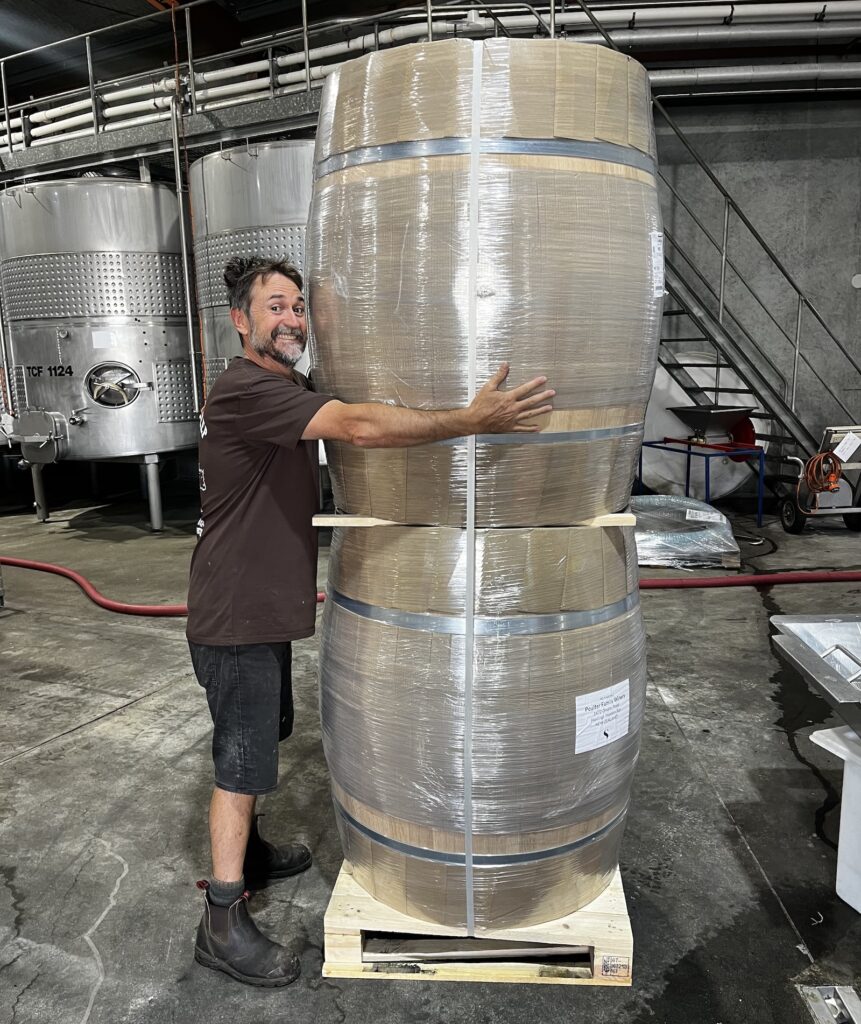
The Cyclone arrived pretty much at the same time as our Overseas Vintage Workers were arriving in the country. When it all went down, there was a period of a few days when we didn’t have communications, so we didn’t know what was happening. Are we even going to have a harvest – at all? Literally, vineyards were cut off. Dartmoor was flooded. The Gisborne road was closed. We thought we might have Deerstalkers but not much else. Our local growers had been flooded. It was a success story in the end, just by chucking resources at it.
These last two vintages have been a lot kinder to us, so we’ve been able to execute our plans for filling the winery up. What we’ll taste downstairs is probably what we’d like to think of as ‘the new Sacred Hill’.
I didn’t know a lot about the Poulters when I came on, but what I do know now is just how hard-working they are.. Very driven and ambitious. And they’re gutsy. They’ll make big calls. They don’t suffer ‘paralysis by analysis’. They’ve recently planted approximately 200 hectares in Martinborough, with more land ready to go.
I think the Sauvignon there is about as close as you get to Marlborough without being there. Similar style without the exuberant thiols. We’re actually developing quite a unique Sauvignon story, because we’ve got different tiers that are exploring different regions. For Sacred Hill, for example we have our commercial Marlborough offering, in the orange label. Under the Reserve, black label, we’re looking to develop a Martinborough style. And then, at the Special Selection end with ‘Wine Thief’, we’re looking to bring a ‘Sauvage’ back. That will be from Gimblett Gravels – the first vintage is in tank downstairs. So three very different styles.
WF: Is there anything else that you would like to do?
NP: At Villa, I was really keen on Albariño and I think there’s a future for it here. There’s some interesting sites and wines coming through. I loved making the ‘Braided Gravels’ Albariño at Villa – fermenting it in cement and doing things a bit different. I’d be keen to pick that up again. The Poulters have planted some down in Martinborough, but I’d like to see some here in the Gimblett Gravels to be honest. I think there are some very interesting, textural whites that could be made from Albariño.
It might not be new, but I’ve also really enjoyed getting my hands back on Pinot Noir here, too. In fact we’re making more Pinot Noir here now than we’re making Hawke’s Bay red – which is a bit of a statement of where things are at, I guess. We’re getting Central Otago fruit from Alexandra and we’re looking to develop a premium Otago wine. We’ve got some interesting options in barrel downstairs at the moment.
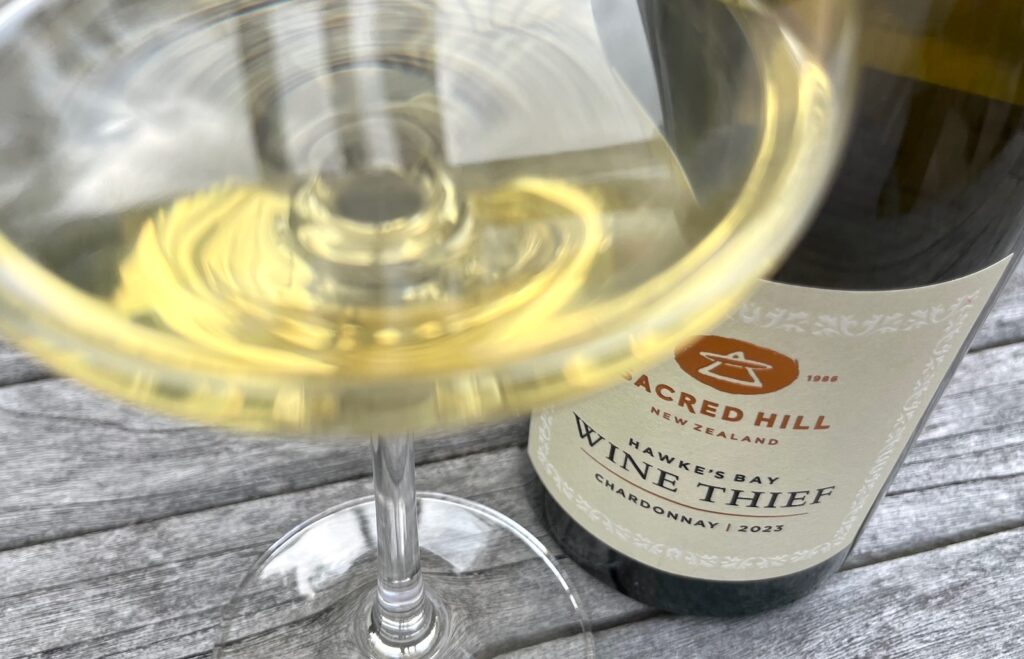
WF: Well I do like my Chardonnay, so I hope you’re keeping on with that. That 2023 Wine Thief you sent me was very good!
NP: Yeah, we managed to hand-pick that fruit and get it out via Rissington which was a much more arduous and slow process to get the fruit to the winery. Our Dartmoor vineyard which is further down the valley, got completed decimated. But Riflemans is further up the valley, 100m above the river, and the Poulters flew into that vineyard a couple of days after the cyclone. And they could drive around the vineyard. You’ve got free-drawing soils, but with that amount of rain, at that time, there’s going to be disease pressure.
It has been a couple of tough years. COVID – for kids going through that – and then the Cyclone. It wasn’t all bad. You’re camped at home and the kids are back on their bikes, socialising with kids in the neighbourhood. But the uncertainty of it definitely took its toll.
WF: In Auckland now – every time we get heavy rain it’s a trigger, and people freak out. It feels like COVID – when you had to gather your family together and shelter in the safety of your own home, and you didn’t go out, and you were afraid. That’s what rain does to us now, in Auckland.
NP: I remember when the Napier to Hastings Road was finally open, through Pakowhai it looked like a tsunami had hit, and then a bomb dropped on it. There were caravans upside down in the middle of an orchard. And there were people standing outside the front of their properties just staring – lost.
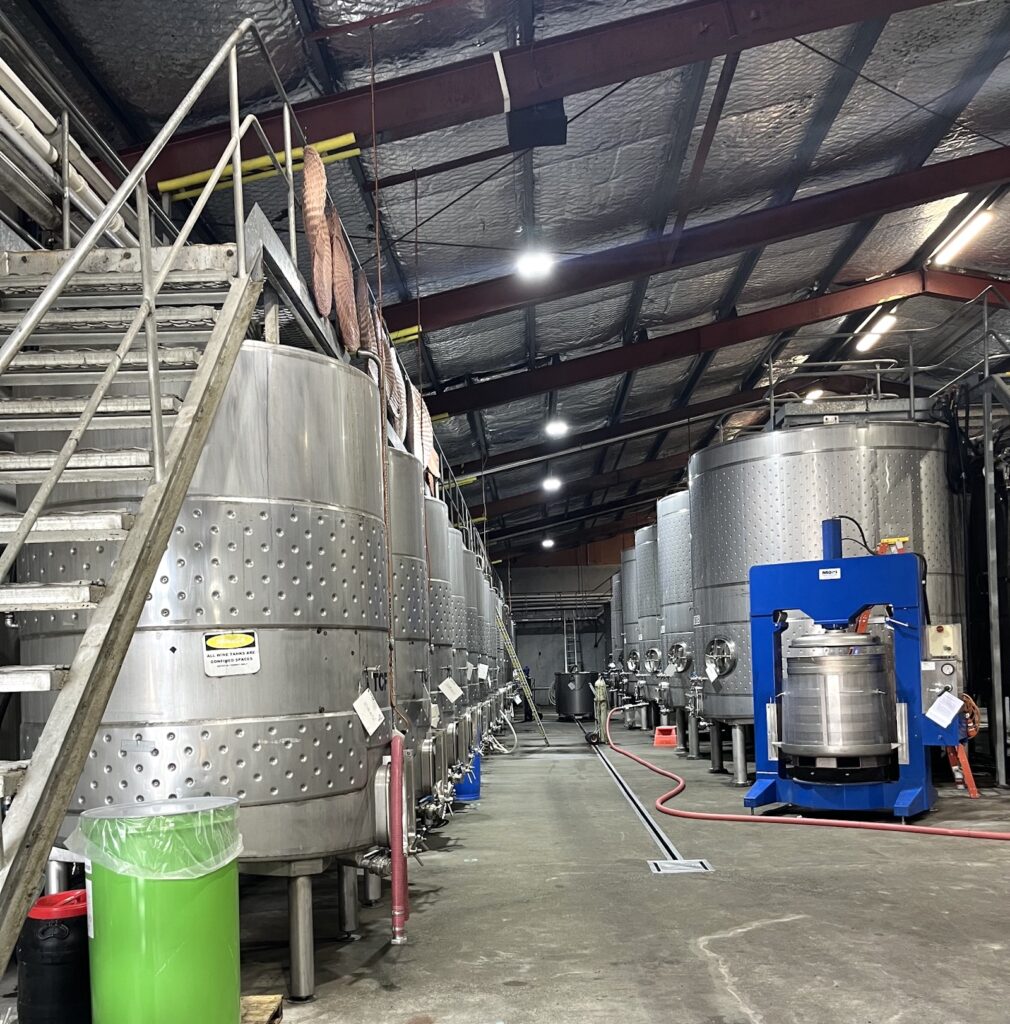
Right, enough about that – shall we go for a walk and we’ll have a look around? There’s not much that has changed here, except putting in an extra half a million litres of tank capacity. The footprint and the processing is the same. There’s some nice toys – there’s the basket press for the reds. Now I’ve used that I wouldn’t go back. And a turbo pigeage which is like a submersible pump that can do an internal pump over. It forces the wine up and over the skins. I’ve never seen anything work better for lees stirring Chardonnay tanks. It brings all the lees up through the tank – and it happens in two minutes.
WF: Have you seen any changes in what varietals or styles are fashionable now?
NP: There’s been a global slowdown on consumption post-COVID. I think COVID produced a false picture of where consumption was at. I think people have moved to more approachable and immediate wines. Wine has slowed, but categories within wine are crashing faster than others – and full-bodied reds is static at best.
Back in the early 2000s it felt like you couldn’t get enough Gimblett Gravels fruit. All you can do is be optimistic that this is a cycle and continue to listen to the customer. I do think we have to learn not to get too far ahead of ourselves. The complexity of wine is that you have to forecast years ahead. Vines that you have to plant and then wait a few years. Then the production process.
This is Sauvage 2024 in your glass. From the Gimblett Gravels – first crop. Hand-picked, whole bunch pressed and then that juice was settled briefly in tank, and run into oak puncheon. Fermented with 100% wild yeast. About 40% went through malolactic, then it was aged for 12 months on full lees.
WF: It’s lovely. A fine wine but fresh and complex. It has that immediacy of Sauvignon Blanc, but has the structure to last for ten years.
NP: That’s the idea. To have a Sauvignon that will develop those lovely waxy, toasty notes in bottle. We oxidise out all those thiols. Now, this is Wine Thief Chardonnay 2024. Hand-picked fruit from the Riflemans Vineyard.
WF: Oh wow – really bright and energy! What is the criteria that sees it labelled as Riflemans or Wine Thief?
NP: We’ve selected several clones and areas within the vineyard. We’ll specifically target the lower-yielding blocks of original-rooted Mendoza that were panted back in the ‘80s, to ensure we’re setting ourselves up to make the best wine possible. No rocket science in terms of how we’re making the wine. Hopefully Riflemans helps differentiate the style of the wine that we’re making.
Riflemans is basically a barrique selection, from the old vines – the hand-picked material. There’s a point where we can drive things stylistically to what we want. To represent the vineyard and the vintage. We’re looking at about 2600 litres out of those two tanks. No finings in that wine – we don’t see the need and we don’t want to add things.
WF: I like how it started out quite powerful, and muscular but by the time I’d finished tasting it, it had slimmed right down and found it’s poise and balance.
NP: We have some interesting option for our Sauvage wine, and I though we could try three very different puncheons that go into creating that wine you tried earlier. First – this is actually the harder press. Getting a bit more pH and skin contact at this point in the press cycle. You usually notice a more opulent and floral character in the heart of the press juice. It looked good enough to keep separate.
WF: Yes, that very aromatic and floral isn’t it? And a smokiness that’s somewhere like pot pourri or incense. Tarragon, orange peel, apricot.
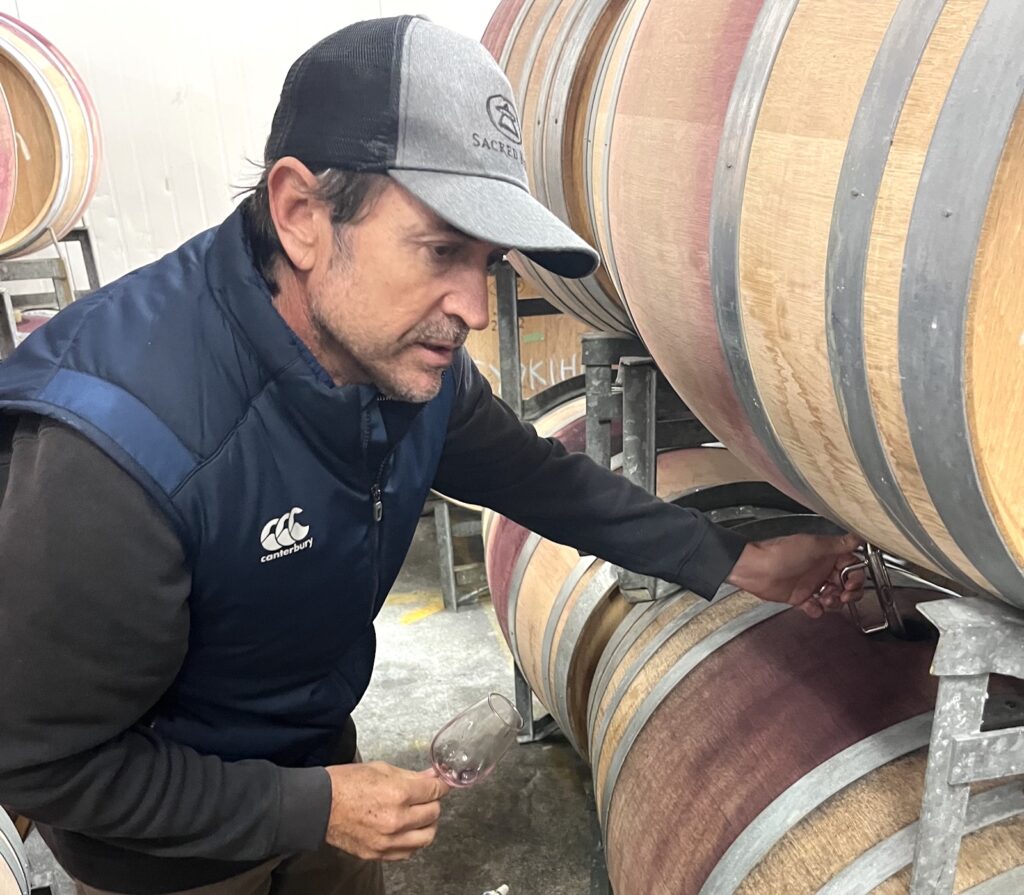
NP: And this is the free-run.
WF: Crikey, that’s quite different isn’t it – hahaha. Super acid backbone and I do like the prickly greenness to it. That’s got a waxiness to it. Quite like a white Bordeaux.
NP: And this is a new Austrian oak puncheon.
WF: That’s quite a bit more pungent! Not sure I like that one as much, but it is interesting to see how different they are.
NP: I think it will look quite different in time as it sits on lees and gets stirred. It will lose a bit of that puppy fat. It shows promise, and it’s nice to have a couple of decent seasons in a row. We’ll look at a couple of reds as well – you’re here now! Cabernet Franc from the Deerstalkers Vineyard. We’ve started to release this under the Wine Thief label. It’s a tiny production – there’s only four barrels of it. There were five, but I blended one of them into the Helmsman. Do you see an opportunity for Cabernet Franc?
WF: I do. I’m often caught asking people who grow it, to do a separate bottling of it and not just use it as support in blends. I’m not so much of a fan of the Loire style, but I like what I see of it when it is done more in that St. Emilion direction, but on its own?
NP: Paritua made some good Cabernet Francs.
WF: And that’s the sort of thing I’m on about! I think the one from Clearview is about their best red? There’s a few around. A nice one from up north too – Dancing Petrel. It’s not quite up there with the really big boys – can be more of a medium-bodied red.
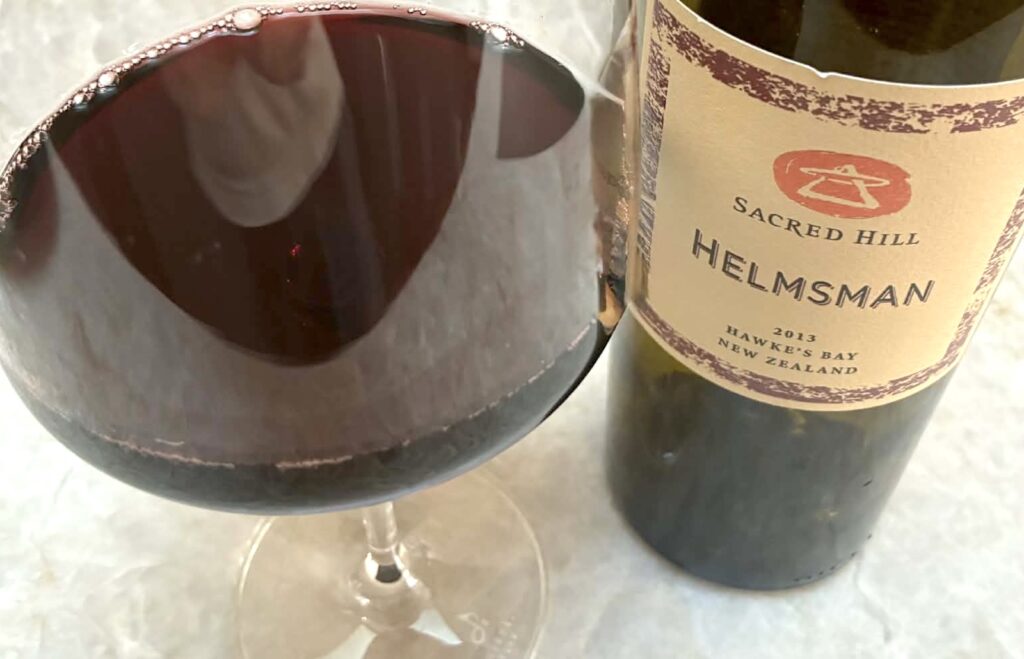
NP: This the 2024 Helmsman. I decided on the blend in December. It’s 86% Cabernet, 7% Syrah and 7% Cabernet Franc – just that one barrel. It’s still medium-bodied and has a nice chalkiness to it. I don’t want to produce, huge extractive, tannic wines, so I’m pretty happy with how it’s looking now. About 40% new oak overall – although that sample is out of a new barrel.
For Syrah we did a hand pick and a machine pick. The hand pick gets a bit of whole bunch, but I’m pretty happy with this – this is the machine pick component, which is about three quarters of the volume.
WF: One thing I’ve been noticing in recent years is how ‘simple’ some of the good Hawke’s Bay Syrahs are. Seems to be less extraction, less oak, more perfume? I do admire the Australian confidence with their version of Syrah – it’s like “everyone would make it like this is they could”, but although Shiraz is an identifiable and well-liked version of Syrah, I’m not sure it is quite the epitome that they think it is (laughs). For me, the Holy grail is an intoxicating perfume with a little bit of grunt behind it.
NP: I think when Syrah comes together in a good vintage in Hawke’s Bay, it captures a lovely perfume, lovely texture and there’s a real fine-ness about it. This is some of the hand-pick. It’s probably fractionally riper then the block we just tried. De-stemmed and fermented in small open-top fermenters and plunged once a day. Started off on wild yeast, then inoculated to ensure completion. Sat un-sulphured until August, and it hasn’t been racked yet, so it is pretty unadulterated.
WF: That’s a step up. Not much between them for perfume, but there’s more plushness to that. A bit more darkness and plump roundness to it.
NP: And this is the third parcel which had about 30% whole cluster.
WF: OK, yes, that’s one for me! A bit more intensity in the tannin structure. I really like the whole bunch fragrance, but I do know people who don’t like it. And winemakers who hate it.
NP: Well, this is clone 777 Pinot Noir off the McArthur Ridge vineyard in Alexandra. This wine is 50% whole bunch. This may be one of my favourite Pinots in the cellar.
WF: Well it’s certainly my kind of Pinot! Richness, complexity and power. It’s very approachable and generous. I don’t know about what I call ‘grandad’s wine’ for the future – that are all backwards when they’re released.
NP: It doesn’t mean the wine can’t have stuffing and density. I don’t think it’s a good enough excuse now to say “it’s got to go away for ten years”. Who’s got ten years? You’re talking to a very small audience who are going to lock the wines up for that amount of time.
WF: Well if you go down that path, you’ve then also got to sell them the next nine vintages using the same story. “Here I am again – remember me from last year when I said buy this, but don’t drink it! well…”
NP: One of the cool things that George started doing was the ‘Library Release’ series. “We’re not expecting people to do that – we’ll do that”, and then release wine when it has had eight years or whatever. Let’s try one last wine before you head off – this is Clone 667, with about 20% whole bunch.
WF: Do you think clones make a big difference?
NP: Yes – some clones have hen and chicken – so different sized berries and different bunch structure and bunch weights. Some clones have thicker skins so you get more tannin. It can have quite an influence. I think 667 is a really good clone of Pinot Noir – it’s one with smaller bunches. And, actually – do you have time to try a rosé that we just blended yesterday, so it is obviously going to be really cloudy. It’s our first 2025 release.
WF: What’s it made from? That’s a lovely commercial wine – a real fruit salad of flavours. It seems a bit sweet first off, but that will be after all those bone dry wines.
NP: Predominately Merlot with a bit of Syrah. How do you think that will sit with a consumer?
WF: Quite well I’d think. Because someone will come in and say “I want a dry French Rosé – have you got one open?” And you’ll say, “no but try this one and see what you think?” knowing it is not really dry… and the reaction is usually ‘Oh yes – that’s the one”. So they think they want something, but it isn’t necessarily the case. And Rosé is a style of wine that I think has more tolerance to residual sugar.
NP: Ours has been about half that sugar for the last couple of years. As long as our customers like it, we’ll be OK!