I’m in Marlborough to gather stories for the website, and I get the chance to sit and have a yarn with Stewart from Saint Clair over a relaxed lunch and a couple of wines at the Vineyard Kitchen.
WineFolio: Obviously I judge and review and run the website, but my real love is getting out and hearing the stories from people. When I moved from the UK over twenty years ago, I worked in Tourism, which was a great story to tell to visitors, and to domestic tourists, which is what I specialised in. But with the lockdowns and tests of COVID, that came to an end, and I had planned to move into specialising any how. So now it is wine stories – and I never get tired of hearing the tales.
I do my own benchmarking sessions as well, and it is interesting to sometimes do it with a crew of people, as they can give you some real insights that you might have missed. Some people just ‘get it’ – and the first wine they try, give you something amazing that is really useful. Other times you might feel that it is too much distraction from what I actually think – and get side-tracked. It’s complicated.
Stewart Maclennan: I’ve been in the presence of tasters who really have it. Watching them with blind wines and how they can pull it apart. Masters of Wine obviously can, and you just go ‘wow’. It’s off the scale. I know people who have done WSET level 4 and that’s enough. That’s years – and gruelling. Level 3, which I’ve got, is a year and a half of quite intimate tasting and knowledge. Jane Skilton was my tutor, which was the best part of the studying – she’s just so good! She tears things into shreds, which is fantastic.
WF: So tell me about your path to here?
SM: I fell into wine, accidentally, 22 years ago. I lived in Nelson and was just doing odd jobs – saving up to go on my O.E. and plans like that. I’d studied at Nelson School of Music, and a friend of mine who lived here in Blenheim, and I were going to go to Brisbane. I was learning that playing in three bands for beer money was not going to be a great long-term solution. In New Zealand that’s quite a difficult road to travel with music – or even any creative streak.
My friend who was here decided to go and have a heart attack. So he’s in hospital recovering and it is about the time of year when harvest is coming. I didn’t know much about wine, but another friend said ‘well we should go and do a grape harvest and save some more money’. So that was my introduction. I did a season and absolutely loved it. The work and the people and the environment. We were working these crazy hours but doing fascinating work. I really liked that kind of work.
He got better and we went to Mexico instead of Brisbane, then went and lived in the UK for a while. Came back – did another grape season, then went travelling etc etc. Then St. Clair moved from the winery they were in, and in 2005 built their own winery. And at a certain point they said “Why don’t you stay?” And at a certain point I ran out of money and agreed! And it went from there.
The industry here has just been in non-stop growth for thirty years. Most wineries are no different and 10-15% growth a year is a lot, for any industry. The facility you built has to be re-built and your processed have to be re-imagined. Your equipment has to upgrade and your staffing and processes have to adapt. That growth just took a lot of us with it. Before I knew it I was Assistant Winemaker, then Winemaker, White Winemaker and Senior Winemaker.
WF: Do you have a hand in everything, or do people specialise?
SM: We tend, as most wineries do, to be red and white – a bit. Just by the nature of the process. I tend to look after white wines – which is 90% of what we do. I love red wine and I love making it, but white requires a different type of work.
WF: Has that growth been because more grapes are being grown? Is all your fruit estate grown or do you buy?
SM: Traditionally we’ve been around 50/50. much of that are growers that have been a relationship with Neal and the family since before I started. Now, and it is similar for a lot of people in Marlborough, that model is shifting to more estate and more leased blocks. So today we’re more like 80%. Because of the uniqueness of the Marlborough industry – principally being a very large crop of the same variety. A very vigorous variety that can produce a lot of fruit. And the dynamics that creates in the seasons when you have a lot of fruit in the same valley, means big fluctuations in terms of pressure.
The grower model has come under that pressure in the last 5-10 years. Where yield is high or space is constrained, companies have to make decisions leading into the harvest. The tensions means that it is better to have your own control. Across the valley you’ll see that trend towards more Estate-owned fruit. In the beginning it is friendly handshakes and loyalties, but as the bigger kids come in, decisions start to be made that are ‘just business’.
WF: You had something to do with AMW didn’t you?
SM: On the conceptual side, with Matt Thomson and others in the beginning. When they actually put it together, I was excited to see some frameworks being put in place. Thank God! St. Clair were slower to adopt, but we have now signed on with Lake Chalice which is great. A lot of AMW’s regulatory frameworks have been under review, which is understandable as they’re starting out. Getting positioned well so that it is encouraging enough, but also holds on to the values that they want to.
WF: I’ve just been to Churton – and they’re not AMW. I don’t think the badge is at a stage yet in terms of recognition that consumers would think “Oh, it’s not AMW”. Where not being a member becomes a thing.
SM: Yes, it’s not in the vernacular, yet. But there’s only one way to start.
WF: What about the Hawke’s Bay vineyards – you’ve had them for a while now?
SM: Ten, maybe eleven years? We actually don’t have a Hawke’s Bay vineyard as we speak! It is a tough piece of the portfolio, and certainly came under a lot of pressure in the last few years. It is difficult for a Marlborough winery to incorporate that into their price structure. You’ve got to do it quite meaningfully from the get-go. The production and growing costs are very different in Hawke’s Bay. The amount of fruit and cost of vineyard management. Transport costs to get it here.
The Marlborough structure is a lot of fruit in the same place, arriving quickly into a facility that has a lot of efficiencies. So if you’ve got a portfolio that has Sauvignon, Chardonnay and Pinot Noir from Marlborough at this pricing structure, then it is difficult to bring a Cabernet to the portfolio that has this pricing structure. The tendency is to keep it line-priced and after a few years you tend to think “this is isn’t working”.
WF: I applaud your level of detail with sub-regional and individual blocks in the range.
SM: I’m very much on board with that sub-regional identification. The single block Pinot Noirs are phenomenal. It’s another of those things where wine is such a long journey. And for a region to learn about its own sub-regionality and differences – things need decades. You grow something in a place and you realise ‘this is just not a good place for that’.
WF: Some of the criticism can be “wrong thing in the wrong place”.
SM: Yes. And this region has only been here thirty years! It’s enough years to get to a point where you move it because it’s not right.
WF: Is it also ‘owner age’ and ‘winemaker age’ where the growers and the producers have learnt many lessons?
SM: It is all of those things inter-connected. Farmers suddenly became viticulturists, and they are not the same thing. If you’re growing pumpkins for a supermarket, it is great to grow as many as you can. There’s a bit more learning involved – it takes a long time. One good thing about working in the same valley, company and industry for the last 20 years is that you do get to see the development of some things. And Pinot Noir is one.
Marlborough has phenomenal Pinot Noir. Some of it is the best kept secret in the wine world – it really is. Watching its development from cherry juice in 2005 through to what people are growing and producing here now is just miles apart.
WF: And with that you’re getting to the stage where certain places are recognised by the vineyard name alone. Does that development come with its own pressures?
SM: Part of Marlborough growing so rapidly and people growing up with it, is that there are many people who were here in the ‘90s and early 2000s who had a lot of pressure – to create the same great wines but at a bigger scale. And everyone tries to hold on to the aspects of that work, as it grows. And lots of them make this mistake – assuming you could just keep working harder. You still had the little details and aspects that you think are important, but you end up wearing a lot of hats.
One of my mistakes was spreading myself way too thin. I went away and did leadership and management courses, and I did get value from that. The value of what delegation really means. But you almost can’t keep up with Marlborough! It’s so fast and grows so rapidly.
WF: Do you feel you work best collaboratively, or do you like to be doing something ‘your way’ – someone comes along and says “This XX Pinot needs sorting out and a new direction – I want you to do that” and focus on that?
SM: Yeah, probably the latter. Often people can involve themselves in the wrong aspect and it starts to resemble micro-management. You see it over and over again. People involving themselves to a degree that’s not enough to be helpful, but enough degree to spoil everyone’s work! (laughs). I do work collaboratively, and I think that one of my strengths is understanding a goal and getting everyone to see that as well. Getting people to that – with help – is one of the most fulfilling parts of my work.
WF: Do you see any major challenges ahead for Marlborough wine – and your part in it?
SM: I think guys like AMW are trying to get ahead of this, because one of the threats is the ‘race to the bottom’. The more average, sub-par Marlborough Sauvignon that enters the world market, the worse it gets. Yes, this year there’s a glut – and people seem to take a short-term view, and panic. I think in viticulture – compared to farming – you need to have a longer term view of things. Australian Syrah did this to itself before, and it is a real threat. There is still a premium aspect to Marlborough Sauvignon Blanc image.
WF: Is there an appetite to make more Sauvignon in different styles – that isn’t what is generally made?
SM: Yes, I think so. We make a Fumé style and lots of others in Marlborough make a similar Barrel-fermented style too. They’re stunning wines. They’re just phenomenal. So there’s a lot of hope. There’s sub-regionality, there’s some control on yield – from AMW, and there’s stylistic approach. We were talking about this with Clive just the other day – the New World’s obsession with varietal-labelling. Fumé Blanc, or Sancerre just is – it’s not a Sauvignon Blanc. In the New World we do it without thinking.
WF: I do see some of, let’s call them “New Wave” wines, that are not. They’re not telling you what it is – they just give it a name.
SM: Yes, and I think there’s a lot of hope in those avenues. Diversity too.
WF: Thinking back to the last Sauvignon Blanc Top 10 tasting that I did. ‘The Raptor’ 2022 won. Quite often there’s a lot of back and forth, but this time there was no need – it was a clear concensus. Why was that? What would have made that wine stand out so much?
SM: For the Raptor series, and in Sauvignon Blanc certainly, we do veer off stylistically with those wines. Small batch, and versus the larger tank farm which has a process attached to it. Which is – clarify, keep it clean, keep it specific and stick to the process… but the Raptor wines – I want more material in the ferment to create a more reductive environment. Sit it on lees for a lot longer, and stir it.
We make a big spectrum of barrel-fermented Sauvignon. We’ve got ‘Barrique’ – a wild-fermented one that we do. And they all become blending tools. And The Raptor Sauvignon has an element of barrel-fermented Sauvignon in it.
WF: Do you like any wines from the Nelson area – I just spent a few days over there and had some lovely wines. I thought a whole range of whites were really quite successful – Riesling and Albariño as well as Chardonnay, which I was expecting.
SM: I don’t know if you get it, but I swear I do, 80% of the time, with Nelson region whites… a ‘hoppy’ character? Do you?
WF: I can’t say I’ve noted that – but I’ll certainly keep an eye out for from now on!
SM: I see it all the time. When I used to keep notes a lot more, and you notice when you’re doing it a lot, it is really clear. If you’re staying in the Veneto, or Tuscany and you’ve eaten the food and drunk the wines. There’s nothing quite like being there and breathing the air. Then you have a wine and you know exactly where you are.
WF: When we got back from Tuscany we cooked a huge meal, just to revel in those flavours – and all Tuscan wines. I find that people who have to deal with flavours of things all day are often into food too. Do you cook?
SM: Yes, I don’t think my friends would call me a foodie, but I’m a pretty good cook. The trouble is that working in the wine industry, you forget the bubble that you’re in. When you then spent time with normal people, you can feel yourself being a bit pretentious.
WF: My wife kicks me under the table.
SM: I’ll walk around a marketplace and I’ll smell everything. It is amazing how quickly you can train yourself on things like that.
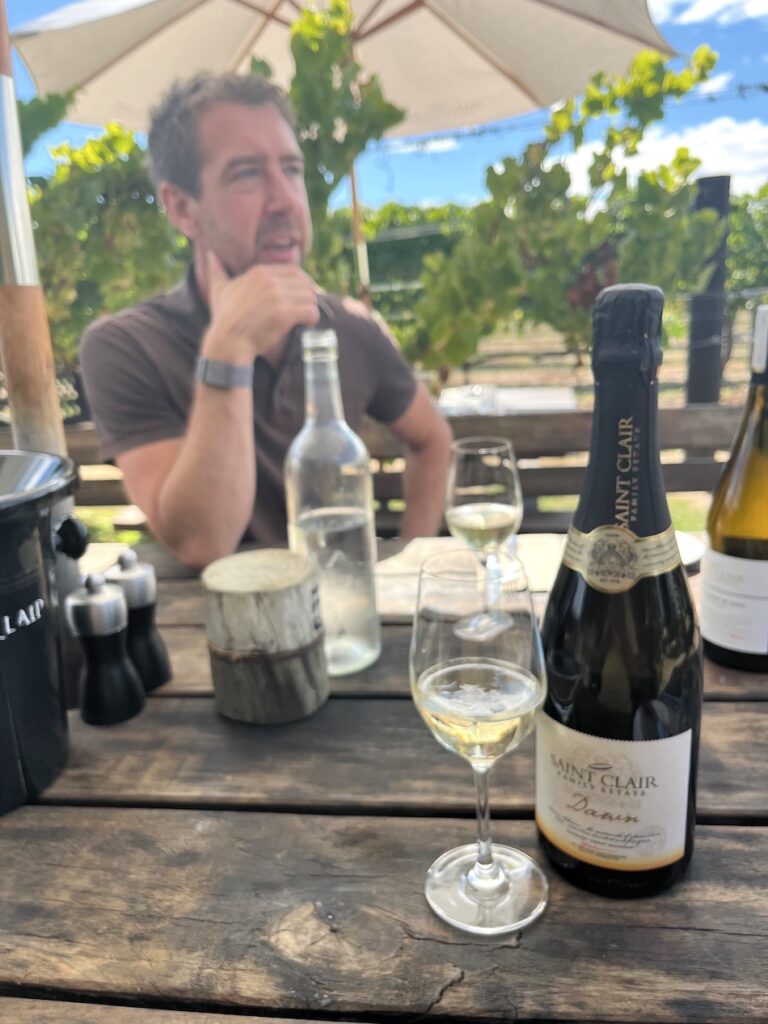
WF: The wines we just had. I thought the sparkling was very pleasant, but it hasn’t left much of a mark on me. Which isn’t a huge problem – I’m not a sparkling expert. I have been trying to improve though – specifically seeking out Champagne tastings to try and ‘get it’..
SM: That was ‘Dawn’. It is 70% Chardonnay, and that is out here on the road – clone 95, and then Pinot Noir. It’s coming along. 2012 was the first and around 2016 I transitioned it from a vintage product to a non-vintage product. You’ve got to build up a bit of the Reserve wine. We have done some Champagne tastings here and I find them really difficult. It is a fascinating thing to produce. I think so much of it is in the ageing, but then you have to have purity in the base wine.
What I think takes the time and the expertise is to understand your base wine, and then the fermentation dynamic. Get your temperature and that piece of the process really dialled in. It took several years for me to whittle the temperature down to 10.5 degrees. To get the confidence to do that. At 12 degrees it ferments in two weeks. And the bubbles were coarse. And it aged strangely. There’s very subtle points of expertise in producing it.
WF: I opened a bottle of the No.1 Estate ‘Adele’ wine with someone, and I said I thought ‘it was pretty good”. The other person said “Are you kidding me – this is sensational!’ – so I paid a bit more attention. That’s what I mean about sometimes needing a shared opinion. I’m thinking of developing something along those lines in the future – a shared Tasting Table.
SM: In Marlborough in particular, No.1 do a LOT of work for everyone. Lee at No.1 puts our bottles through tirage. We do that because they’re set up for it, and they are experts. I mention Lee because he’s not on the customer-facing side of things.
WF: Do you do anything where the ferments take ages?
SM: The Omaka Chardonnay – it used to sit in barrel for ever – until friggin’ December! Just not finishing. I used to get really worried about it when I was younger and Hamish would say “just relax. Leave it alone. Stop looking at it!”
WF: Is there anything else that you’d like to have a go at?
SM: Well, the last thing I made was a Pet Nat in the last couple of seasons. That was quite fun to make because you can throw something in a bottle and it will ferment – and that’s fine, and a lot of people do that. And what you get is God knows… There’s a whole, quite detailed, approach to it if you want to do a good job of it.
I tried to make a Marlborough sherry a few years ago (laughs). I took some Grüner in a couple of barrels and filled them to the right amount. Fortified them – to one to 15.3, and one to 18.1, or something. There was some acetobacter in the Pinots and I thought ‘that looks good’ (laughs again) – I’ll see if I can transfer that across! But I don’t know if I did in the end. I think I said ‘Let’s see what Marlborough’s natural flor is gonna do’.
No flor developed on either barrel. For seven years. I did bottle down one of them and it was quite nice. I have a Czech friend who loved them! So I’d really like to keep developing that side of things. Love to have another crack at it. I love what people like Halcyon Days are doing. It’s OK for people to produce natural and quirky and interesting wines, but it’s a whole different thing when someone knows what they are doing – specifically. They’re still playing with fire! And it’s not always gonna work out. It is so hard to do them well and when you find them it’s really special.
We make an Albariño here now that’s a lot of fun, using fruit from a small block in the Awatere. It’s hard to do on a small scale – the acidity is just fascinating. We often put a puncheon through MLF just because we need to get that balance – and it does a really clean MLF. I don’t know how common that is, but it works for us. Someone I know mentioned Picpoul recently – it’s come up a few times.
WF: It’s very popular in Europe. I went out with family and one of my nephews works in the wine trade. He chose the wines for dinner and a lot of it was Picpoul.
SM: I do wonder if that could be a marvellous variety for Marlborough. You get into that conversation again about our addiction to varietal labelling. Does it matter?
WF: Well the New World kind of invented it didn’t they? Mondavi, and the Aussies? I remember I liked Pinot Noir before I knew I did. I liked Burgundy – never knew it was made from a grape called Pinot Noir! And I love Pinot Gris. If it was my last meal on earth, I’d have a bottle of Grand Cru Pinot Gris from a good producer in Alsace on the table. It wouldn’t be my first choice, but if I had ten bottles, it would be there.
SM: It’s such a great grape varietal. It’s so versatile and it responds to your winemaking so well. It gets thrown under the bus a bit because it is so ubiquitous. Say people did start planting Picpoul and it was a great variety for the region. Would it be a requirement that Marlborough called it Marlborough Picpoul, or could producers go down another track?
WF: Is it a bit like when people make a white wine from Pinot Noir? What do you call that – because Pinot Blanc is already a thing, that’s different. So that’s a type of wine you can make without having to explain what it is made from, to a customer? You say what it is to people and it confuses them. I’ll say ‘like Champagne is made from Pinot Noir’ – and typically the response is “No, it isn’t – Pinot Noir is a red wine’.
SM: What I would love to do is make some balsamic vinegar. But it’s quite a process. Have you seen or been around ageing balsamic vinegar?
WF: No. Is it a solera-like process?
SM: It’s a 30-year thing. I think that would be something. There’s probably a solera system with balsamic.
WF: I only have one bottle left, and I had to laugh when I got down to my next-to-last bottle that I was going to share, and thought I really ought to google it, so I know what to say about it. It wasn’t expensive when i bought it – but it certainly is now! It’s Malaga. A fortified wine from the place, that has all but died out now. The one I have is labelled ‘1885 Solera’. It is wonderful. i think it is PX and Moscatel, but lighter than you’d imagine. It’s also now worth about $650 a bottle as the producer closed a long time ago! I love the non-vintage approach. Talking of Champagne earlier – I really liked the Krug Grande Cuvée bottling that is made of multiple wines. Could Balsamic vinegar also be single vintage though?
SM: Yes, you could definitely have a vintage product. I wonder how commercial balsamic vinegar is made and I expect it is not quite as romantic. Probably one of those processes that gets lost in commercialisation. I like the idea of a commitment to a 30-year thing.