
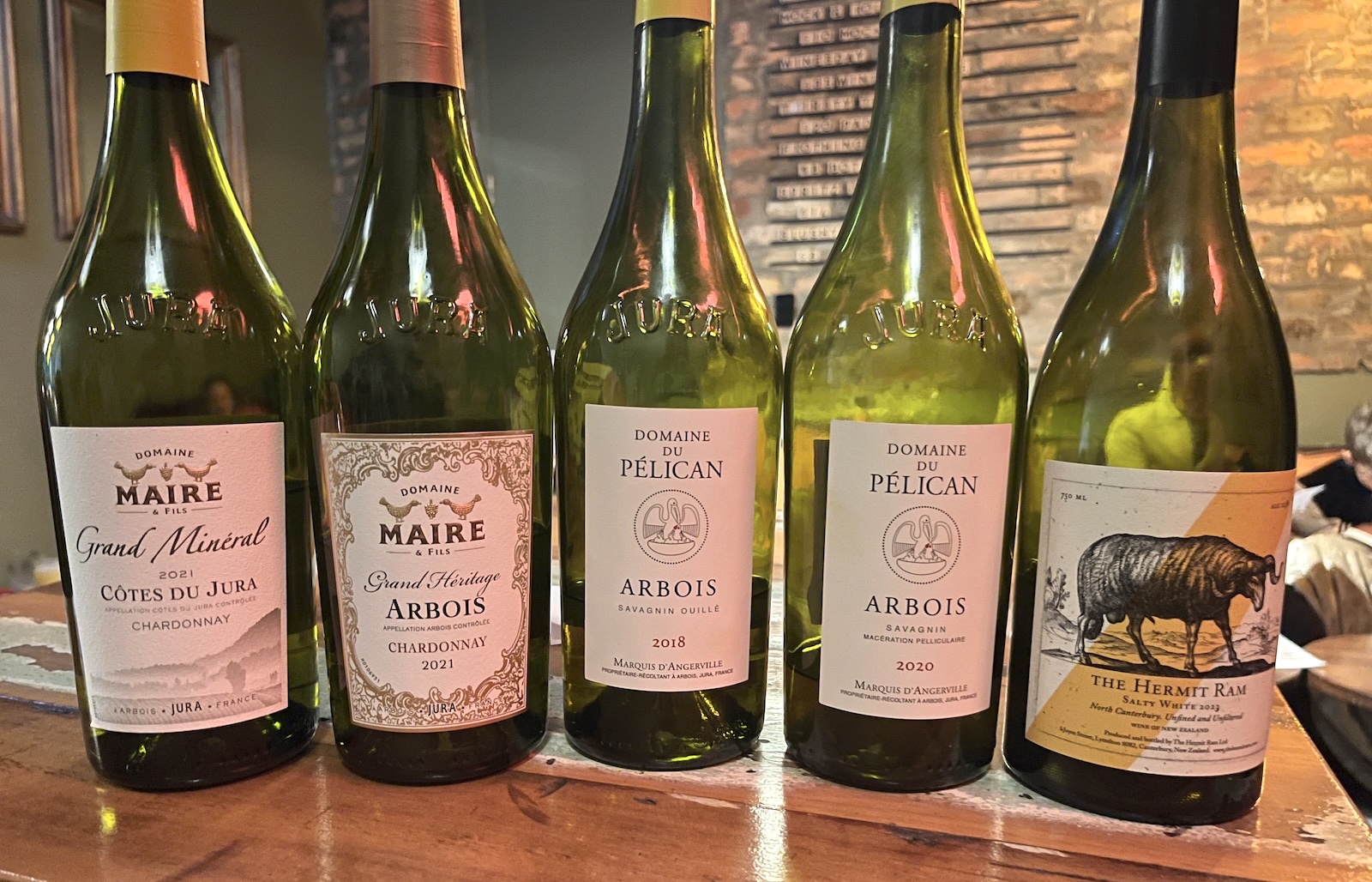
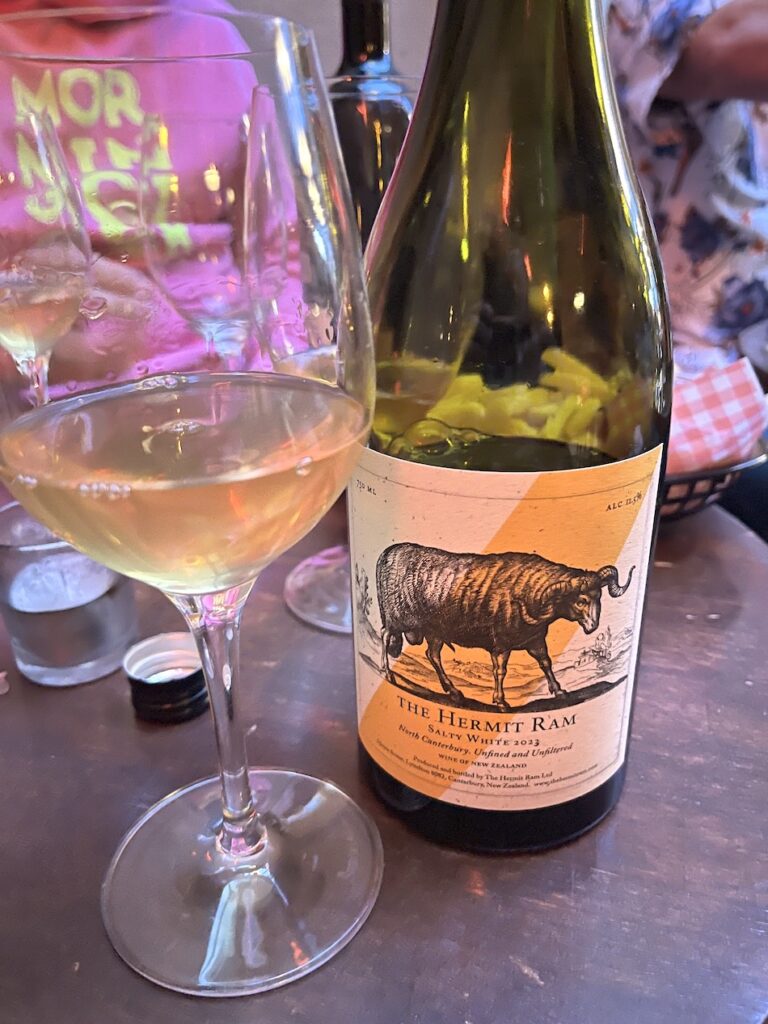
A simple idea for a tasting from a friend in the industry, with the theme “wines from Jura” became a viable article idea for the WineFolio website, when another white wine crossed my path in the last week. That particular wine was a New Zealand white wine from The Hermit Ram – their ‘Salty White’ from 2023. I read online that the method involves “Whole bunch fermentation, partially in stainless steel, and partially in amphora. Two barrels are filled and left untopped to develop a layer of flor”. The winemaker, Theo Coles comments that “Salty White is my ode to the New Zealand coastline, an attempt to marry both the saline and floral elements of our land.”
So, an afternoon meeting of The Symposium was called, with a brief to bring ‘something Jura-esque’ (if not actually a Jura wine). I approached it with the idea that Jura wines are almost always one of those sub-categories that is bubbling away underneath. Never quite making the break into mainstream, but inspiring many winemakers, and keeping winelovers interested. With the ‘Salty White’ in tow, why not look at how a New Zealand interpretation tasted alongside a couple of bottles from Jura itself?
The Jura is one of France’s smallest but most distinctive wine regions – it produces wines unlike almost anywhere else. While it has become fashionable in natural wine circles over the past couple of decades, Jura has centuries of tradition. It also has grape varietals that you rarely see elsewhere – Savignan, Poulsard and Trousseau, anyone?
There are five key appellations. Arbois AOC is the largest and most important appellation – arguably the historic heart of Jura. Arbois produces every Jura style and has the greatest concentration of benchmark producers. Château-Chalon AOC provides itself on being the spiritual home of Vin Jaune. It is the only wine that is permitted, and it has to be made from 100% Savagnin, using long oxidative ageing.
Côtes du Jura AOC is the largest geographically. A long strip of land running north-south with very mixed terroirs and styles. Quality can range from everyday wines to world-class. L’Étoile AOC is a small area known for Chardonnay, Savagnin and Vin Jaune. It generally produces slightly finer, more delicate wines than Arbois. Finally, Crémant du Jura AOC focusses on traditional method sparkling.
There were a couple of ‘pairs’ of wines – two each from Domaine du Pélican, and two from Domaine Maire et Fils. Add in a bottle of Gravner (I know), a magnum of Poulsard from Domaine Rolet (yes, I know), and even a Vin Jaune style wine from Waipara – plus, of course my ‘Salty White’ and you have the makings of a mildly respectable and educational tasting session.
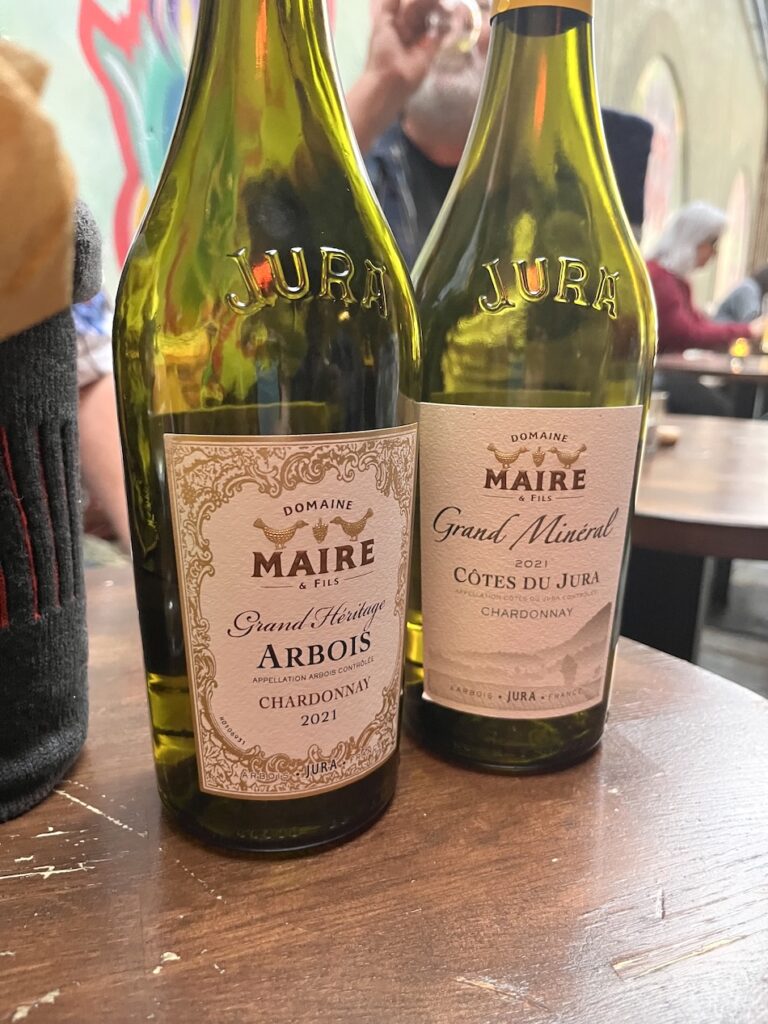
We start with the two Domaine Maire et Fils wines. Both from 2021 and made from chardonnay, they would form a simple introduction to anyone not familiar with the regional style. Grand Heritage Arbois Chardonnay 2021 is Appellation Arbois Controlée, made from mostly Chardonnay grapes with just a touch of Savagnin.
It is matured in oak barrels using the local “sous voile” technique. Meaning “under a veil”, the wine ages in partially filled barrels without being topped off. A naturally occurring film of flor forms on the wine’s surface, protecting it from harmful oxidation. I could tell at first sip that it is Chardonnay, but the nutty, spicy, and saline flavours are quite distinctive and make the varietal almost irrelevant.
The Grand Mineral Chardonnay 2021 is Côtes du Jura AOC and has much less of the phenolics from the sous voile method. Cleaner, but blander too. More Chardonnay, and perhaps slightly Chablis-like in its chalky minerality. That crushed shell flavour turns up in the bouquet, and lines the textural quality later on in the back of the palate. Otherwise.. peach, apple, citrus – it’s a nice wine, and good value.
I sneak the Hermit Ram Salty White 2023 into the line-up blind – its kiwi identity hidden inside a bag. It obviously sits in place though – the slight coppery opaqueness in the glass, that oxidative waft of struck match, wood smoke and almonds; the orange fruit flavours. The first reaction from the gang is “Yum!” which bodes well. The signature of Sauvignon Blanc is there in the palate, with a touch of gooseberry, grapefruit and green herbal flavours, but also a little pineapple and apricot. It carries some weight and has a waxy texture at the back, plus you get that tang of interest from the flor right the way through.
A range of Jura wines that is perhaps best known, and available, locally is Domaine du Pélican. Independently, two of our group had chosen to bring wines from this producer – and both were Savagnin wines from the Arbois AOC. Arbois Savagnin Macération Pelliculaire 2020 is the most cloudy and deeply coloured of all the ‘whites’ today – you’d definitely call this an ‘orange wine’. This skin-contact cuvée was only first made by them in 2018. It sees two weeks on the skins, and like so many of this style, seemed to love the air – it evolved beautifully in the hour it was open (and quickly consumed). Very salty acidity and a spiciness that spreads between the tannin and texture equally. This was a hit.
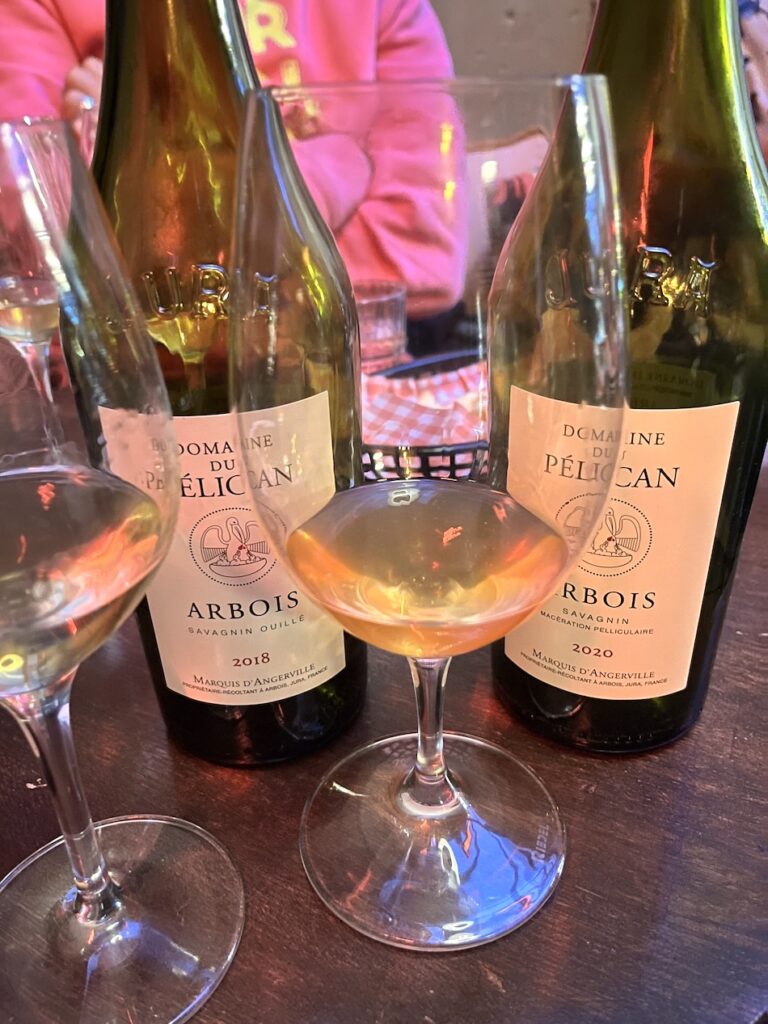
Arbois Savagnin Ouillé 2018 is a good foil to the skin-contact version. “Ouillé” refers to the ‘topping up’ of barrels to prevent oxidation, resulting in a fresher style of wine compared to the more oxidative style. Again, the clarity of this one seems to slightly lessen its appeal, to me – but only if compared to the skin-contact wine. There is white peach, crisp apple and lots of citrus flavours to enjoy, and a ‘fine wine’ elegance to the palate. A bright zing from the acidity and a wet-stone minerality. This was also a hit.
No-one complained too much when one of the Symposium decided that their contribution would be a bottle of Gravner. This estate is based in the Collio hills straddling the Italian/Slovenian border with all wines made in amphorae – specifically ‘qvevri’ imported from Georgia. The Gravner Ribolla 2016 is Venezie Guilia IGT, and frankly regarded as not only the best ‘amber wines’ in the world, but one of the best wines on the planet – of any kind.
Ribolla Gialla is an indigenous grape variety that is late ripening, has high acidity, thick skins and can develop noble rot – regarded as perfect for making complex skin-fermented wines. Intensely aromatic, with lemon peel, sage, persimmon and marmalade on the nose. Fresh, tightly energetic but also with a depth and complexity. Another wine that excelled on contact with air – you could drink this at any stage of your meal, but I’d probably go for charcuterie.
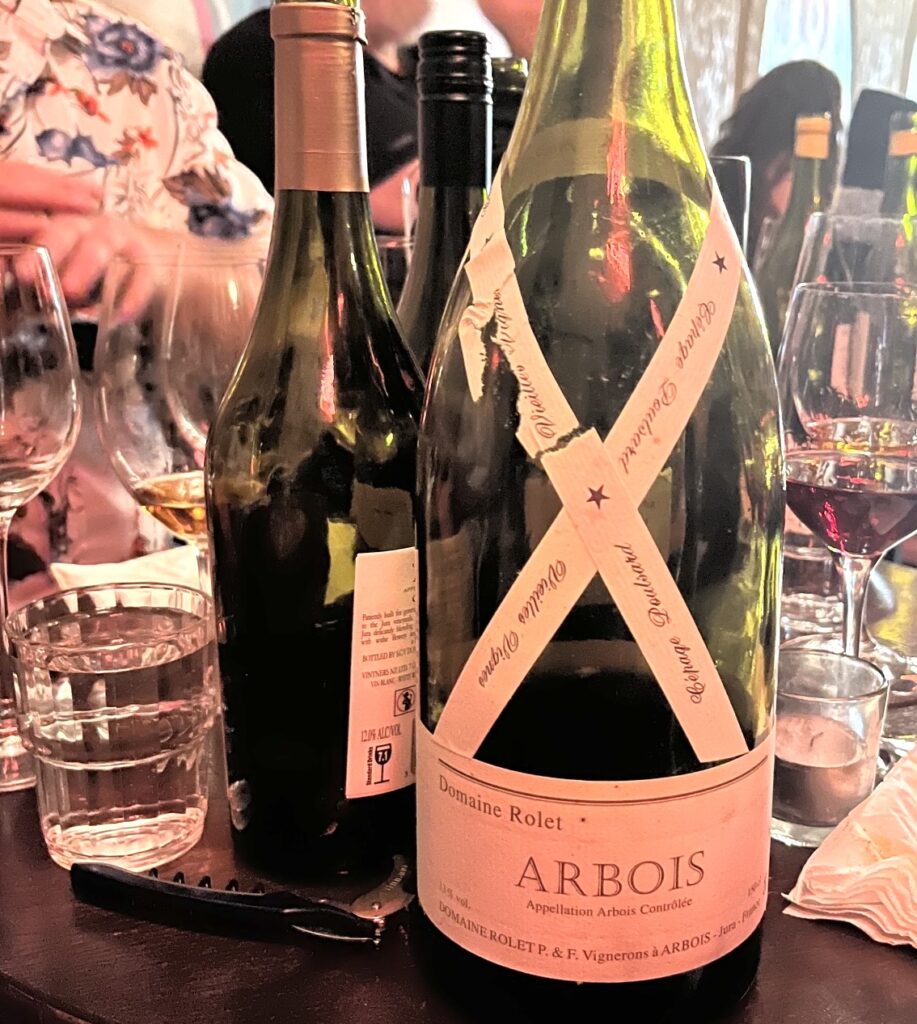
Only one red wine made its way from France to be opened today, but if we look back at this tasting in a few years time, we’ll remember one wine from this afternoon – Domaine Rolet Arbois Cépage Poulsard was in magnum, but it was the vintage that had our jaws dropping. A fresh and energetic lighter-bodied red, most of the group had a guess at being, maybe, 15 years old. There was a touch of browning to the ruby colour, but nothing to suggest that this wine was actually forty years old – from 1986! Softly tannic, with notes of strawberry, pink cherry and grenadine. The light touch doesn’t mean it didn’t have both character and presence. Wow.
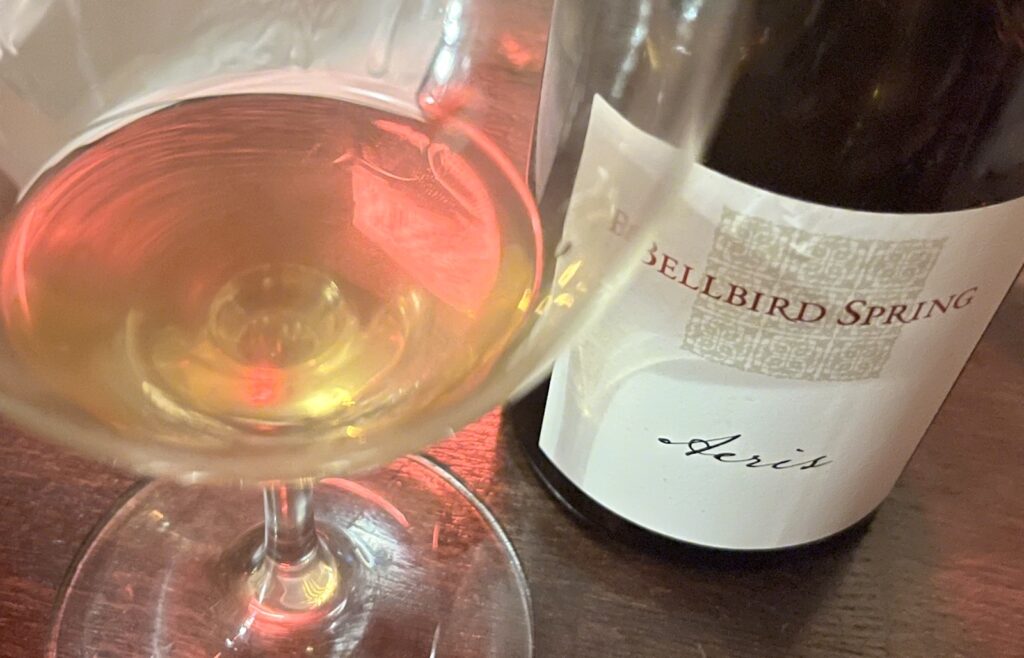
Vin Jaune is perhaps the other famed wine of the Jura, and although we didn’t get one onto the table, we did have this – Bellbird Spring ‘Aeris’ is a non-vintage wine – made from Pinot Gris. Bellbird Spring is an organic family-run estate on the terraces of the Waipara River in North Canterbury. The method here is to first ferment the wine to dry, and then age it for four years under flor. The sweetness isn’t the main effect here – balanced against a juicy acidity, grainy texture and nutty phenolics, it is just one layer to discover. Again, varietal is pretty irrelevant.
It is interesting that both of our New Zealand entries in this tasting come from the same region. But, then again, not so strange when you consider my answer to a question I get asked a fair bit.. ‘what regions do you think are the best in New Zealand?’. And I always reply that I consider North Canterbury is the most diverse and under-rated region of them all. No surprises then that something ‘Jura-esque’ came from there. A great afternoon’s learning was had.

2 Comments on “A tasting of Jura – through a kiwi lens”