As someone who loves to tell stories, I thoroughly enjoyed the twenty years that I spent working in tourism when I moved to New Zealand. It meant that not only did I get to see pretty much the whole country, but also, gradually, come to the realisation that some of the nicest ways to pass a couple of hours as a tourist in this country, are Cellar Doors and vineyard visits. It is a great ‘breather’ between activities and you get to meet some real characters and scratch the surface of what makes New Zealand tick. Fundamentally, it is a mix of farming and craft – or, art and science.
Because I was going around and researching ‘visitor experiences’ I didn’t always get to focus on the wines of any one region. So now that I do… I am keen to get back to the regions and fill in the gaps. Tasman was one place that I felt I had to get to, and in late summer of 2025 I managed to fit in a visit. This is a chat that I had with Mark McGill on that trip a year ago.
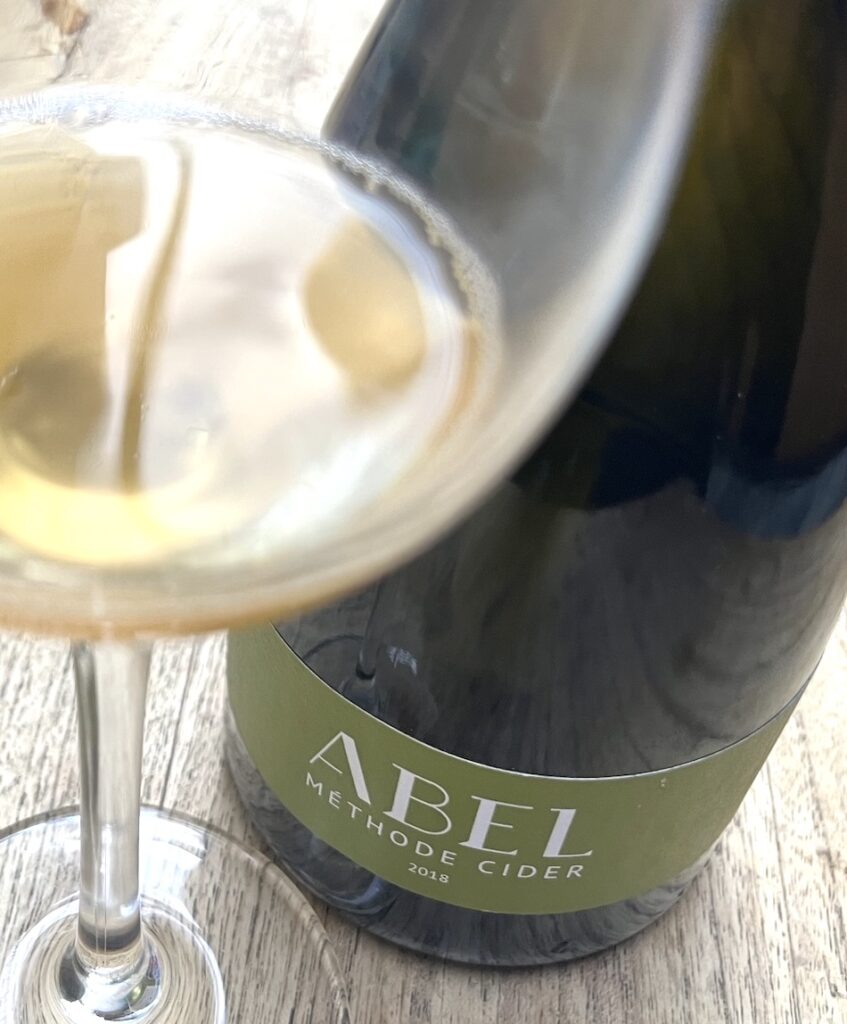
I moved to New Zealand from Bristol in the UK, where we love cider. For example, I’ve been on trips to the Taunton Cider Factory. Well, I know I have, but don’t ask me about it – it got a bit hazy quite quickly. When I first met Mark at a trade show I told hime the story of when I first tried the Abel cider, and hated it – I spat it out. It would have been one of the early ones.
Mark is good enough to laugh this off saying “Well my first one was 2007, but our earliest vintages like 2015 or 2016, they were pretty tight and austere. We like acid. They probably took two years in bottle to come around. The vintages after that were a little less acidity because it was uneconomical to hold them in bottle for the right time”.
Mark’s father planted a vineyard in Wairarapa in the early ’90s and ‘got the bug’, heading off to Lincoln University in 1998 for a three-year degree. A spell making wine in Australia followed that, before being tempted to come back full circle at the vineyard that his Dad had planted – now known as Soulstone Estate in the early 2000s. His partner, Sophie, also grew up around the wine industry – her parents are James and Wendy Healy who established the Dog Point vineyard in Marlborough.
Sophie was working for a winery supply company in Melbourne selling yeast and equipment, when she crossed paths with Mark who was out selling French oak barrels. They settled back in Moutere in 2015 and spent a while looking for the right spot, before buying the land they are now on.
I start my conversation with Mark by wondering whether the region has an annual event? Because a lot of smaller regions tend to hang their hat on that – like ‘Toast Martinborough’ or ‘Roam Central Otago’. Mark is quite frank in his reply, telling me “No, we’re the only region that doesn’t have its own thing. One of the big things for me is that when people ask me where I’m from, I say ‘Tasman’. Not Nelson – because there’s no vineyards in Nelson. So why do we call ourselves ‘Nelson Wine’? It’s like the Yarra Valley saying ‘Here’s my Melbourne Pinot’ isn’t it? I talk about Tasman, because Nelson is its own region”.
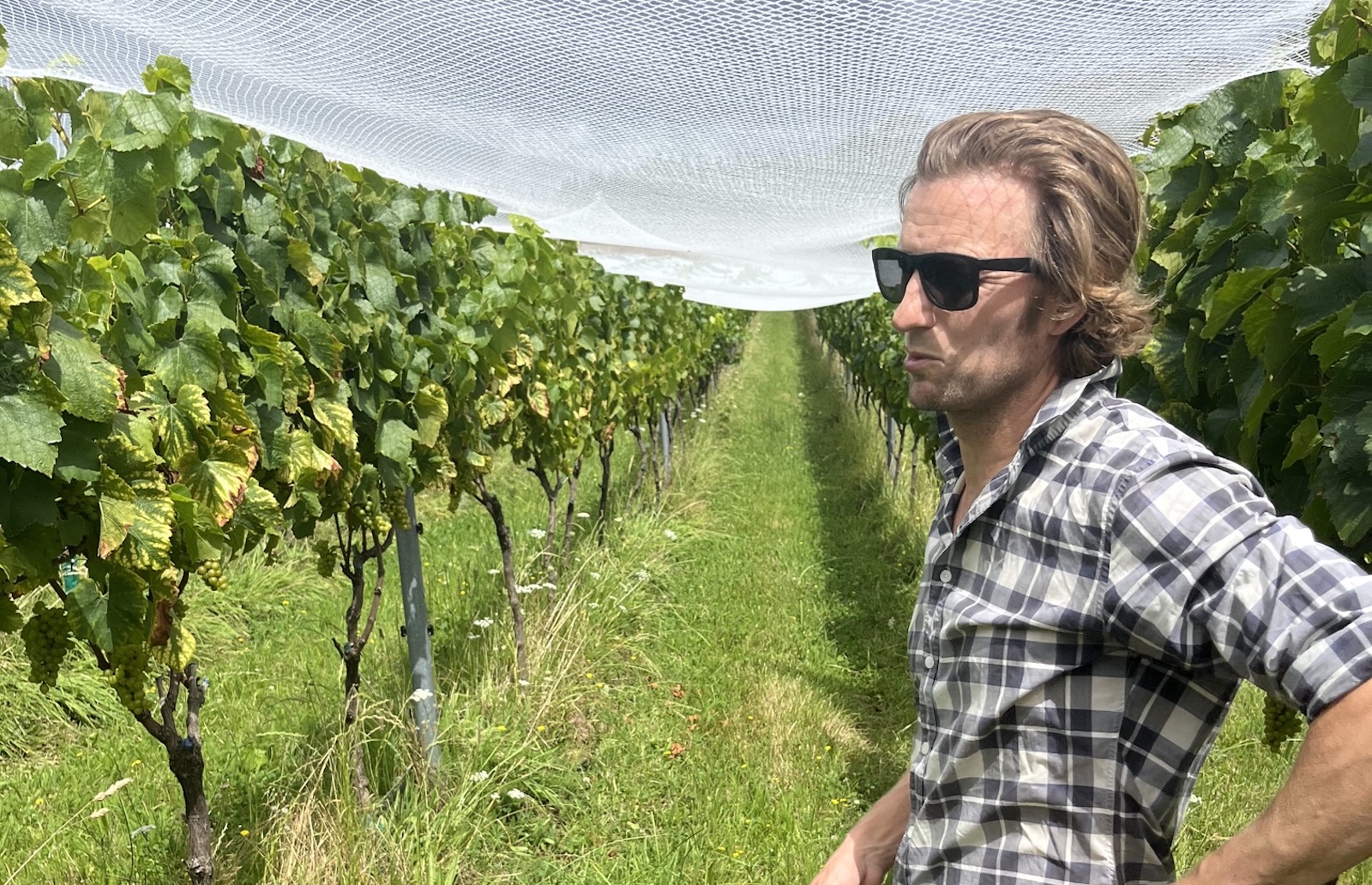
We go for a walk and Mark shows me ‘the Empire’. It’s all Chardonnay, with Mendoza, Clone 15, and over on a bigger block they have got 548 and Mendoza. I ask if they chose the clones because they liked them, or that they would suit the place? Mark tells me “It’s a bit of both. A – we like them; and B, from talking around it seems that Mendoza and Clone 15 are grown around here and do pretty well. People say 95 doesn’t seem to do as well here, but then we do buy fruit from two local vineyards and that’s mostly 95. We’ve had no issues with it providing you don’t overcrop it”.
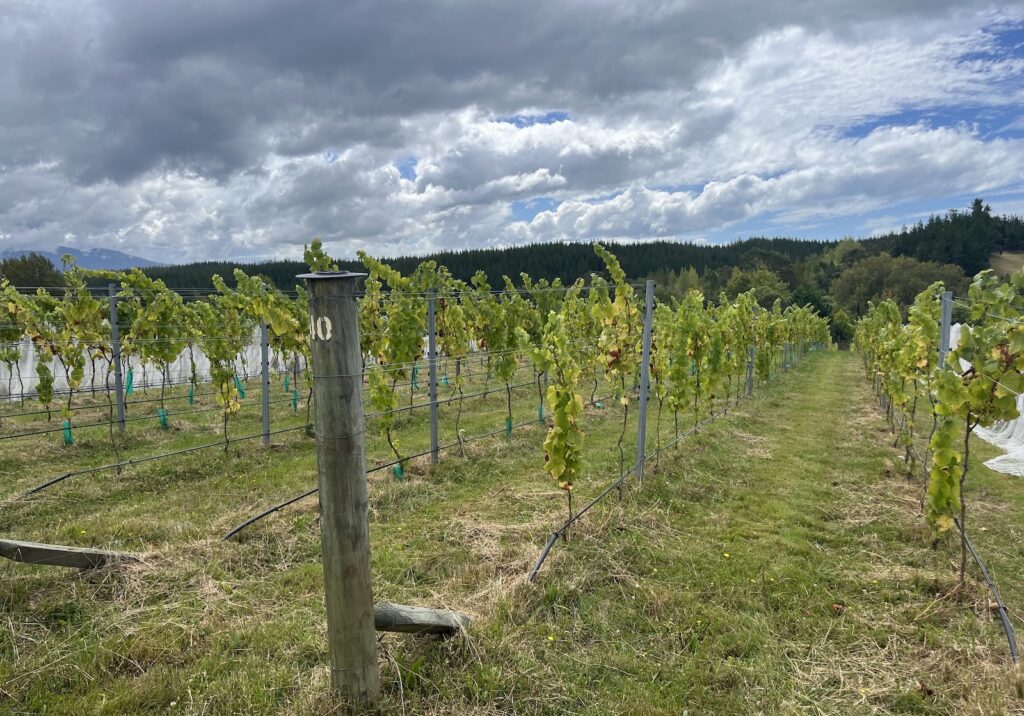
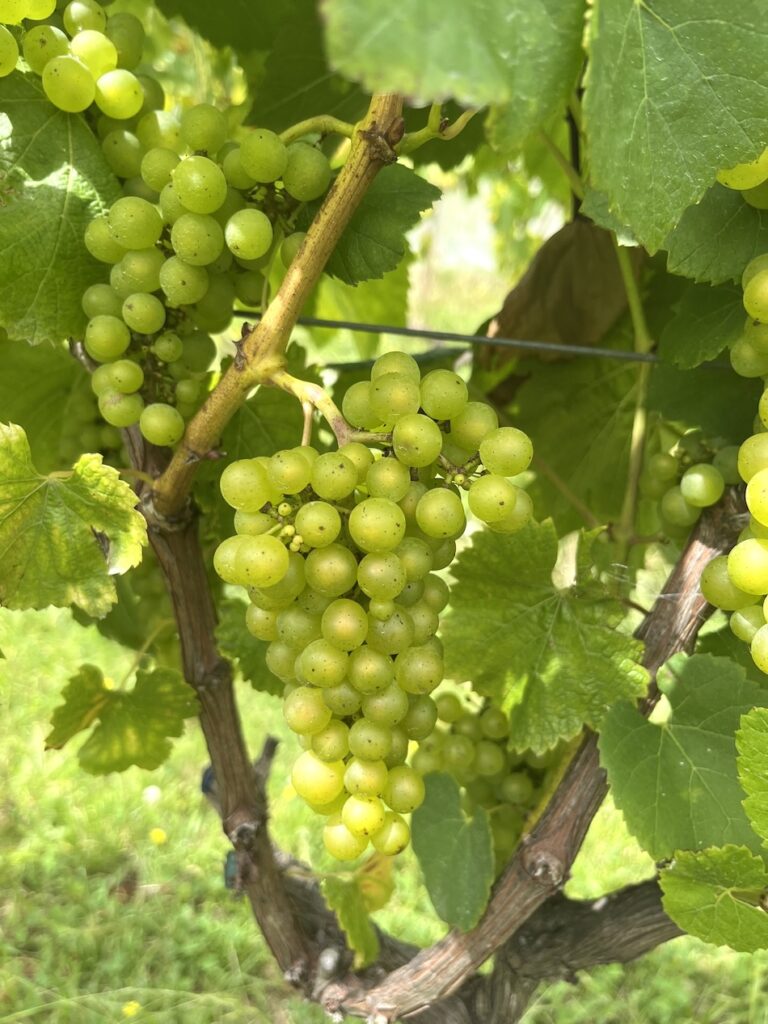
They planted their vineyard in 2019, but did have to replant a whole lot of the Mendoza vines. The Mendoza had around 20% failure rate, whereas the others that were all planted at the same time were at 2-3%. Having to replant 2500 vines put them behind a bit in terms of production, but last year they crushed 25 tonne of Chardonnay. 548 is a new clone which has the characteristics of Mendoza but without the hen and chicken – and is reckoned to be a stronger vine.
In terms of the home vineyard, it is of a size that they can do all their own work on it. The vineyard had been an apple orchard of a hundred years, but today it looks immaculate. They’ve taken the decision to leaf pluck on the eastern side and will cut everything back to two bunches on a shoot. They are looking for dappled light – with the nets on it reduces the light but does increase humidity. In the days before I arrived they probably had 50mm of rain which wasn’t welcome. The fruiting wires are at 1200 because they run sheep through the rows year round. The sheep go into each block a week at a time – leaf plucking, bud-rubbing and mowing as they go, which works well.
I’ve only come across the one wine from them – a very, very good Chardonnay. The Tasman Chardonnay normally sits for 20 months on lees before bottling. I look for ‘character’ in wines and that one certainly has that. Here is my review from when I discovered it in 2023 – www.winefolio.co.nz/?p=9298.
I wonder if they have plans for more, and Mark explains “We have in bottle our first single vineyards. Off here and I have a leased vineyard about 20 minutes from here – Ngatimoti, which is old vine Chardonnay planted in ’97. We took over that vineyard. It’s only small. There will be the ‘Tasman’ which will be the original blend of grower vineyards plus some from here; and a couple of single vineyards and then we’ll see where we go from there. It will probably be ten years before we fully come to terms with what blocks are giving us what fruit. We’ve already got some favourite little parcels”.
In terms of how they approach the vineyard, they aren’t organic but as Mark puts it “We farm with respect for the land. Watch, listen, learn and adapt. One of the problems with organics is that New Zealand doesn’t have its own national standard. Everything we do for organics is decided by Europe and how far away is that?”
The building on the property was an apple-packing warehouse and they have converted a small portion of it into a ‘functional’ winery. It is where we end up after the brief spin around the vineyard. Mark tells me “We put some slot drains in, waster water, insulated it – and we haven’t quite finished! It’s a job for the winter, ideally. It’s a good space and we can slowly grow into it, as we need. We keep it simple”
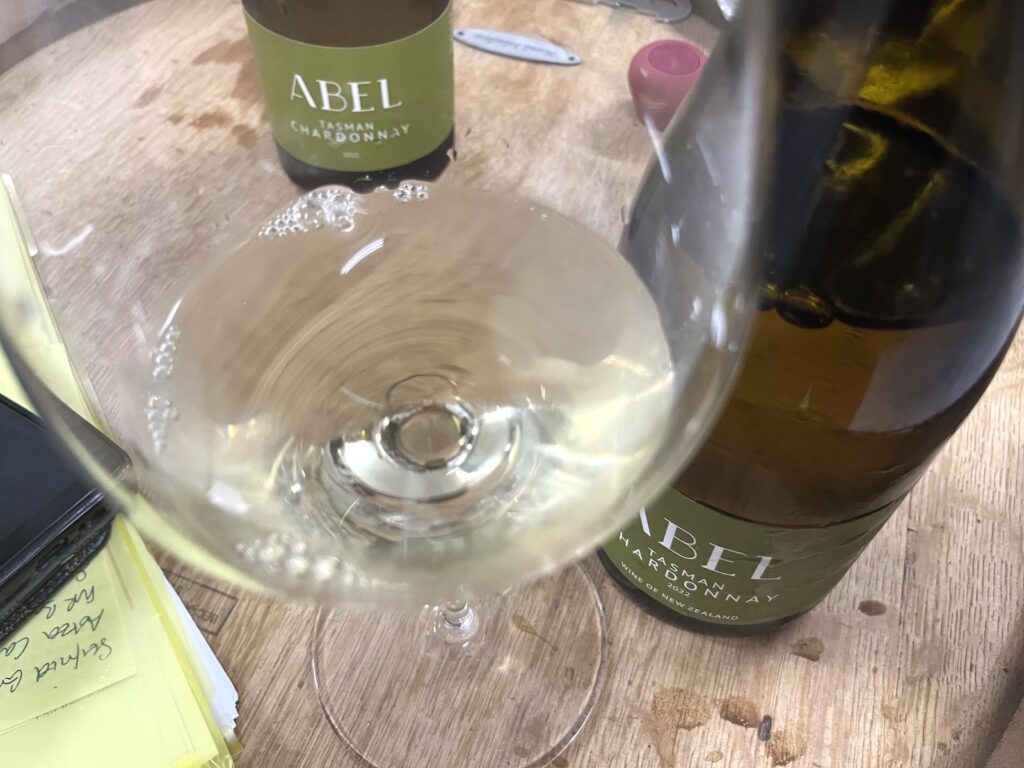
They are thinking of making a sparkling wine – it would be another string in their bow for things like events. But for now, Mark opens a couple of vintages of the Chardonnay to taste. The first one I tried was the 2020 that certainly left a mark. The 2021, that is open now, I have had before, and recognise as soon as I taste it. A wisp of smoky reductivity merges into citrus, nectarine, apple crumble and touch of grilled nuts. A mouth-watering minerality and juicy acidity with a zesty, pithy quality. There is a hint of oak but only as a background note. It was a good vintage (although quite small with frost at flowering) and it shows in the glass.
“We’re trying to make wines that we like!” is how Mark sums it up, and I try to get him to confess to what other wines he likes. All I can draw out of him is “I’m a fan of the Rhone, so Condrieu and Syrah. Syrah always wins over Pinot for me, always has. But I’d never do Syrah here – that’s Hawke’s Bay’s job”. The 2021 Chardonnay went really well – with Mark having to allocate stock around to make sure it was drawn out for as long as they could. It is a balance between wanting the wine to have had time in bottle, and losing a listing at a good restaurant because you have finished the stock of a vintage.
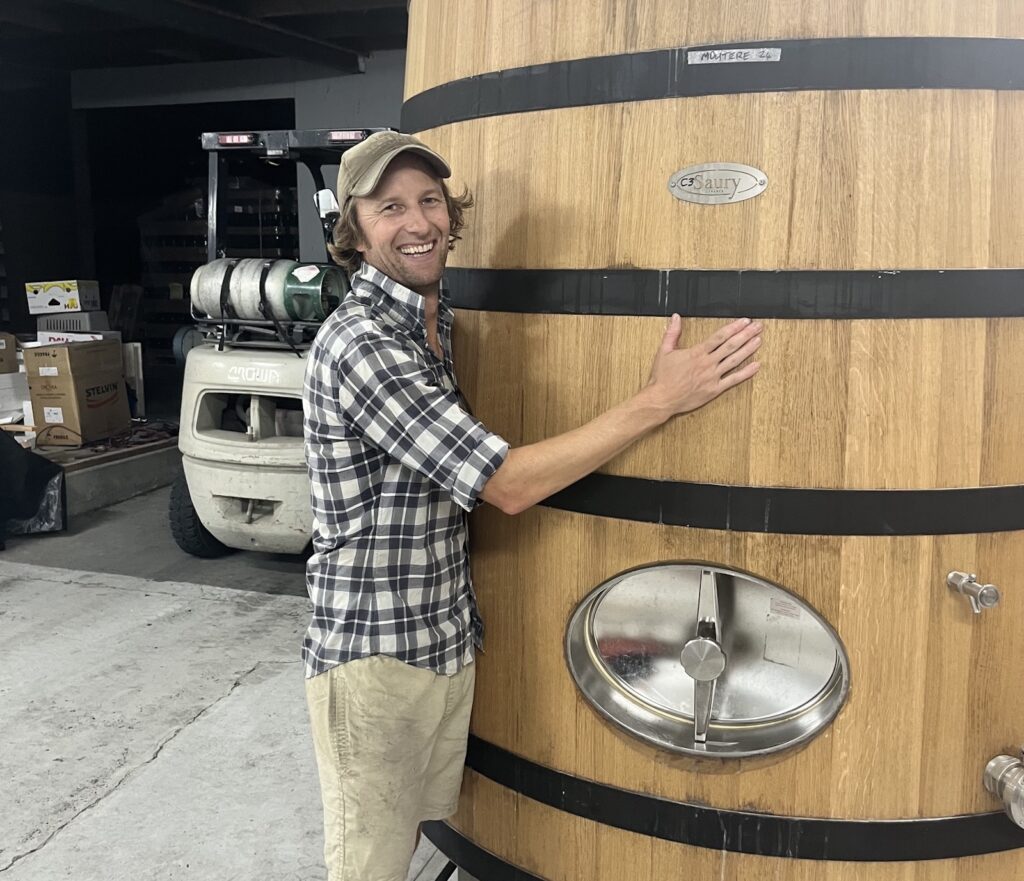
They also try to keep at least one portion of any release in the big cuve (see photo of Mark giving one a hug) for as long as possible. I notice that one of the barrels has ‘Sea Level’ chalked on it – and ask about that as I’d recently had a Chardonnay branded as Sea Level. Mark says “Yes, that’s one place we get fruit from. Sam Smail makes his own brand as well. He basically sells a lot of his fruit, and then keeps a little bit of Chardonnay, Pinot, Chenin and Pinot Gris and he makes it over at the Côterie in Marlborough. He was the winemaker for Whitehaven for many years”.
With Mark having travelled around selling barrels, I imagine there aren’t too many winemakers he hasn’t met in New Zealand – or Australia. We try the 2022, which is a different vintage but same components. Having the time to keep the wine – and on lees in particular – makes such a difference. A complex wee beastie, with burnt butter, white peach, apple, grapefruit pith, oatmeal biscuit, sweet lemon and nougat – and that’s just the bouquet! An energetic, fresh acidity is the driver – succulent and lifting, before the palate widens and a silky texture finishes it off. It really is very, very good.
Mark has this to say about my description: “A lot of people say energy, and for us that is acidity. You keep the wines fresh with that and its a natural thing. There’s a little bit more Mendoza in the ’22 than was in the ’21, and that’s because of the frost. So that extra amount of those small berries has probably given it more zip. The ’21 has gone really well, so things just get better! It’s a good representation of Tasman because you’ve got a vineyard up in the hills, one at sea level, then Ngatimoti and a little bit off our place”.
He persuades me to try the cider again. I tell him “I can see why I didn’t like it in the past, but I do like this one”. It is quite ‘fine’ in terms of style – it is clearly aimed at people who are into the more hand-made, ‘individualistic’ artisan side of things. A ‘beer’ type drink for people who like Chardonnay. Fruity, obviously, but with a clean, sharp line and directness to it. Marks adds that “Most people who like our cider, like our Chardonnay – and vice versa”
I see the wines just keep getting better. The attention to detail, with the two bunches per shoot, handpicking and picking at the right time. They want that freshness and those citrus-led flavours. It is details but not overly-complicated either. That Moutere clay is also a big factor in how the fruit develops. It is perhaps a surprise that after the Neudorf Moutere Chardonnay got a 100-point sore from Bob Campbell MW, that more people haven’t come here to make Chardonnay. They are a label to keep an eye on.
(note – since my visit, James Healy died unexpectedly. As Mark said: “it was a bit of a shock to all, we thought he had a couple more vintages in him but unfortunately his ticker decided otherwise. His legacy will be remembered in mind and in wine of course”.)