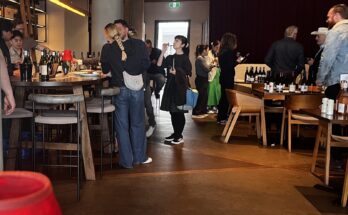
The last week of Winter brought a special event this week – an extra evening of The Tasting Table as I had been asked to present to a group at HMS Philomel – The NZ Royal Navy Base in Devonport. The Leander Lounge is one of the most impressive venues in town for an evening out, with spectacular views across the harbour to Auckland CBD. Unfortunately it is a classic wet Winters night in Devonport, but we have a full table and plenty of very good local wines to show off.
A change-up to the way the food for the night works today too. I will often work to have food matches to the wines – talking to the venue and chef, but tonight’s offering trumps any need for such discussions. It is probably the most impressive grazing platter that I have seen, and guests are therefore able to fill plates with such a range of charcuterie, cheeses, hot seafood, paté, dips and spreads, that it is the equivalent of a five-course degustation!
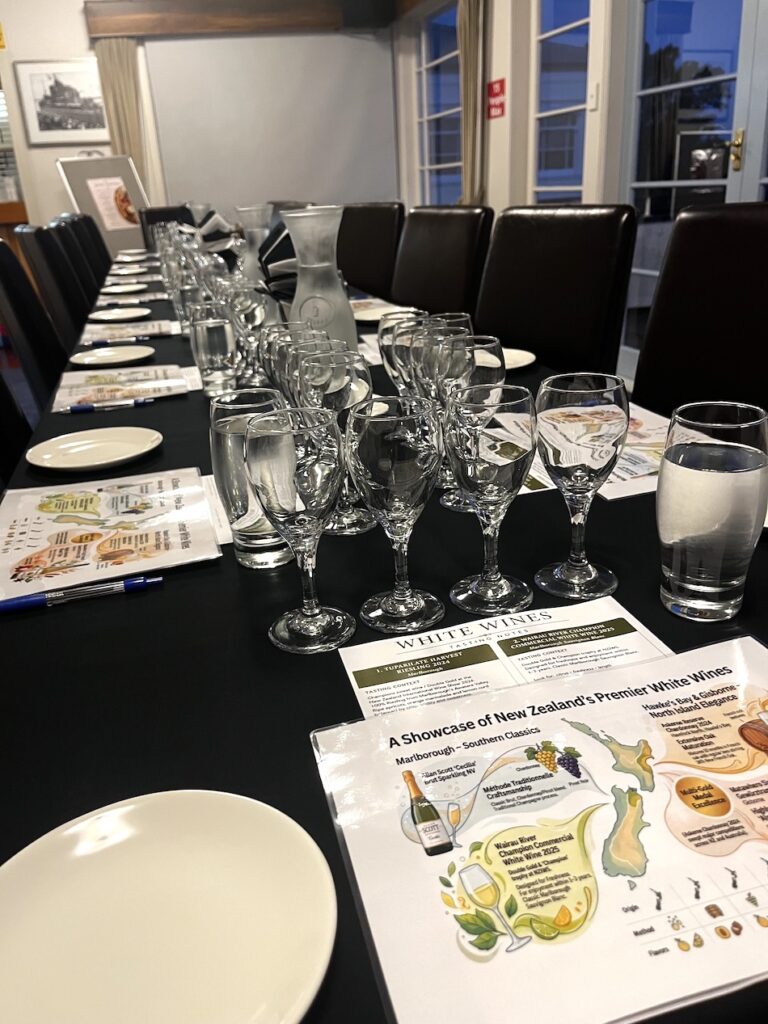
We start the evening discussing the state of play in the NZ world of wine – how exports are holding up, the trend for lighter wines and the methods for judging wines (and my role in that). I also talk about some of the reasons why I’ve chosen the wines we’ll be tasting tonight. Each producer is a family-owned and run operation. Some small, some a little bigger, but all making what amounts to well-made versions of classic expressions. The sort of thing that wins medals!
I saw most people starting off on some luxurious dips with crudités for the opening wine and the first of the still white wines.
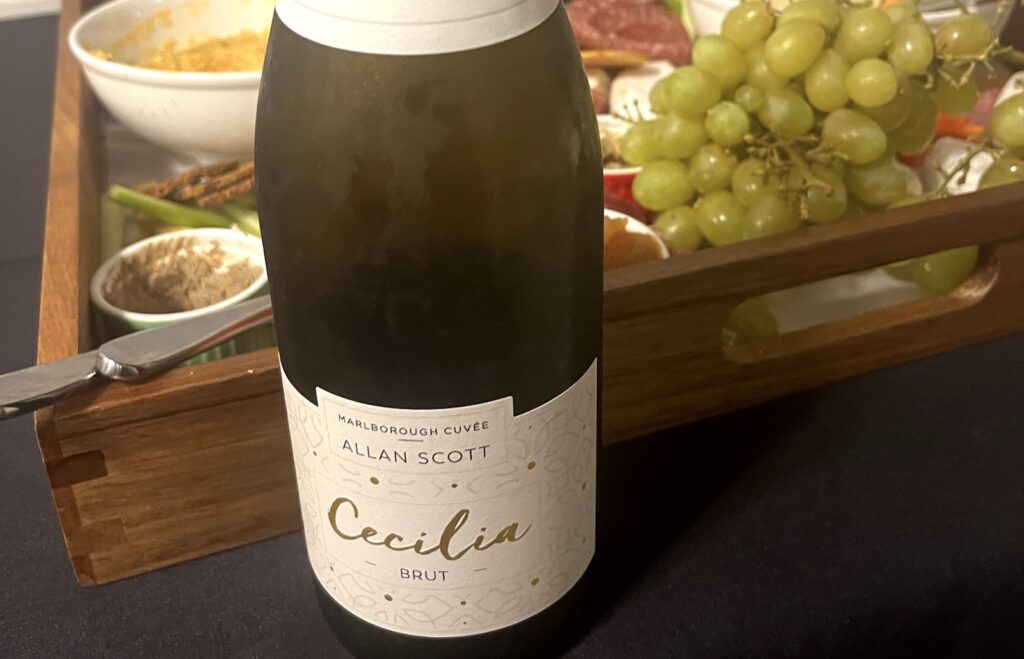
Wine number 1 is Allan Scott ‘Cecilia’ Brut Sparkling NV. A classic blend of Chardonnay and Pinot Noir. Originally created by pioneering winemaker Allan Scott to honour his wife Cathy (whose middle name is Cecilia). The winery website describes her: “she has always been a very fond believer in bubbles.” They add “For everyday celebrations or celebrations every day”
A very fine, persistent mousse of bubbles. The bouquet reveals a fresh burst of blossom, citrus, lemon and red apple, with underlying hints of yeasty brioche or baked bread. A soft fruit entry showing crisp apple and pear. Not a simple quaffer, it features a creamy mouthfeel, vibrant acidity, and some complexity, without being too simplistic. The finish is clean, crisp, and refreshing.
My guest comments included: “I don’t usually like sparkling wines, but this was one of my favourites of the night”. “The fizz is really smooth and lingering”. “I wouldn’t buy Champagne because I don’t think it is worth the price – but this is excellent value”.
Wine number 2 is Wairau River Sauvignon Blanc 2025 – produced by the family-owned Rose Family Estate in the Rapaura sub-region of Marlborough, from four different Estate vineyards. It won the ‘Champion Commercial White Wine’ Trophy and a Double Gold at the New Zealand International Wine Show 2025 that David judged.
A classic expression of Marlborough Sauvignon Blanc, designed to be enjoyed fresh within 1 to 3 years of purchase.
Very pale silvery-green colour in the glass. The aromas are power-packed with passionfruit, blackcurrant, lime, and grapefruit zest, with hints of green grass and pea pod. The palate doesn’t lack for punch, with full-flavoured juices of guava, nectarine, and stone fruits. Crisp, light-to-medium bodied, featuring a mouth-watering mineral acidity and a clean, dry finish.
I have a quick discussion with the group about ‘Thiols’ – the very important natural aroma compounds in this style of wine. They had this to say about the Sav: “This seems to have a lot less ‘attack’ than most Sauvignon Blanc I’ve tried”, “I’m getting a bit more sweetness on this second glass”, “Is it Ok to say that I can smell tomato leaf in this?”
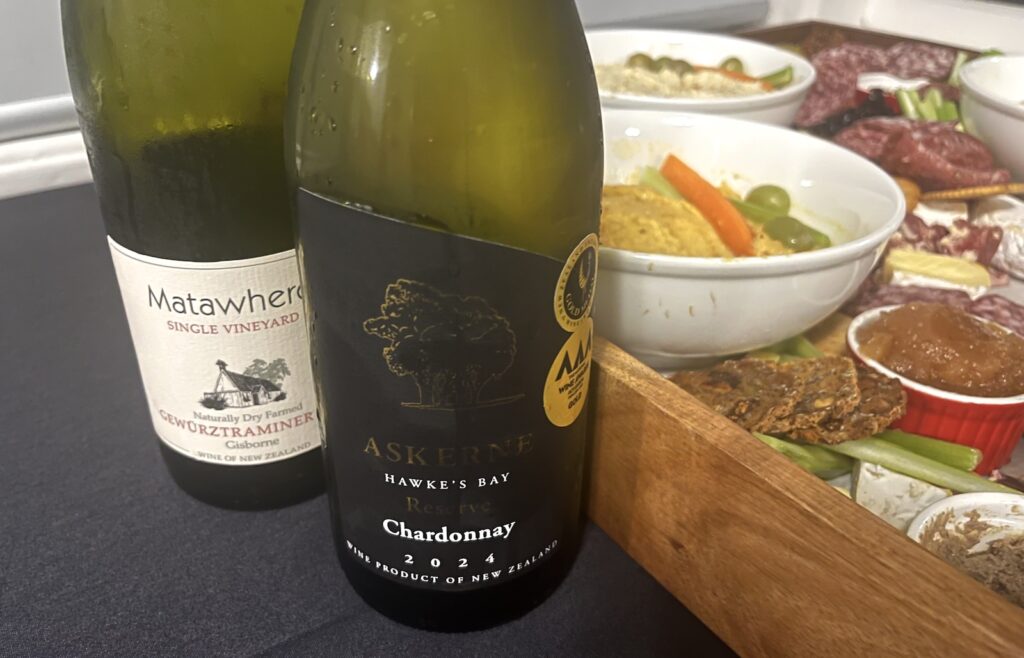
As we moved into the next two, richer whites, I could see that cheeses, breads, crackers and a little paté were the popular choices for munching along with the Chardonnay and Gewürztraminer.
The third wine is Askerne Reserve Chardonnay 2024. Produced by the family-owned boutique winery in Havelock North, this vintage has swept major wine competitions, earning multiple Gold Medals across New Zealand and Australia – including Gold in both of the NZ shows in 2025. Also in the Hawke’s Bay Annual Chardonnay Collection. Aged for 10 months in French oak barrels – with 36% new oak – with regular lees stirring to add weight and velvety complexity.
A bright, medium -pale straw colour in the glass. Powerfully scented with ripe yellow peach, baked citrus, roasted hazelnuts, and a touch of smoky wood and vanilla. It is dry, plush, and has some weight in the palate, with a smooth, satin-like texture. A refreshing, juicy acidity keeps the wine tasting fresh and crisp, balancing out the silkiness and caramel-laced bright citrus flavours. A delightful contrast of butterscotch and grapefruit pith on the finish.
Guest comments: “This reminds me of the old Chardonnays you used to get – in a good way” “Rich and creamy, almost decadent!”, “I thought I didn’t like Chardonnay, but I like this”
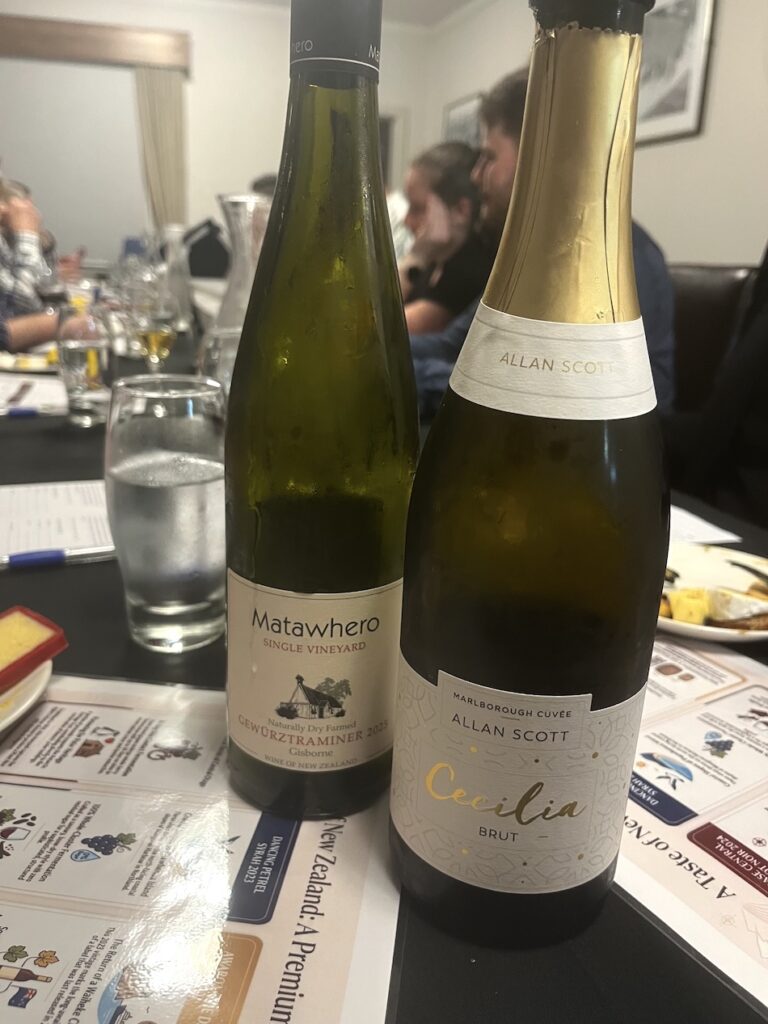
Wine 4 is Matawhero Single Vineyard Gewürztraminer 2025.
Grown on the Matawhero “home” block vineyard in Gisborne. The winery is known for being the very first in New Zealand to plant Gewürztraminer grapes. Typical of this highly aromatic variety – one of the great ‘Alsace’ grapes alongside Riesling, Pinot Gris and Muscat.
The fermentation is stopped, leaving about 7 grams per litre of residual sugar (natural grape sugar). This gives the wine a “just dry” taste with a tiny hint of sweetness.
The perfume shows red apple, white peach, mandarin, lychee, ginger and jasmine. Just off-dry to taste, with a lovely spicy character around the edges. Rich and full with notes of Turkish delight, star anise and mandarin. It has a tight balance between great acidity, ripe fruit and a talcum powder texture. A contrast of candy-store confections and white pepper adds more personality and interest. That ripe fruit lingers on the finish.
We had a bigger variety of guest comments for this one than any other, with some positive and not-so! “It’s like walking into a sweet shop and taking a deep breath” , “It isn’t a wine taste I’m used to but it goes pretty well with what I’ve got on my plate right now”, but also…“I wouldn’t buy this – yuk!”
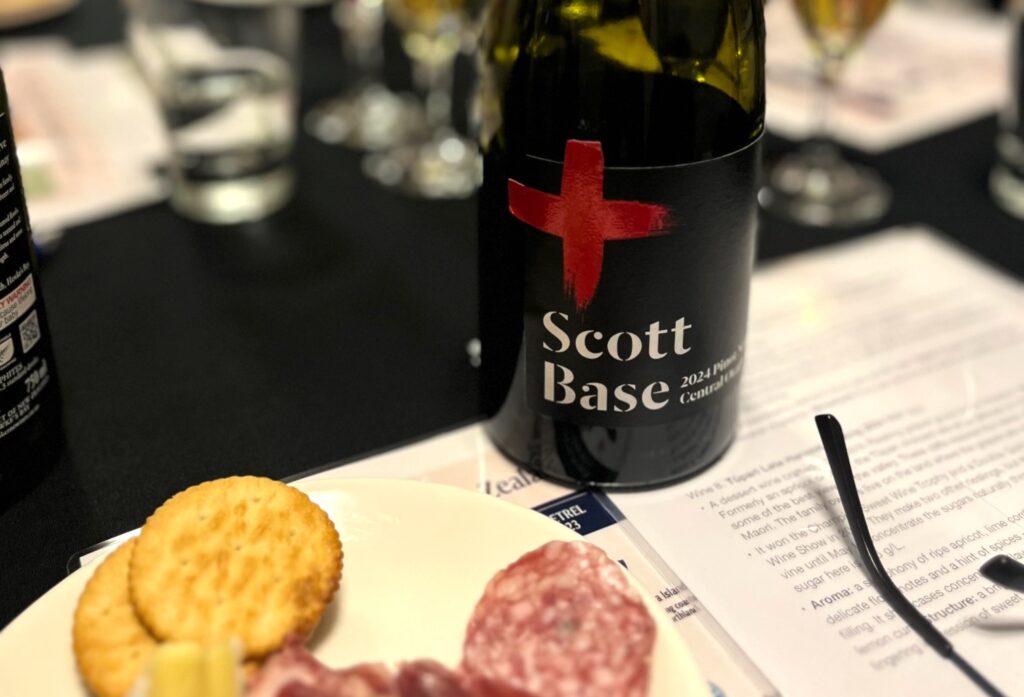
Now it was time to crack into the salami, olives and the softer cheeses – with a touch of spice from the chutneys, to go with our reds. The coppa was my choice to match the Syrah.
Our first red was Scott Base Central Otago Pinot Noir 2024. Although the Scott family is based in Marlborough, they established this dedicated single vineyard in Central Otago in 1994 to capture the region’s distinct, intense terroir. Cromwell has a great ‘diurnal range’ of temperatures between daytime heat and night-time cold – which has an effect on the grapes of ‘fixing the acidity’.
Hand-picked grapes were destemmed (but not crushed) and gently transferred to open fermentation tanks, spending up to 30 days on skins for optimal colour and tannin extraction.
A deep burgundy-ruby colour in the glass. The bouquet is not shy – packed with fresh red cherry, cranberry, blueberry and mocha. Primary fruit-forward flavours balanced out by a fine, clay-like minerality in the palate, where a plush texture and a grip of tannin structure offset, and balance the juiciness. A subtle, peppery spiciness at the finish.
This was popular – guest comments included “My favourite wine of the night” and “It’s so ripe and velvety – how do they do that?!”
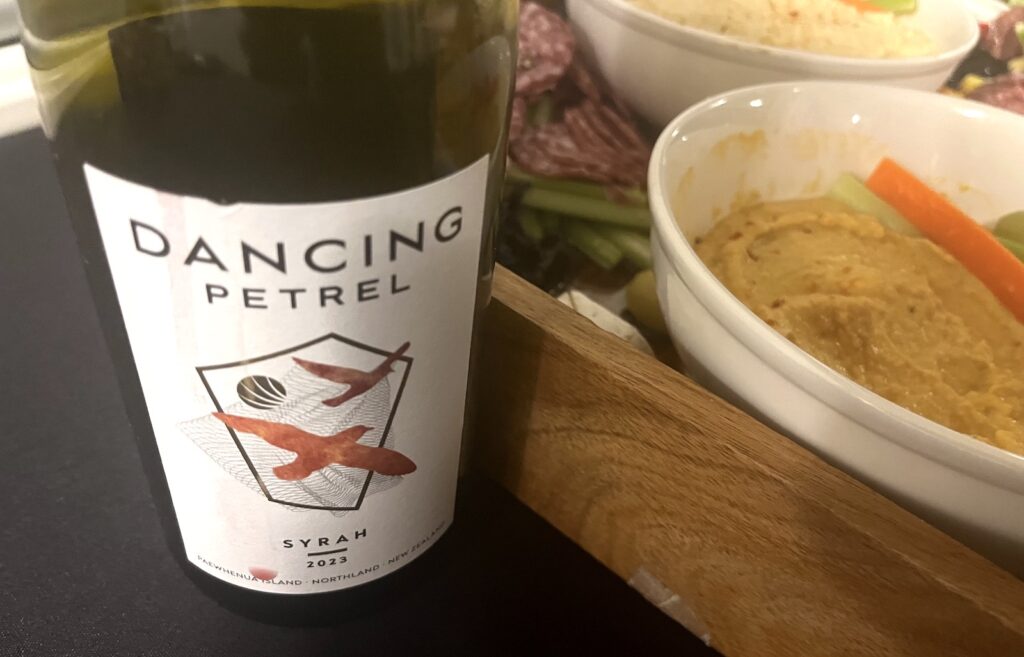
The sixth wine was one that I had naively assumed that no-one would have encountered before… but I was wrong! Dancing Petrel Syrah 2023 is made from their picturesque Vineyard, located on the north-facing coastal slopes of Paewhenua Island in Northland’s Mangonui Harbour. And one couple knew the producers very well!
A savoury style featuring 100% whole-cluster fermentation and no residual sugar for a bone-dry finish. They also grow Cabernet Franc and Tannat, while the whites include Viognier, Arneis and Pinot Gris.
Rich and complex scents of blackberry, plum, dark cherry, and liquorice, mixed with woody herbs and black pepper. The palate is ripe and medium to full-bodied with a gentle spiciness. The oak aging rounds out the fruit notes with a touch of smoke and vanilla. A firm grip of tannin and balanced acidity gives the wine great flow and direction across the palate. Finishes in harmony, pulling the elements together and has good length.
Another very popular wine – “Delicious – I’m so happy to find a new favourite wine” “Is there any more?” and “I want some of this on my Christmas table”
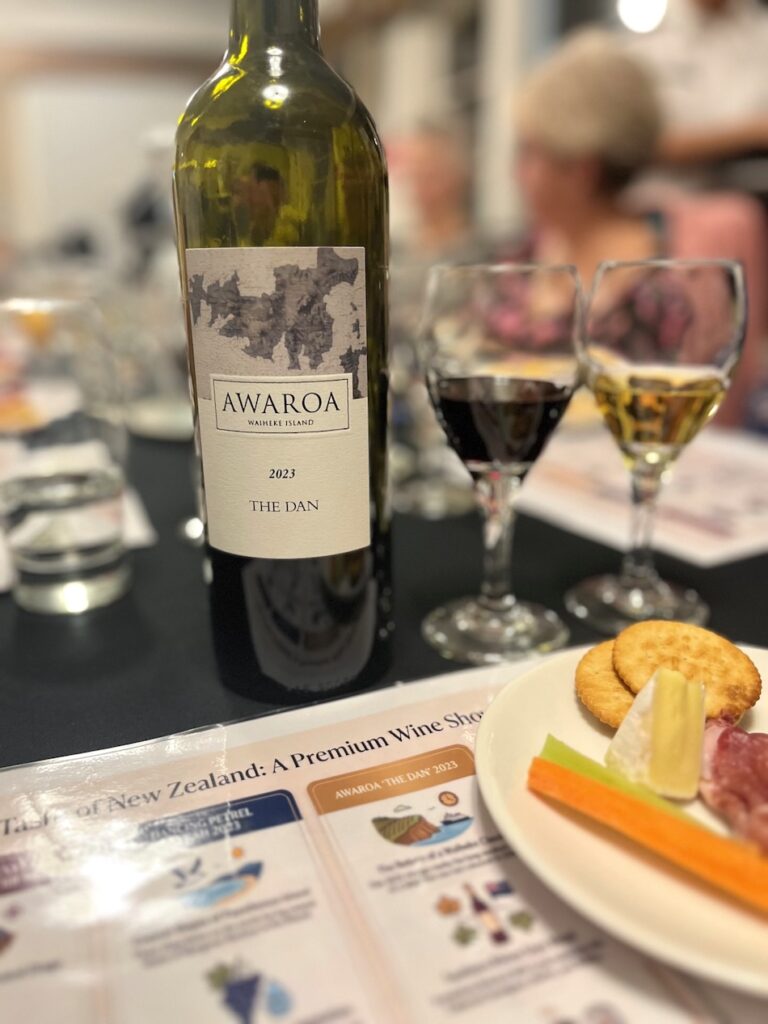
By now, there was some serious experimentation with piled plates and an abundant range of most of the platter offerings appearing, as the guests got into the swing of it. And that important slice of cheese for the dessert wine.
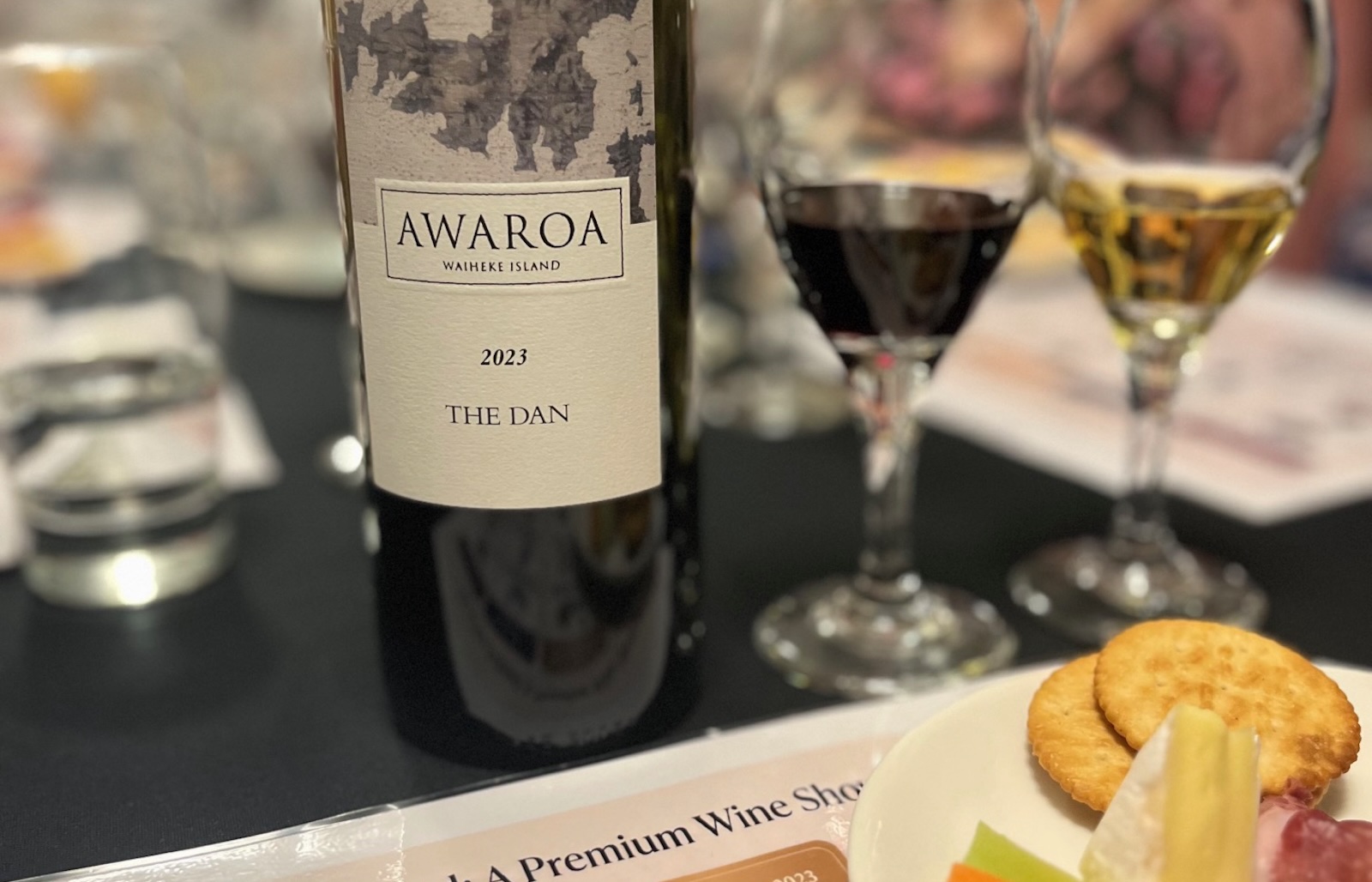
Awaroa ‘The Dan’ 2023 is a vintage that marks the return of the blend, which was last released in 2018. It is 60% Syrah and the other 40% is Cabernet Sauvignon, Merlot & Malbec.
Hand-harvested and wild-fermented on Waiheke Island, then aged for 12 months in mostly one-year-old oak barrels. It has a Southern Rhône feel to it, although the Syrah/Cabernet blend is a very New World-Australian thing.
A dense but bright purple colour in the glass. The perfume kicks off with blackberry, damson plum, cassis and smoky oak, and has a teasing note of dried herbs. The palate showcases an elegant New Zealand style of red blend that is becoming more popular, with ripe dark fruit and a distinct mineral character. Firm-ish tannins provide structure, and plenty of acidity gives bite and freshness.
Guests commented: “I’ll be looking at visiting Awaroa next time I’m on the island”, “A new label to me – never seen it before, but I’ll be keen to have again”, “Love the smoky spiciness”
The finale was Tūpari Late Harvest Riesling 2024 – a dessert wine made from 100% Riesling grapes grown in the Awatere Valley, Marlborough. Formerly an apricot orchard, the Tūpari vineyard sits at an altitude of 150m-200m on cliffs with some of the best views in the valley. These cliffs inspired the name – Tūpari meaning “cliff” in Maori. The family owners live on the land where the grapes are grown.
It won the Champion Sweet Wine Trophy and a Double Gold at the New Zealand International Wine Show in 2024. They make two other rieslings, but the grapes for this one were left on the vine until May to concentrate the sugars naturally through “noble rot” (botrytis).
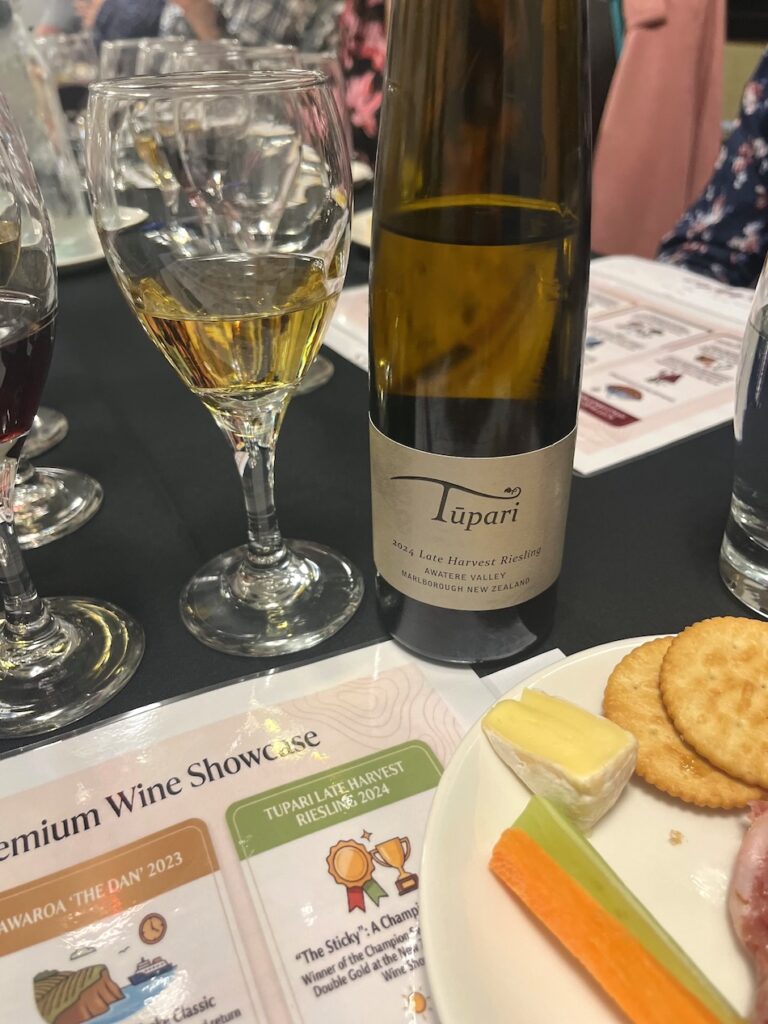
Aromas of ripe apricot, lime cordial, honey and candied lemon peel, with orange blossom floral notes and hints of spices – ginger and saffron. The palate is rich, luscious, and mouth-filling. There are concentrated flavours of pineapple, golden peach, orange marmalade and lemon curd. To balance those unctuous fruit layers is a bright, refreshing acidity and a touch of chalky minerality. The finish has excellent length, leaving a lingering impression of honeyed sweetness.
“I would have believed that something affected by ‘rot’ could taste so divine”, “I’d like to have this in bigger bottles!”, and “Like sunshine in a glass” were just a few of the happy words I heard spoken about this wine.
I advised all the guests to grab a couple of pieces of cheese to taste alongside this ‘sticky’ – and the results were very pleasing. A few people asked why you wouldn’t have something sweet with it, and I did say that food matching is a very tricky thing to explain. I’ll often add that any wine that you love will make you happy, and if that is chardonnay, why not have it with the steak you’re eating? But, in my experience, that piece of cheese will do more for your enjoyment than a slice of chocolate cake – this time.
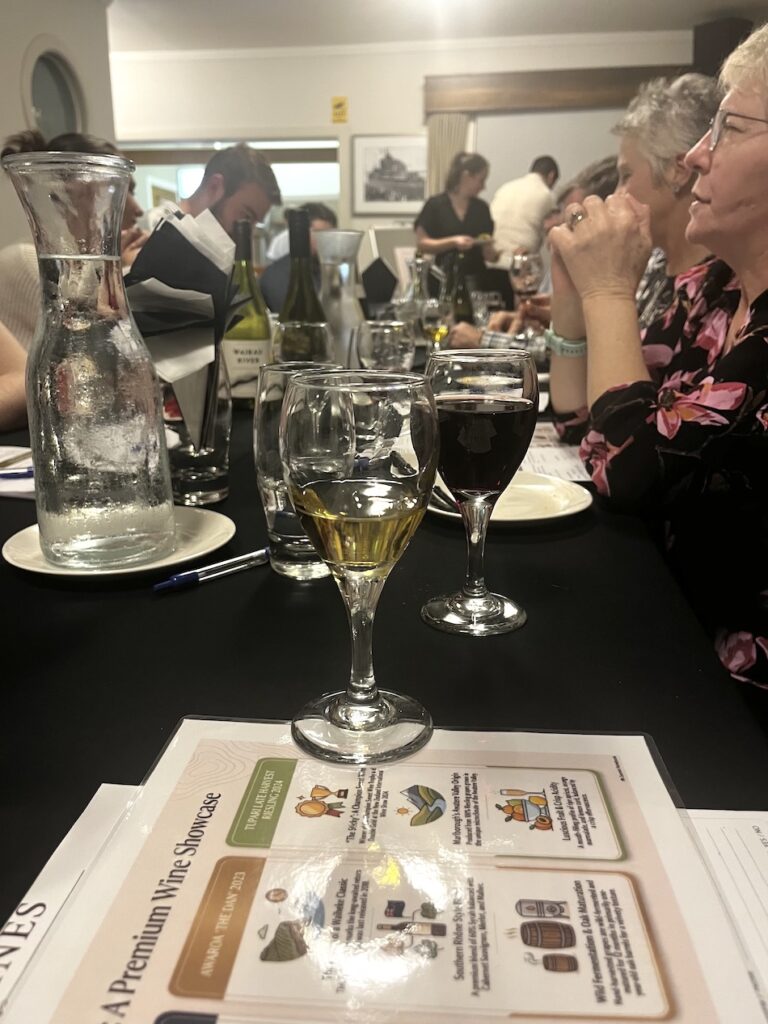
Thanks to everyone involved in this very enjoyable evening – especially the officers who organised it. I probably did a bit more chat than at a ‘regular’ Tasting table event – but, then, the people did do a bit more listening! The surroundings were impressive and the night ran very smoothly – as I might expect from having three hospitality staff on hand, running on military precision!