This is the sixth CRU event, celebrating the release of the new wines from Kumeu River. As well as the 2025 Chardonnays, there is also the 2022 vintage of Rays Road Pinot Noir. The wines get sent all around the world, and are released locally in September. This is the first time to be able to taste them.
There’s also a glass of the Kumeu River Crémant Rosé as you arrive. Mostly from the 2020 vintage, with around 20% reserve wine added. In the past the Rosé has been a mixture of Pinot Noir and Chardonnay, but this one is 100% Pinot Noir. It is made as a white wine, and the colour comes at the dosage, which is red wine. That addition gives a lovely salmon colour. There are lifted floral and bright red fruit flavours. There is brioche but also mushroom pie notes on the nose. It has been in bottle for a year and is drinking very well right now.
The 2025 vintage was generally dry during harvest. The previous two vintages had been quite small, so they were glad to return to a normal sized harvest. A match to the 2021 and 2022 vintages, but probably not quite up to the standards of 2019 and 2020. The temperatures have not hit the heights of what Kumeu saw around ten years ago. They haven’t broken the 30 degree temperature mark on a day since 2022.
The grapes are harvested by hand – a process that is becoming more and more expensive. You can harvest using a machine for just over $100 a tonne, but hand picking is generally in the $700 per tonne mark. But the family consider it an expense worth doing.
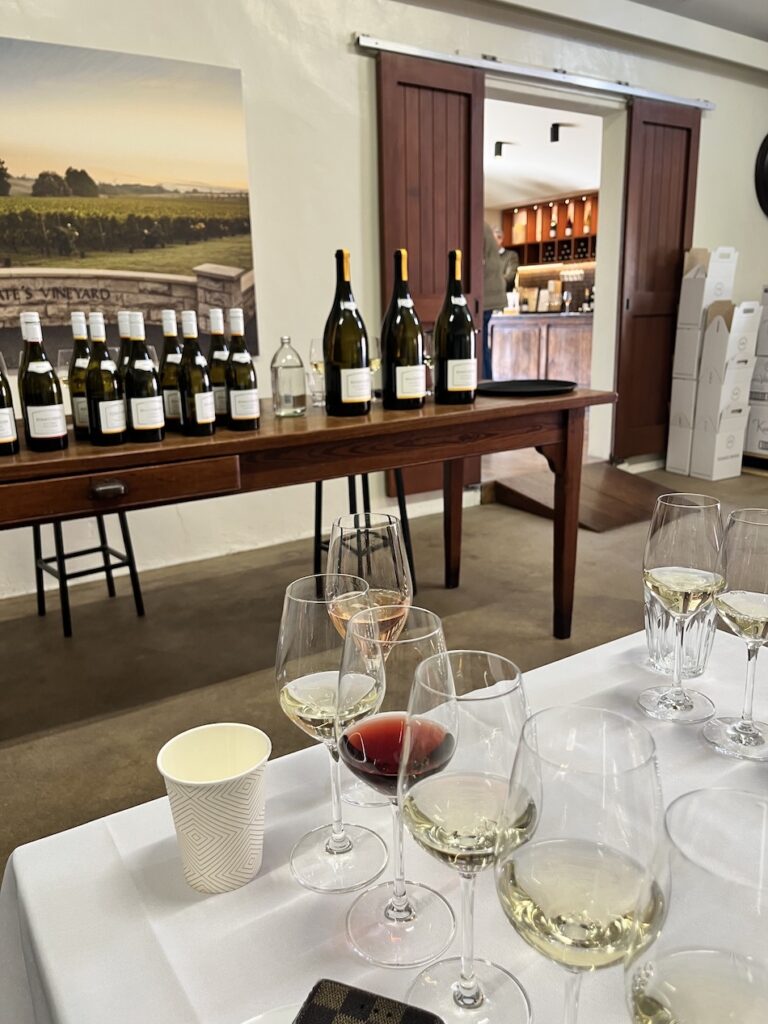
The first two wines to taste are the 2025 Rays Road Chardonnay and the 2022 Rays Road Pinot Noir. The first wine has been the rising star of the stable, coming on leaps and bounds since the first release in 2018 – which readers will know made only a small impression on me – but I have come to appreciate it significantly more since then. Indeed, tasting the 2019 vintage recently was a revelation – https://winefolio.co.nz/?p=14072 – I gave it 95/100.
I visited the Rays Road Vineyard at harvest time this year – https://winefolio.co.nz/?p=14408, and was very impressed. It is a relatively new vineyard for the Kumeu River label – purchased in 2017. It was founded and planted by Trinity Hill, and was around 20 hectares of Sauvignon Blanc, four hectares of Pinot Noir and just one hectare of Chardonnay. All of the Sauvignon Blanc has now been removed, and following a little bit of planting this year – more Chardonnay – the vineyard will be back to full production.
Now approximately 20 hectares of Chardonnay, still four hectares of Pinot Noir, but also 0.2 hectares of Nebbiolo. The first release of the Rays Road Chardonnay in 2018 came from that initial one hectare, but, interestingly, that block now goes into the Village wine – not the Rays Road Chardonnay. When they purchased the vineyard it was 100% irrigated, and one of the first things they did was turn the water off – forcing the vines to push roots deep into the limestone soils. Any new plantings still get some water, for them to get established. The limestone soil retains moisture very well.
The Pinot Noir was all the same clone at purchase, and, again, some re-planting took place, using newer clones – 828 and 943 – from Burgundy. It has been a steep learning curve in particular for growing the Pinot Noir, with the grapes, and the wine getting better each year. The limestone seems to have a distinctive influence, which can be seen in both wines. They are brightly aromatic, with a chalky minerality and an ozone perfume to both. Lots of zesty citrus, salty acidity, and a bigger sense of toasty oak than before in the Chardonnay now that it is all done in (mostly old) barrels. The Pinot has a vibrant spiciness, and red cherry, blueberry and damson plum flavours. An investment in an open top fermenter for the Pinot Noir will offer more scope to experiment with whole bunch techniques.
Michael and Milan had both recently visited Chablis, and see many factors from the Grand Cru vineyards there, in the Rays Road vineyard. Michael does add that “People consider Rays Road to be one vineyard, but it’s not really. It’s a blend of a number of different sites within that block. We see differences in the parcels, and it offers opportunities for individual expressions. We’ll taste one of these downstairs, and that one is also a single clone – Mendoza”.
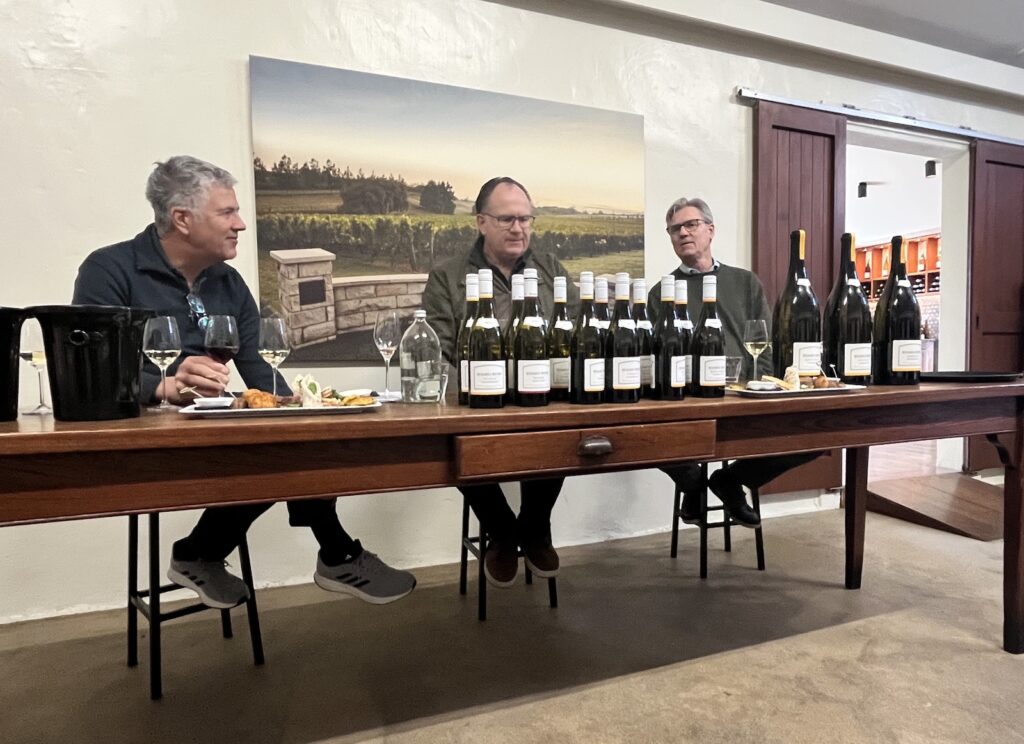
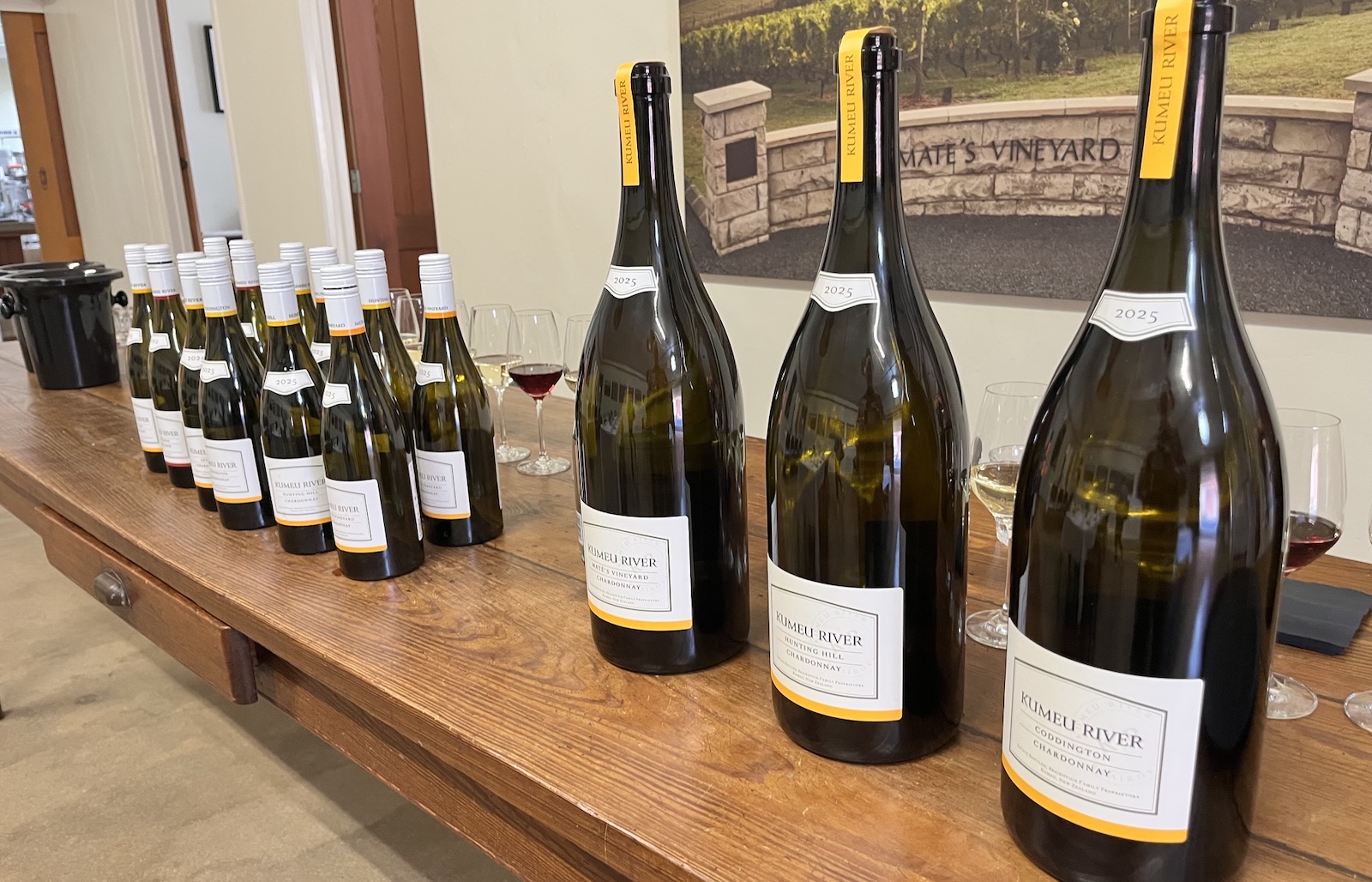
The next two wines are the 2025 Kumeu River Estate Chardonnay and 2025 Kumeu River Coddington Chardonnay – moving from Hawke’s Bay limestone to Kumeu clay soils. The Estate Chardonnay represents the benchmark – the “one good white wine” that their Father, Maté Brajkovich had wanted to produce. They’ve been making this the longest, and comes from a consistent source of vineyards. This wine is drinking beautifully on release – it usually does – and has an attractive peach profile both on the nose and in the palate. Layered and complex it will improve and be good drinking for the next “six to eight years” as Michael recommends.
Coddington is normally the richest of them all, and so it appears in this, it’s 20th year. Ripe, with volume, texture and lovely pear, nectarine and hazelnut notes. There is buoyant acidity here too – something I think I’ve seen improve in the last few years in this vineyard wine. Good news is that from thinking they would lose the vineyard when it was sold 15 years ago, they now have five-year leases on it, which provides some continuity.
Last years 2024 Kumeu River Coddington Chardonnay came out top at a very significant Tasting in London this year – a revisit of the original ‘Paris Judgement tasting’ from fifty years ago, which is a brilliant result for this wine, that is often seen as the poor cousin of the Kumeu single vineyard wines.
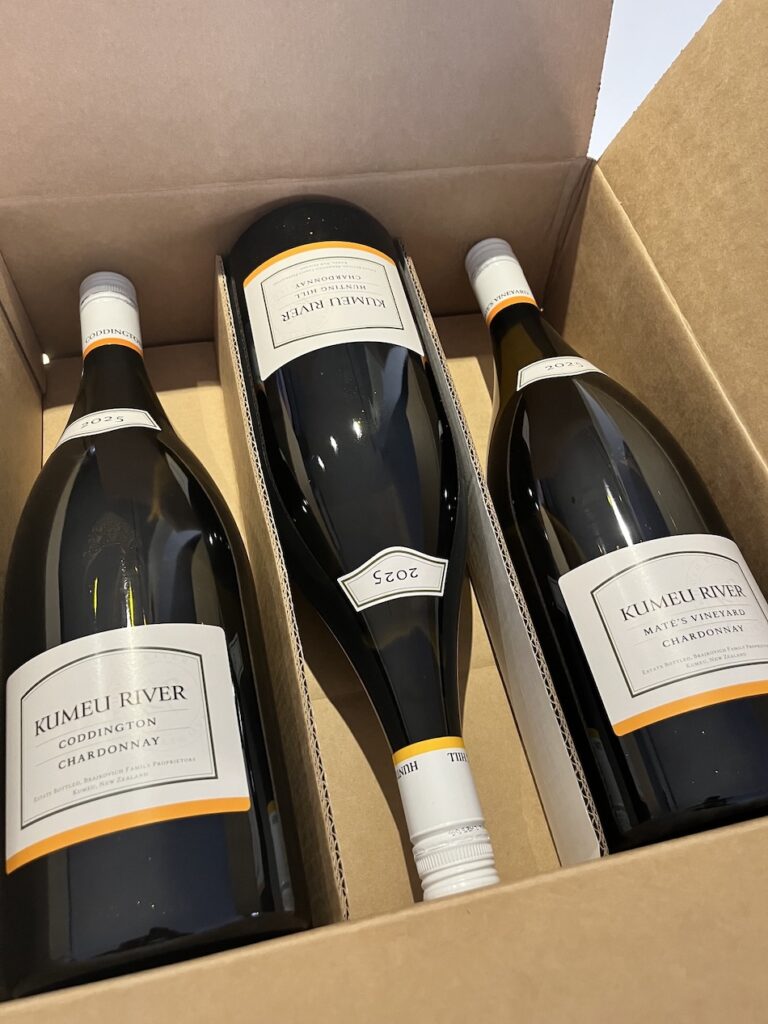
The two wines from the family’s own block across the road from the winery – 2025 Kumeu River Hunting Hill Chardonnay and 2025 Kumeu River Matés Vineyard Chardonnay can often seem hard to judge and a little ‘closed’ on release. The signature lemon blossom nose of the Hunting Hill is very enticing, but the palate is very tight, although it shows great length. Readers will know my descriptor for Matés on release is ‘the beautiful chaos’ – but today it seems quite a bit more approachable and seamless on first sip. In fact, this stands head and shoulders above the others – and more so than in recent years. I don’t recall, other than the 2020, one that was this good on release day. Generous concentration, power and opulence.
Winemaker, Michael talks us through an updated version of his “it has more stuff in it” description of Matés. As he explains: “The whole bunches go into the pneumatic press and get squeezed. But we tend to squeeze quite hard towards the end. Where a lot of winemakers are happy getting 650 litres per tonne of quality juice – we take it a bit further and get about 720 litres, because we really like what comes out of that at the end. Providing the equipment is good enough that you don’t over extract. And it’s those very fine tannins that you then get in the wine that are the building blocks for the future, making them richer and more textural as they get older. The contribution of tannin to Matés is significant.
It is that ‘stuff’ that gives the wine the ability to age. Red wine has more phenolics in it – the colour, the tannin – and that can react and improve with age. White wine has a lot less of it, but there are white wines that age beautifully because they have enough of the complexity to age. There’s lots of white wine that won’t age at all. Ours have shown over time that they have the ability to age. Winemaking is a series of little steps and every one of them is critical”.
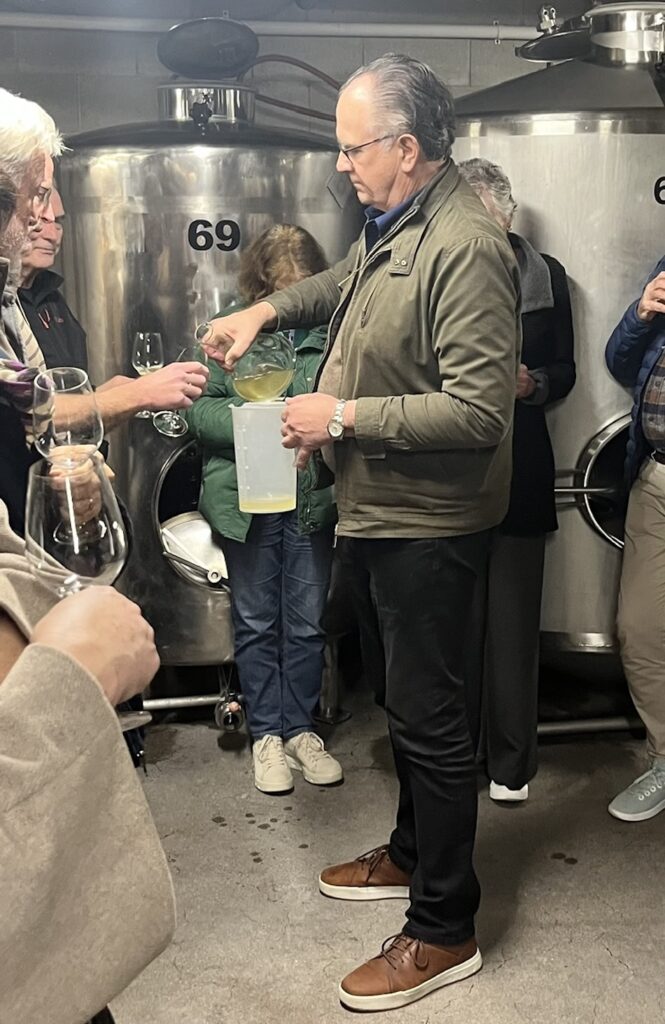
As is usual, we’re invited to head down to the cellars to taste some of the next vintages from barrel. There are 900 barrels of the ’26 vintage and they have just completed malolactic fermentation. Then they get sulphur dioxide added and the wines start to settle. Michael just takes a sample from a single barrel, and they aren’t filtered, so there is a touch of haze to what we’re trying.
Choosing barrels – and what percentage of new oak is used in each wine – is a long process – taking place over years. Michael would buy from up to ten different coopers at the start of his career. He explains “We narrowed it down over a number of years to four, but over 80% of our barrels come from François Frères. Gillet is in the same village – Saint Romain – and is a bit heavier handed with his toasting. For the Hunting Hill we buy barrels that are tight grain, or very tight grain, and then there is something called ‘hand selection’ where they go by hand and look for particularly tight grain, because the tighter the grain, the more elegant the expression.
We used to buy barrels according to forest. So they came from Allier, Vosges and Nevers. But as Jim Clenenden from Au Bon Climat in California used to say ‘You could always tell when a french cooper was lying, because his lips were moving’. A lot of coopers now sell on grain size rather than provenance, and you can actually see it. It’s a better indication of the kind of result you’re going to get. But the price just keeps going up – we now pay between 1100 and 1300 Euros each for these barrels, and this year we bought 130 new ones. It’s a very important part of our wine style.”
In difficult vintages, like 2018 and 2023, where the fruit was coming in quite light – it was felt that no new oak at all was justified. But with the small vintage, then the percentage of one or two-year old barrels jumps, and the feeling of oak isn’t really any less.
Our last taste is an exclusive look at the new wine – which is Mendoza clone Chardonnay from Rays Road. It is a glowing straw-green colour and is quite a bit lighter on the palate than I might have expected. But it is from quite young vines, so that is probably part of the precocious nature. The saline minerality is there – a sign of the limestone, but there’s also a richness here. It has a similar feel through the palate to the regular Rays Road wine, but has a youthful bounce and vibrancy to it – particularly in the bouquet.
There was no specific intention to keep this parcel separate, but because it stood out so much when tasted on its own – there is a new wine. Michael thinks it will fir into the range around the price of the Coddington Chardonnay. They also have another candidate amongst the blocks. Michael felt he should have a chat to Nigel and Blair from Felton Road about it, as that one is called ‘Block 5’, which caused some hilarity amongst those present today.