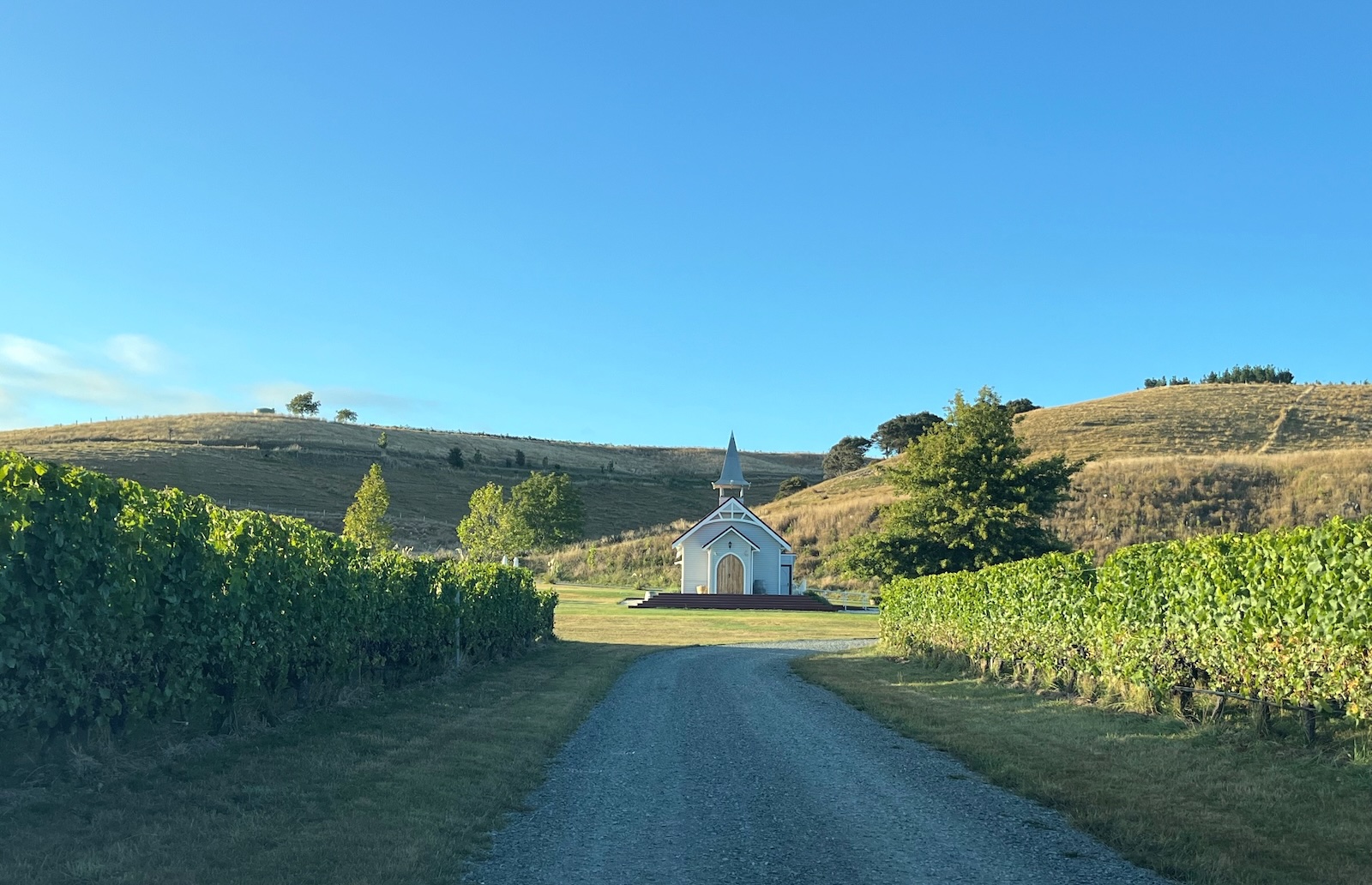
A stunning February morning sees me pulling into the parking next to the old church at the Clos Henri vineyards. I’m here to meet up with Lara Campbell, and talk about this place and the collection of wines they make. We’ll start off with a drive, and walk, around the landscape, and then we’re inside for a taste.
The church at the heart of their estate, Sainte Solange Chapel started life in the 1920’s as a Presbyterian country church in the village of Ward, in the south of Marlborough. In 2003 the chapel was relocated onto the vineyard to begin a new life as the tasting room for Clos Henri. This building – made of native Rimu – was deconsecrated and named ‘Sainte Solange’ in memory of owner Henri Bourgeois’s wife Solange Bourgeois. A wooden steeple was added to act as a tie to the Bourgeois family’s home village of Chavignol, in Sancerre, France.
Lara Campbell: We’re part of the Fine Wine Producers of New Zealand which is a collective group of wine people from all over new Zealand. People who are focussed on how we can elevate fine wine here. We had this dinner a couple of weeks ago and we were hosting Alder Yarrow – at Brian Bicknell’s – and the yarns were great. And he’s got books from the last forty years – and he’ll bring them out and there will be young pictures of Ivan (Sutherland) and Simon (Waghorn), and it’s just brilliant.
WineFolio: It is amazing when you do that. Even people who you see now and then, but then there will be a photo of someone like Jane Hunter receiving some massive award and she looks about 25!
LC: It is fun because these are people who are real legends in the Marlborough industry, still. But it would be cool – for the world – if we could collate their stories, along with a ‘brief history’ of Marlborough. It’s actually a small, tight-knit industry and we forget we’re not like the big boys in the world. Our production here is still smaller than Champagne. We share a lot of care and empathy for people in our industry and are always learning from them.
WF: But I do think that Marlborough is feeling the changes before some others. Having to move to something like Appellation Marlborough to protect the brand and name and standard. It is quite special here and to have it lose some of its shine, particularly overseas, would be bad. If the world falls out of love with Marlborough Sauvignon Blanc, then we’ve got a problem.
LC: Palates are shifting. People are drinking less – even from a health perspective, but I think that they are drinking better. Drinkers are now moving more comfortably into that more premium section. A lot of companies want to be there, but they haven’t been in that bracket before so they don’t know how to do it properly. And that’s the scary thing. If you’re going to go into that bracket, you have to have a product that meets that value.
WF: You have to have your story straight too. I think the ‘sub-regional identity’ story that Marlborough is now telling, goes some way towards that. And I do think that the difference is more pronounced in Pinot Noir than it is in Sauvignon Blanc. It’s there in both, but I think Pinot gives a better demonstration.
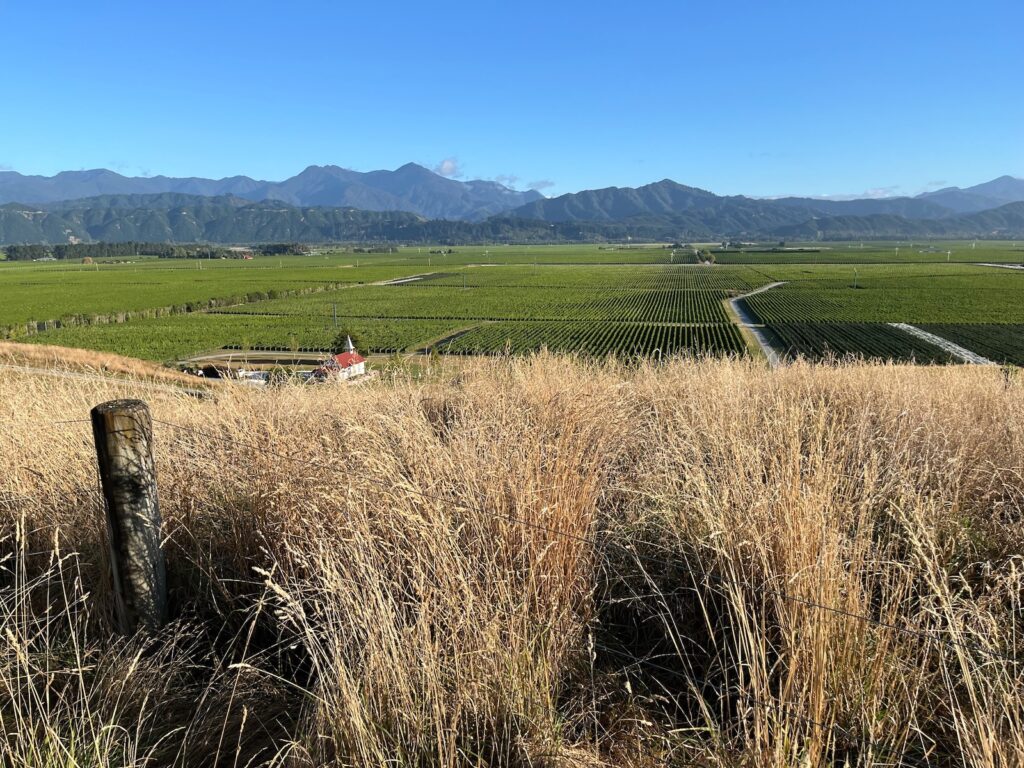
LC: Building on that regionality, I guess what’s really cool about Clos Henri is that we sit at the junction of two sub-regional appellations. The hill we are standing on is the beginning of the Southern Valleys. So all of that backwards over there is Southern Valleys – Waihopai and then the Omaka. Really beautiful wind-blown clays. This was formed during a glaciation period – 250,000 years ago called the Waimaunga Glaciation which is why we call it Waimaunga Pinot. Where our hill goes down and meets the valley floor, that’s where you start getting into the Wairau sub-region. We’ve kind of got the best of both worlds. That beautiful fruit bowl, punchy, aromatic intensity from the Wairau valley for our Sauvignon Blanc, then clay richness on the hill, with elevation and aspect that gives us lovely Pinot.
We really love this block – ‘Lone Tree’, which goes into our single vineyard Pinot. It’s really low-cropping – we’ll be lucky if we get four tonnes out of this block. Two different rootstocks, and we’ll ferment the two rootstocks separately, then blend them together afterwards.
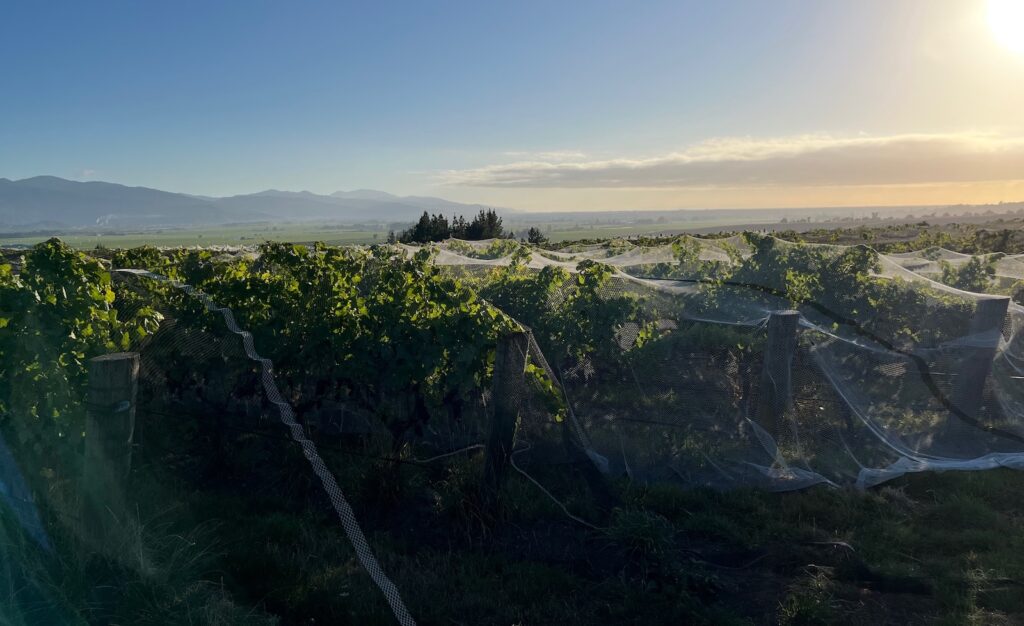
WF: I see some changes in contours here and there – so you’ll get slightly different ripeness and characters?
LC: We see more spicy characters coming from the top. I love it, because we always pick by actually tasting the grapes! In 2024 we had five days of rain and everyone picked before it came, but we looked at a remaining 10 hectares of Sauvignon Blanc and thought ‘we are not going to get this in’. Lionel, who was visiting from France said “It’s OK, the vines can handle it, let’s hold off”. We ended up waiting two weeks so that the rain had gone through and the vines dried off. Everyone else was having their harvest parties!
We had a harvester working at the front, and Kevin from Greywacke called and said “What the hell – are you guys still picking?!” Then later on he was talking to Damien and said “I’m so glad you guys waited, because it didn’t make me feel so bad about waiting either!” And now there’s this really beautiful richness to the fruit in the wines from ’24 now; which we attribute to the extended hang time.
This is actually the back end of our Estate – which is 110 hectares in total, with 47 planted in grapes. Those pines up there are still us, and they’ll be ready to be felled in about six years. When they are, we will replant with all natives – then we turn into a wildlife haven.
WF: Well, when you’ve got a lot of the same thing planted, it must be good to add some diversity back in when you can?
LC: Yes, and I think Marlborough is guilty of that – a lot of old windbreaks were pulled out, just to make it easier for sprayers to turn. Now, we’re coming up to ‘la Colline’ which is ‘The Hill’ and this vineyard has traditionally seen really good quality from here – a bit more of a fruity but elegant style compared to Lone Tree which is more savoury and spicy. They complement each other really well.
We also have a wide range of weeds that are growing in the vineyard! When our cultivator comes through it picks up the dirt and actually just flips it over. You’ll see all this dead grass that used to be on top, but rather than disturbing too much of the soil, you’re chopping that grass layer out and it stays as a whole clod. It creates this nice, breathable, organic layer on top. And when it rains it is a lot more receptive to that water rather than it running off. I believe that if you do focussed cultivation, you’re going to get good results.
WF: When was it all planted?
LC: First vineyards in 2001, down on the valley floor. Then 2004 up here on the hill. So about twenty years old and really coming into their own now. The valley down there is also all ours.
WF: Is that beehives down there?
LC: Yes. Obviously we love the bees. One thing that we noticed a few years ago when we got a bit of rain before harvest, was that the bees were coming along and clearing off any juice coming out of split berries. Did so well that we didn’t really see fruit flies coming in.
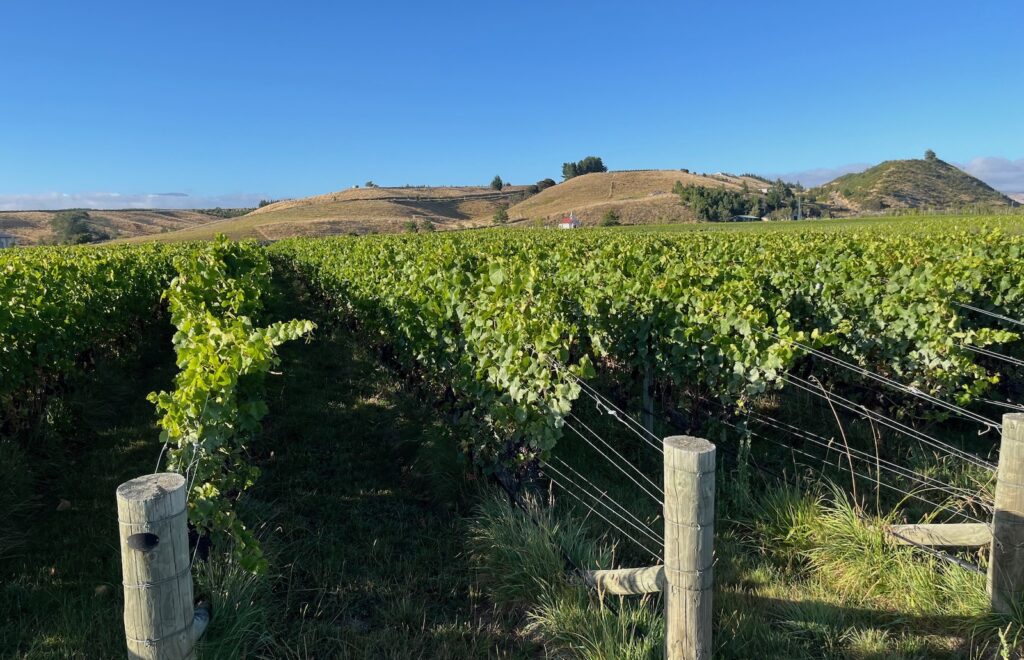
The Bourgeois family spent 12 years looking for what they wanted. They had a decent list of important things – and one of those was cool climate, one was Southern Hemisphere – but a big one was a range of soil types. Up here you can see the diversity across the Estate. There’s the terrace out the front, and also that road you would have driven up? That’s actually built on top of a fault line! It’s an offshoot of the Southern Alpine Faultline. It dissects our estate right through the centre, in fact, the faultline is what the road is built upon.
We wanted to highlight that because that’s given us quite distinct geology on the estate. Everything to the left hand side of that road is on the stony greywacke soils, and on the right is a clay-loam soil. Then up on the hill is Wither series clays. So, three different soil types.
The Wairau Valley was formed during the Otiran Glacial period, with the glacier retreating back towards the West Coast, carving a path through the mountains. The river that formed is against that range on the far side – the Richmond Ranges, where the stones are tumbled and smooth. But our stones up here are still angular, with rough edges. When those get worked up in the vineyards, they grind together and return a touch of that minerality to the soil.
The Sauvignon Blanc that was planted is mostly Massal Selection – but on different rootstocks. That’s where the differences show and we actually ferment those separately. With the Pinot we also focus on the clonal selection, and we have mostly the Dijon clones – 667, 777 – and a few American ones as well. But we also make the two cuvés to show the effect that soil has. We are really trying to express the place. It’s always nice to answer that question ‘is terroir a real contributor to style?’
WF: How long have you been here?
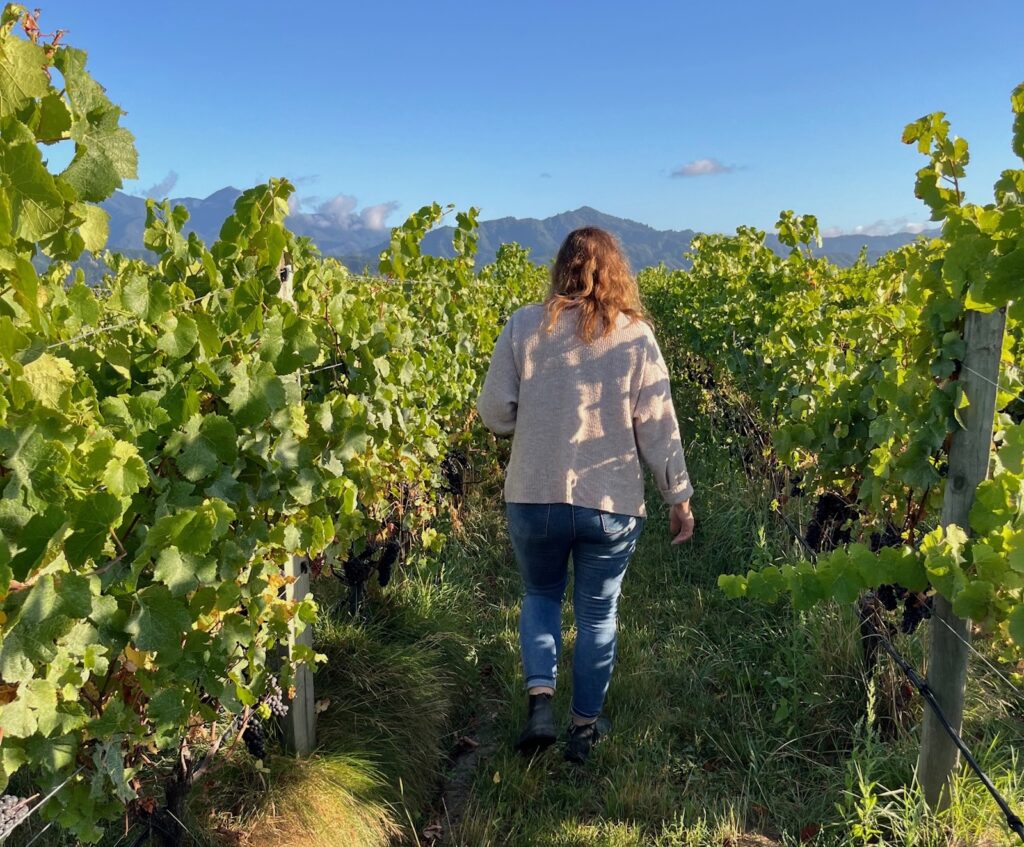
LC: I’ve been here for twelve years. I’m Assistant Winemaker but I also do Sales and Marketing. I started as a student, in the vineyard. After I did a year in the winery, and loved it – so stuck around. The Bourgeois family are still heavily invested in every decision that gets made, and they come over about three times a year, from Sancerre.
They are tenth generation vignerons. They really came to the fore in the 1930s. Henri Bourgeois – who we are named after, was the current General Manager’s grandfather. He really advocated for Sancerre to become an appellation – alongside Jolivet and Mellot, and expanded the business. In the 1960’s his sone Jean-Marie and his brother Remy took over the business, and it is currently Jean-Marie’s two sons and their cousin who manage it.
WF: What’s the best part of the wine year for you?
LC: Each part of the year has a different challenge to it. I definitely do enjoy harvest. You get everyone together and there’s this fun and enjoyable aspect to it. Yes, the hours are long, and you’re always sticky! hahaha. And you get to see the fruition of the last twelve months of work. But on the flipside I love pruning. In Marlborough you’ve got these frosty mornings and it is cold, cold, cold until smoko. Then the moment the sun burns off that, you’re in a t-shirt – pruning vines – and it’s just the best. I love that Marlborough can feel like Summer even in the middle of Winter.
The style of pruning we do is quite unique. We are double guyot, so two canes, focussed on the sap flow. So each vine then presents itself as a nice puzzle that you’ve got to solve. What am I going to leave – am I choosing the right one – and how is that cane going to be bent over? You’ve only got forty iterations of something. It’s not like beer brewing where you can start something new every week.
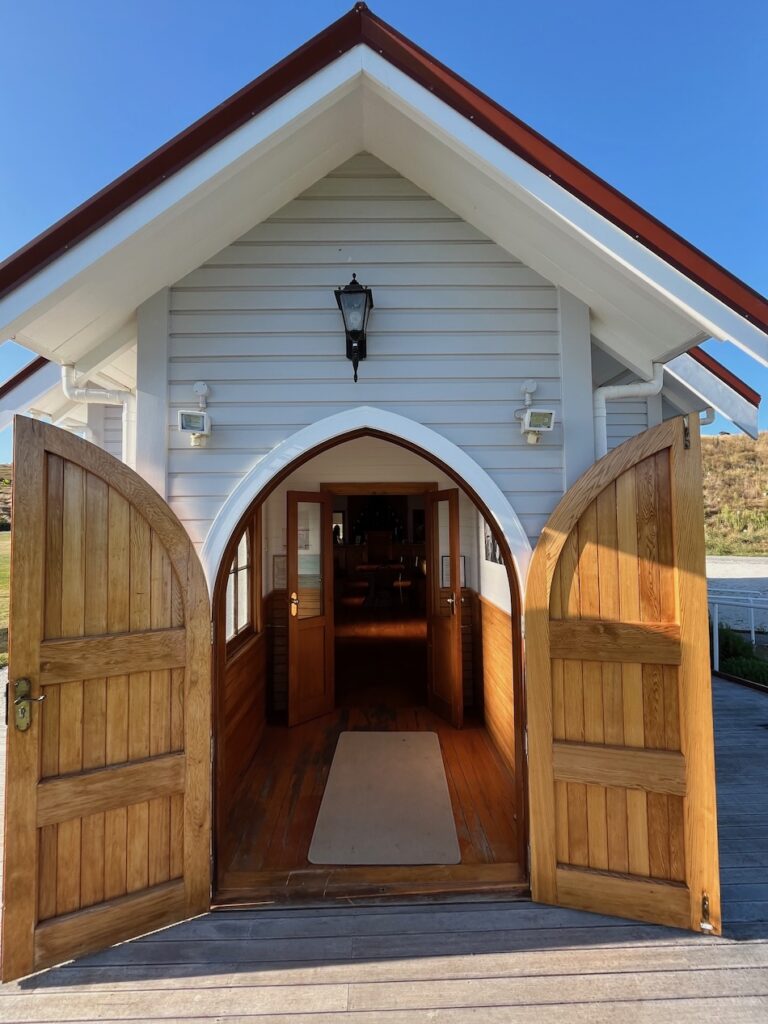
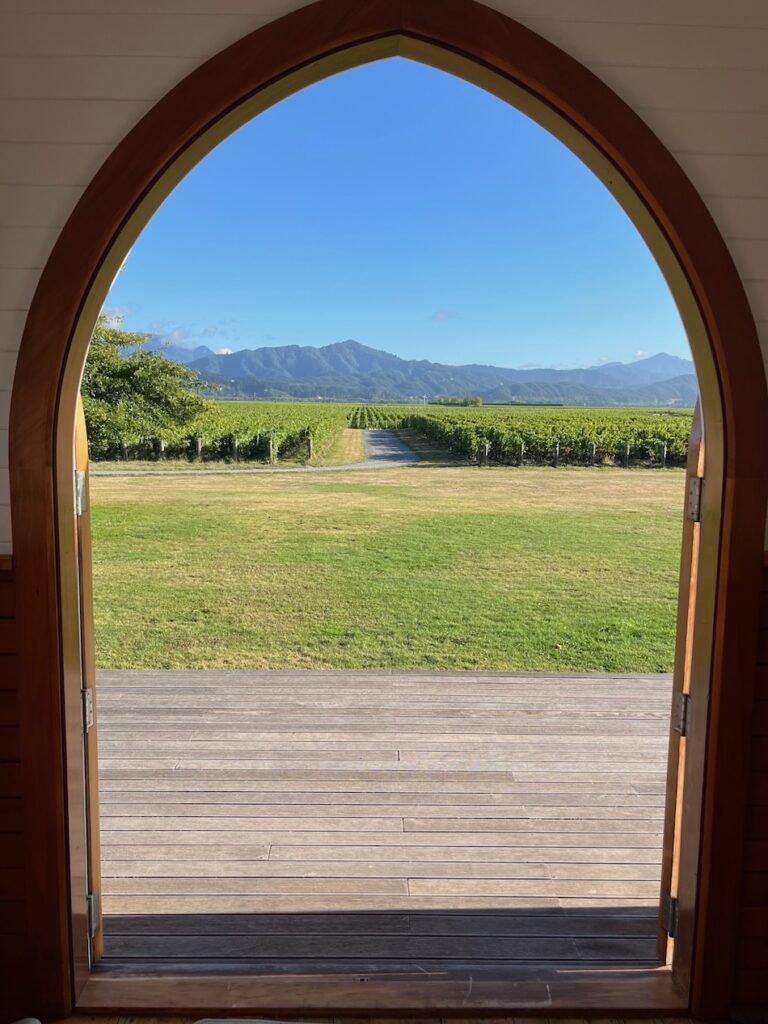
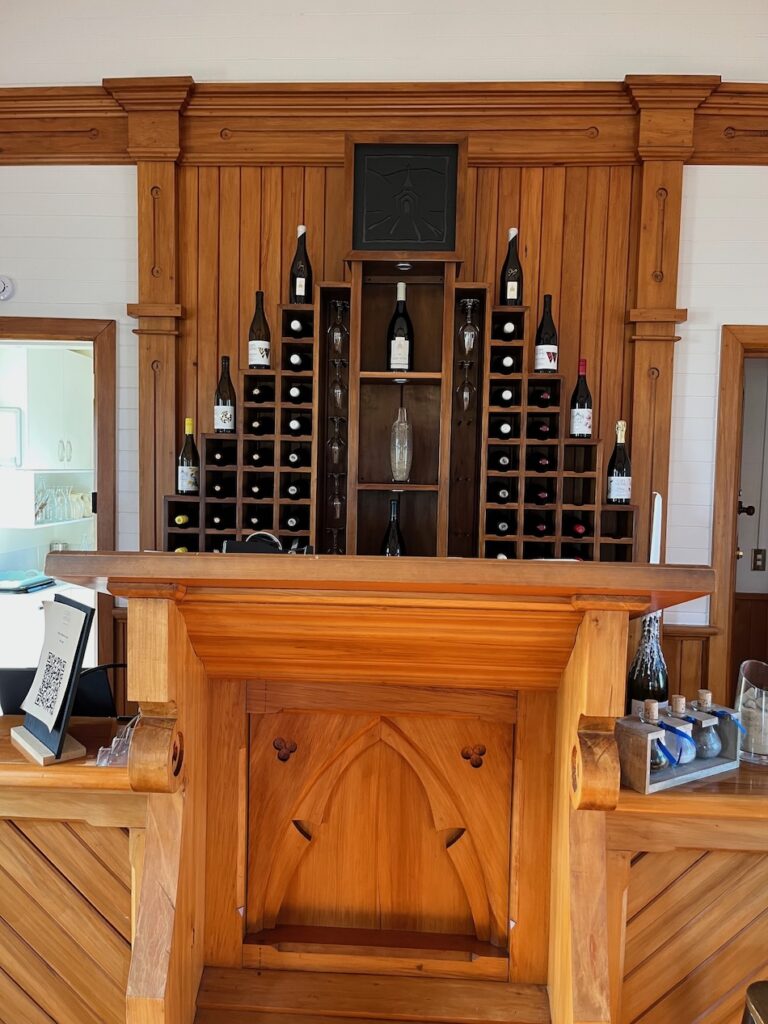
At this point we have arrived back at the old church, and I have a gasp of amazement as we go in!
WF: Wow, this is an incredible building to have as a Cellar Door!
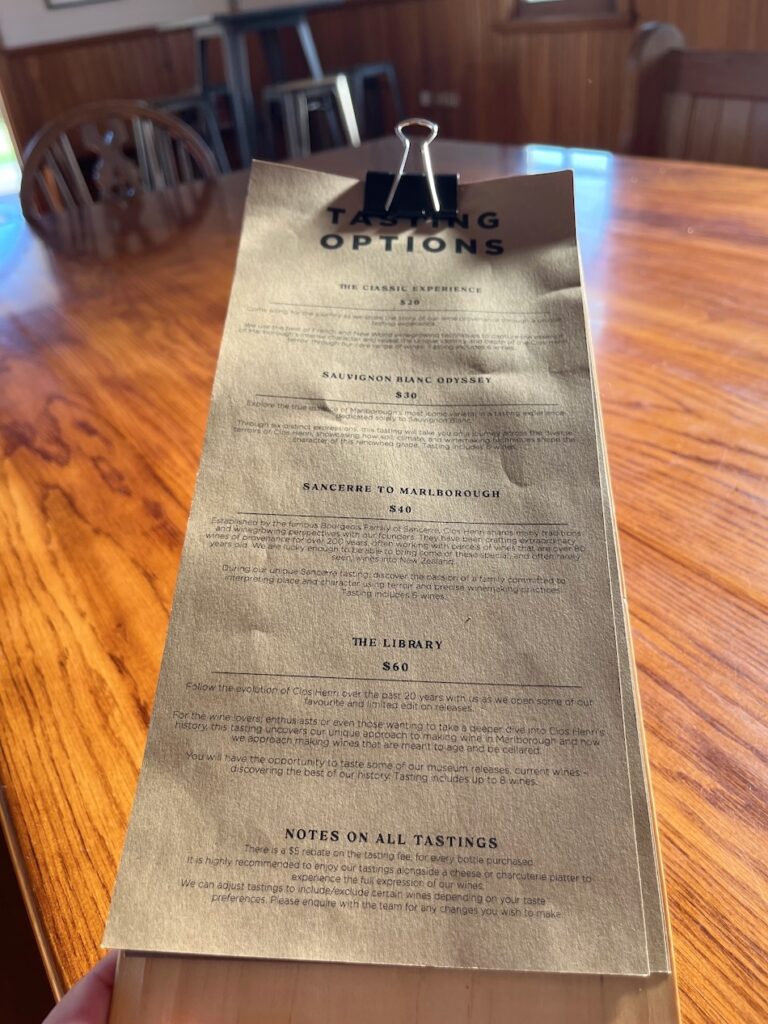
LC: In 2003 the Bourgeois realised that they needed somewhere to sell the wine from, and whilst they were deciding what to have as a Cellar Door – this building came up for sale. Our tastings are meant to be interesting for those who don’t know anything about wine, but then also have that added layer of complexity for seasoned wine drinkers.
In Chavignol, where the Bourgeois family are from, they have this cheese called Crottin de Chavignol, which is a small, hard cheese that becomes quite creamy and pairs massively well with Sauvignon Blanc. New Zealand needs to find more of those regional pairings.
You don’t go to the Rhône and eat seafood with your Côtes du Rhône. You have some beautiful beef! It’s like Brittany – they love wine and they love food, but they produce neither! Or Belgium – it’s countries where they produce the least that love food the most. In New Zealand everyone knows someone who has a boat, so we tend to be quite blasé about our fantastic seafood.
WF: Yes, when I ask people what they do on a rare day off – it is often the reply that they go out on a boat. What do you do on your time off?
LC: A good day off is hiking, for me. If I can get out into the mountains. Let’s start you off tasting with our Blanc de Noirs? 100% Pinot.
WF: Yes, that seems like Pinot I’d say. It’s lovely. A bit of white peach, red cherry and strawberry. Quite elegant and has that vinous quality that goes way beyond just juice.
LC: With the Bourgeois their passion is Sauvignon Blanc and then Pinot Noir. It’s their focus to do that well, before doing anything else – so this is a bit of a rebellion. We’re seeing that people just can’t afford good Champagne any more. But in France you also have Crémant de Bourgogne and Crémant de Loire.
And we felt the decision was almost taken for us, because in 2014 we had a bumper crop. So we thought ‘Well, we’ve got some extra, let’s make a small volume’ – and it worked out really well, and we sold out.
Now – this is our Estate Sauvignon Blanc. It is a blend of all the different soils, and for me it is like a handshake between France and New Zealand. It’s got a bit of that classic Marlborough nose, then all that minerality and purity that Sancerre has. If that wine was in France right now, it would seem so massively aromatic compared to the Sancerre. And that is fascinating to me because you’ll still get people who drink Sancerre and say that they prefer something a little more elegant or refined?
WF: I’ve had a few of the Fumé style wines since I’ve been in Marlborough this trip – and everyone is terribly proud of them. But I do wonder if it is quite a difficult wine to sell? It can be quite un-typical of Marlborough?
LC: The Fumé wines are an interesting one for me. There’s this desire to be seen as different. I think people are trying to make wines that are more of an exploration and experimentation?
WF: Is it a reaction to the idea of ‘bulk wine’ being made, and a desire to stand out as a more ‘artisan’ product – rather than a commodity?
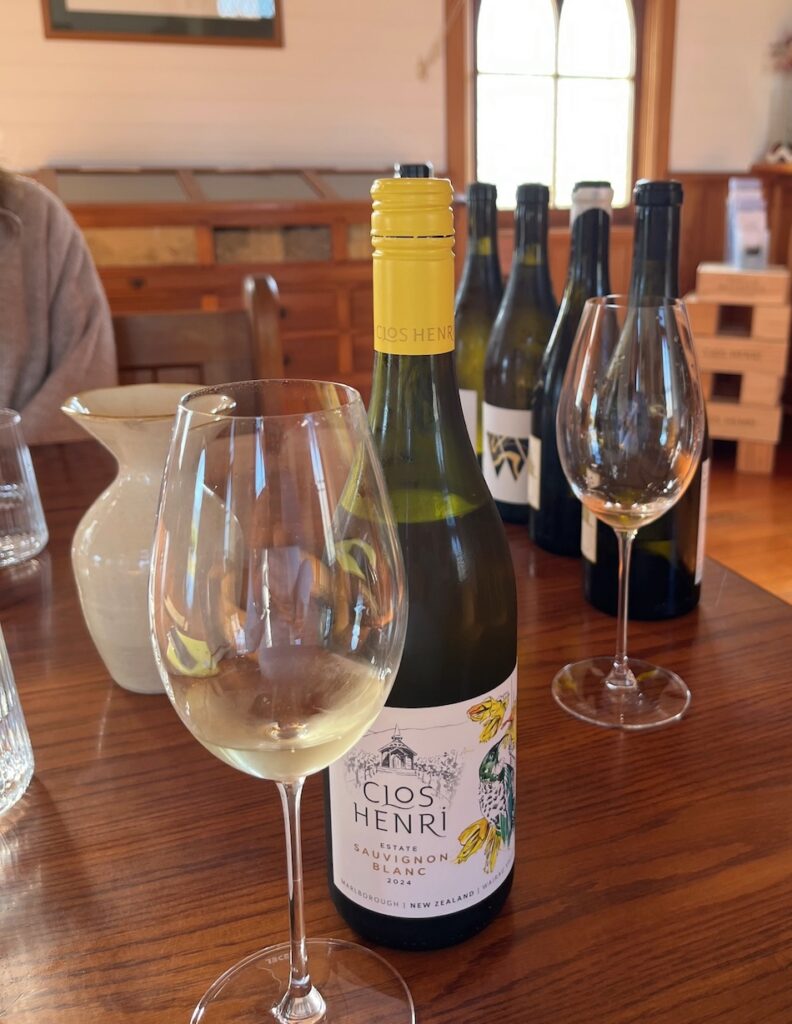
LC: I think it is a matter of creativity. At the end of the day, winemakers are still creative people who want to express their personality through the wines they are making. If you’re able to do that by making a slightly different cuvé that is an interpretation of a classic, then that’s really fun.
So how can we make a style that is interesting to drink and where people can discover the nuances of Sauvignon Blanc? And people are doing a great job. You’re no longer just tasting thirty references of an Awatere Sauvignon Blanc that’s made in a stainless steel tank, with a cultured yeast, you know? Now, you’ve got twenty of those, and ten examples where people are re-defining the normal.
Now – this is where things get interesting. These are the two distinct expressions of the soils. You’ve got stones on the left. 85% is fermented in stainless steel, and the remainder is fermented using a mixture of French and Austrian oak. You’ve got cinnamon and white spice coming in from the French oak; but with the Austrian oak, it is Stockinger, large format as well – and that gives a creamy richness. Stockinger is a big favourite in Sancerre.
I always say we’re like the kids who live at home – and you open the fridge and call out “Mum, can you buy more cheese?”. But here we’re like “We need more Stockinger”. The French barrels are all from forests close to the Loire. I like the nice identity that is to be gained from using similar oak. I think this is a good representation of where we are at in the vineyard.
WF: There is a bit more tropical in the Stones – pineapple and guava, but there’s more green – chamomile, tarragon, and meadow grasses – in the Clay. I imagine the Stones is quite tight at the start, but would open up nicely with bottle age? I like that these are ‘fine wines’ – sealed with cork – that you would see development in.
LC: In Pinot Noir – if you drink a wine too young – that to me, is one of the sins that people commit. I think Felton Road nailed it a while back when they said they weren’t releasing wine that was too young to be drunk. These two older Sauvignon Blancs I’ve got for you to try – are my favourite styles. In my first vintage in the winery – 2016 – it was one of those ‘goldilocks’ vintages where it wasn’t too hot or too cold. Everything just kind of came in at the right ripeness.
And one of my first jobs was to stir the barrels. We do a lot of lees contact with them and they’ll stay in barrel for up to a year. We tasted them and thought “heck these are too good to blend away” – so that’s when it started, with us realising that there was some stuff there of a different level.
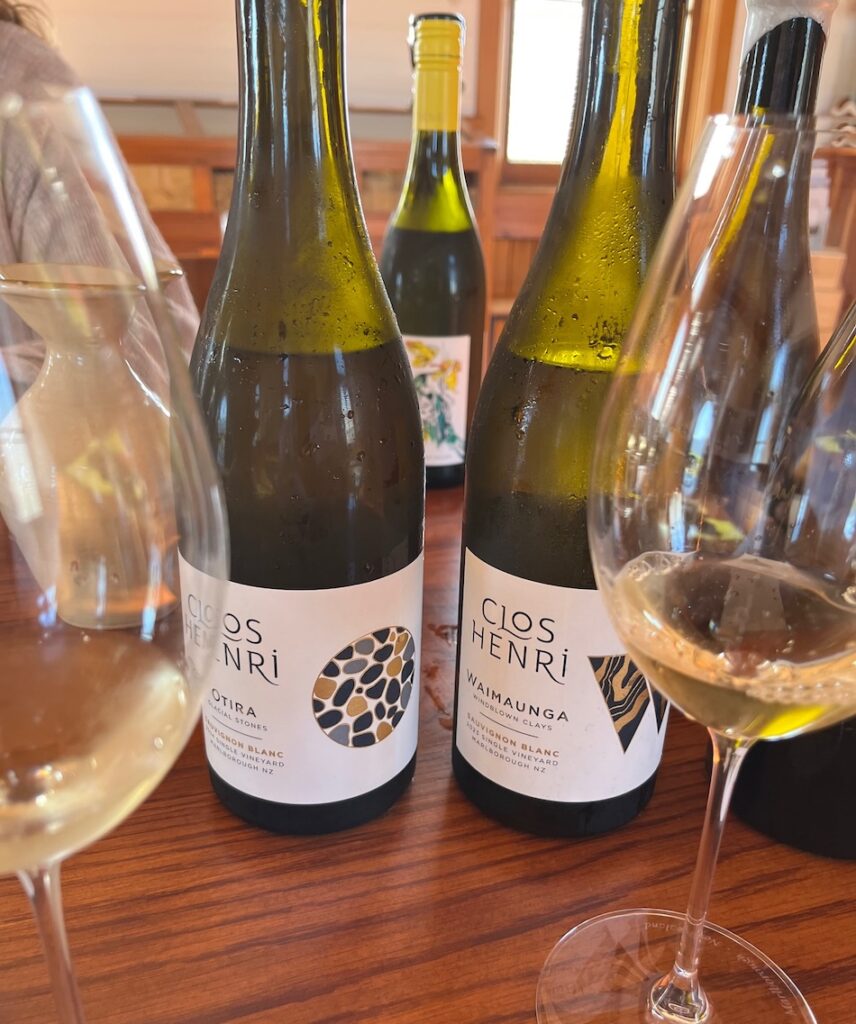
We pushed the boat a bit and left them in the stockinger barrel for two years, on their lees, with really low sulphur, as the lees have that anti-oxidant quality. But, you know, lees are a funny one. A lot of people don’t try their lees, but those that do – it’s nice to see New Zealand finding its identity as winegrowers, because we don’t have that generational knowledge. A lot of it is what we learnt off our own backs. You go to France, or Italy, or the States – to learn from winemakers. Here we’ve had the benefit of that input from the Bourgeois.
WF: So, will the first two I tried, end up like these two older ones?
LC: Not exactly, because those were a special case.
WF: The current release Sauvignons were fantastic wines – some of the best I’ve had on this trip. But one of those older ones might be the best wine I’ve had on this trip.
LC: (smiles) Would it be the Stones?
WF: It might be. It is sensational.
LC: (laughs) That’s my favourite. I saw you were having either ‘a moment’ or thinking how to politely say you didn’t like it. What I like about the Stones, is that it really takes you away from Sauvignon Blanc as a varietal and turns it into ‘this is a complete wine, in a polished, gift-wrapped box’. You start looking at it not as a wine of varietal, but a wine of place.