In October last year, a trio of wines – all Chardonnay – crossed my path that were something new and quite extraordinary. The article about those wines is here > https://winefolio.co.nz/?p=13681, and I concluded with the words “A stunning debut” and a 97/100 score for one of them. They prompted me to contact the winemaker – Chris Scott – and say that I’d love to catch up next time I was in Hawke’s Bay to see what else might be fermenting away for the project.
That day unfortunately coincided with the beginning of one of the earliest harvests in Hawke’s Bay history – prompting some last minute rearrangements… but, rather generously, not a postponement. There was also a rather unseasonal storm to contend with, which might have actually helped – me – as it put a temporary halt to picking in the vineyards.
As the duo are setting up for us, I ask Laura – ‘You must be used to this – with what Chris does with Church Road?’
Laura Scott: The difference is the admin side of it. You’d think with the number of bottles that we’re doing, that it wouldn’t be huge, but I think it doesn’t matter if you’re doing 10,000 or 3,000, it’s huge. But it’s good – I’m enjoying it and learning lots. It’s just the two of us, but we’re a team. And we’ve not jumped in too deep either. We’ve been conservative about how much capital we’ve put in. And we’ve always wanted to do it.
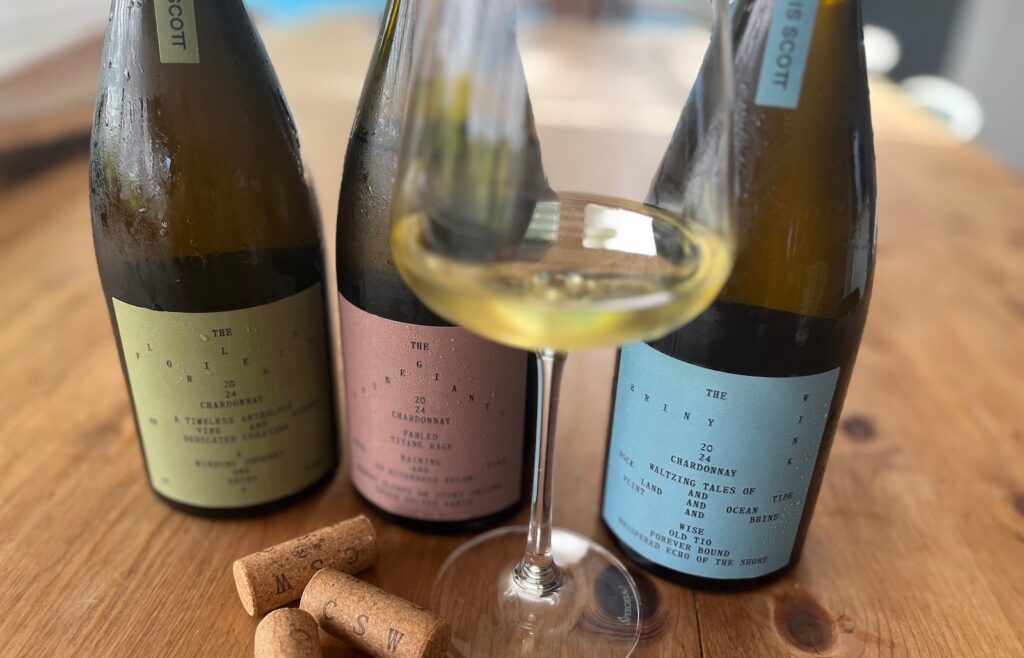
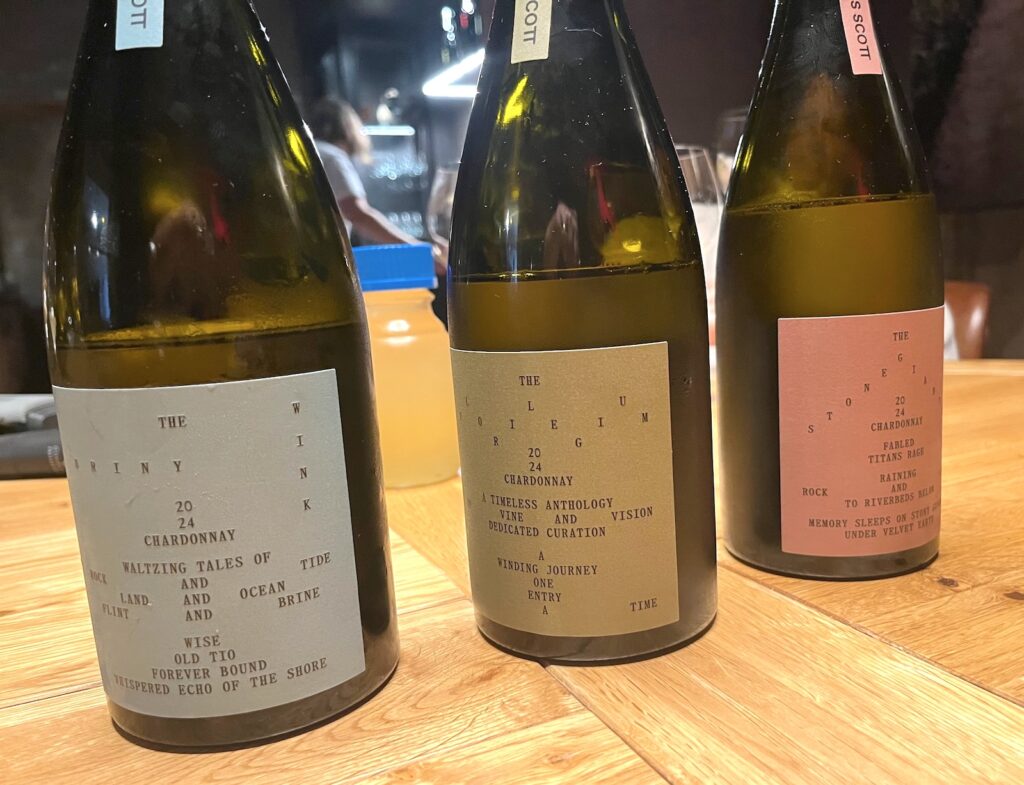
We didn’t think we’d launch coming out with three Chardonnays, but it is how it’s happened and we’re really happy. I did try and design the labels myself at home and quickly realised that my design skills aren’t up to it, so we used someone up in Auckland!
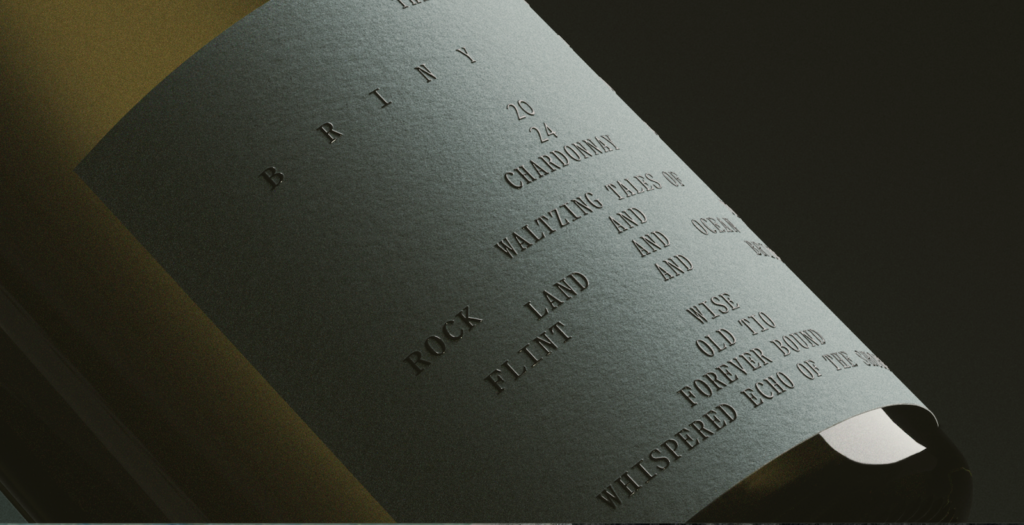
WineFolio: I have a design degree, and I can see that these have been designed – but in a way that looks un-designer-y. And I like that intention of it. They’re made to look naïve and Jura-esque.
LS: Seachange Studio took the inspiration from Concrete poetry – the old typewriter thing they used to do.
WF: Oh wow. Part of the designs that I did as my final assignments for my degree show were Concrete Poetry!
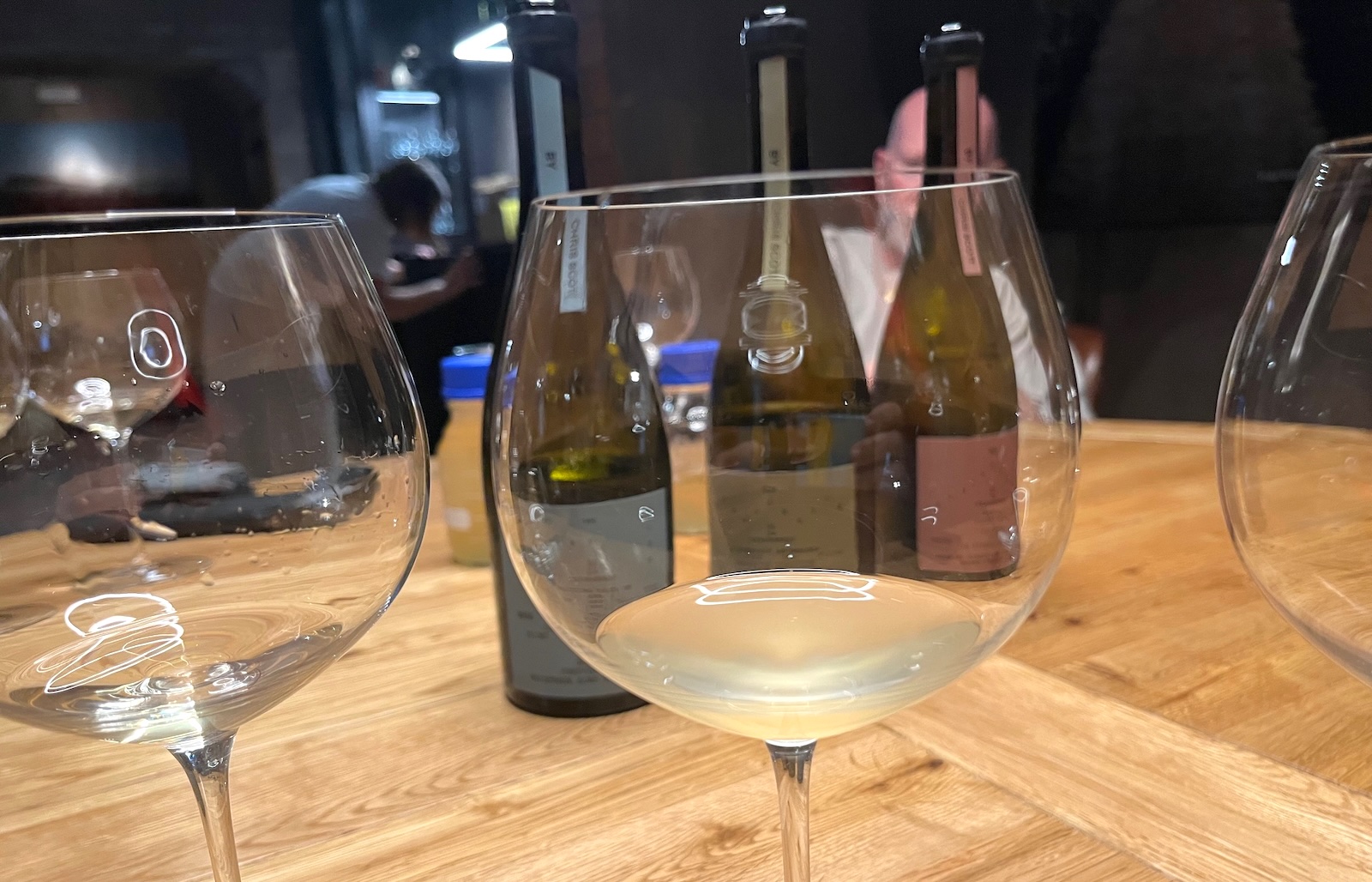
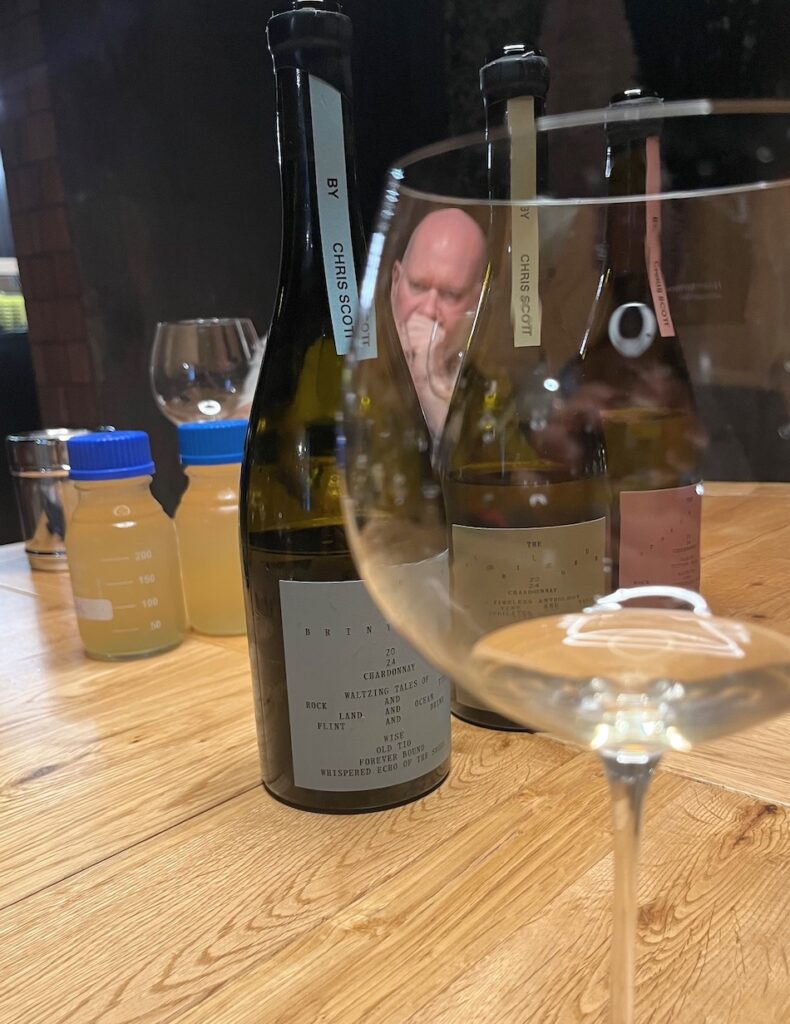
LS: There you go! We think it’s fab. Maybe not what we were expecting, but just love it. These bottles are the wines you’ve already tried. We have them under coravin to show people. The 2025’s have just gone into tank.
Chris Scott: Well, we’ve got a few wines to try! You’ve tried the ‘24s but we just blended the ‘25s last week and tucked up in tank. So that will be good to compare.
WF: Who is taking the wines now?
LS: By the Bottle and First Glass retail in Auckland. At Mr D’s in town here; and Ahi and Origine restaurants reached out to us and are very keen to get it on the list. We did all our energy getting it into bottle, and only now are we like ‘let’s get selling’.
WF: It’s like being a parent to it. You want people to discover it and for it to grow, but you also want it to stay small – and you’ll be sad when the last bottle goes. So do keep some!
LS: I’ve earmarked some for Library Stock. How exciting will it be to try it in five years alongside a new release? We have sold a few six packs! When we sold our first six pack to someone that we didn’t know – who wasn’t connected to us – that was a pretty exciting moment.
WF: I love all the details on the wines on the website. People are pulling all of that off sites these days. But when it’s serious wine, for ageing, it’s good to see all the information.
CS: It took us ages to do all that. I think some people find it too hard to maintain. Because we’re making such small volumes we didn’t filter them, we just let them settle – and then the bottling date was very much determined by how long it took for them to get bright enough. At bottling, all of the risk is at the start of run and end of run. Whenever you move a wine, that’s when you’re going to get oxygen, get dilution. When you’re dealing with small volumes like this if you do get some oxygen or dilution then over that small sample you can’t get away with much. So from my perspective the whole approach was ‘let’s just try and touch it as least as possible’.
It works. It’s just a different mindset to commercial winemaking. On bottling day it is just get it out the door – rush, rush, rush. With this, it’s ready when it’s ready and let nature do the work. No fining, and the wines are reasonably protein stable when they come out of barrel, because of the time they’ve been sitting on lees. Close enough that I’m not concerned.
WF: Where’s the furthest a bottle has been sent – that you know of?
CS: South Island! There were requests from Australia and Japan, but we’ve got to get set up with NZ Wine Collective – but at least they take care of all the crap for you.
LS: And you’d think with Chris having been in the business for so long it would be starightforward. But I say to him ‘where do you go to for this?’ and he’ll shrug and reply – ‘well, I go to Procurement!’ (laughs). Well now – I’m Procurement!
WF: Any issues with stuff like that? Getting barrels and bottles and so on?
LS: Yes – when do barrels arrive in the country. Getting bottles with a flat panel that doesn’t cause your labels to flute? Getting a box to fit our bottle! There’s been all sorts.
WF: It is a fairly nice bottle.
CS: It’s the same as we used to use on the TOM Syrah. And I think Craggy Range uses them on the screw cap version of their prestige range. They’re a nice bottle, but they’re bloody expensive.
LS: We had these, and an alternative one, mocked-up with the label. And this one just stood out as so elegant. So we’re like “Oh, we’re going to have to get the expensive bottle!” And the colour of the Stone Giants was contentious. We wanted them to be more orange, like the iron-rich soils over in Bridge Pa, and we never quite got there.
CS: The look on our designer’s faces when I said we might have to go with the cheaper bottle, and it looked like they were going to cry, so we didn’t press too hard on that colour. And we have had a lot of positive feedback on the colour of that label as well. I didn’t expect it to be called “The Pink One”! At tastings it’s always ‘the blue one, the green one…”
WF: How’s the sourcing of fruit going?
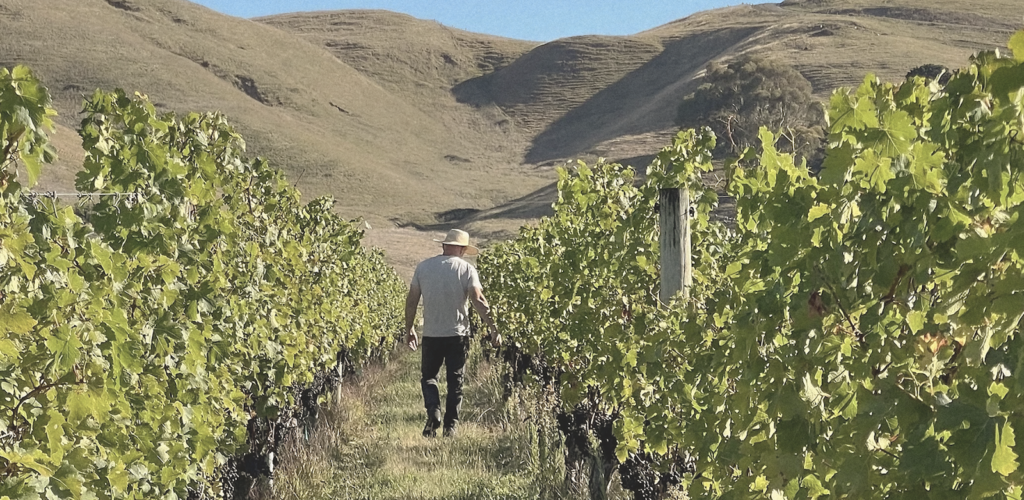
CS: We’re working with a couple of different growers. We’re still getting some Chardonnay fruit from Church Road, because I love that vineyard. So I asked and we got a bit of fruit from the top end of the block where the soils are a clay-loam topsoil. Loamy at the bottom and as you come up the clay just gets whiter, which is a result of the limestone further up the valley. That top end always produces wonderful Chardonnay. It is exposed, so ripens later and retains its acidity and freshness, and it always has an oyster shell minerality.
In comparing ’24 to ’25, it is similar harvest conditions – both years were very dry over vintage, but ’24 was a bit lower cropping due to Cyclone Gabriel. In 2025 the acids really held, and we had to push the sugar ripeness a little bit more. There’s a little more oomph in the ‘25s. The ‘24s more elegant and the ‘25s will be more full-bodied.
WF: Yes, I’ve heard that said already on this trip – at Cuvar and at Tony Bish, they’ve echoed that sentiment. You take your pick then – and it’s nice to have vintage variation. I tend to think that the ‘23s are looking better than everyone predicted.
CS: Yes, the Church Road Grand Reserve Chardonnay for example. We were going to start this project in 2023, and then the cyclone hit and we went ’naaaah’. We had an option on some fruit, but we paused everything and thought we’d revisit it.
LS: The ‘Briny Wink’ has definitely been the crowd pleaser since we launched, with lots of ‘non-Chardonnay drinkers’. We purposely used less oak in this, to preserve the purity of the vineyard.
WF: And, I don’t think that price will really be too much of a barrier. I’ve had occasions recently – in the last few months – when I’ve felt that really a good Chardonnay was called for. And, with a few exceptions, that, to me, means Burgundy. So I’m in the market to buy a few as replacements, let’s say. And then something like your wines comes into view as an alternative – once you’re in that market.
CS: I do think that New Zealand, possibly more than anywhere else in the world, is really competing with top Burgundy Chardonnays. People might complain about a New Zealand Chardonnay costing $80 to $100, but in Burgundy it would be twice that. You get more bang for your buck.
WF: Do you have a favourite child? I’m loving this Stone Giants today. It’s very clean and direct.
LS: I like the Florilegium. The Briny Wink is my favourite label though. The Stone Giants was the one where Chris said the numbers were so out of whack.
CS: It’s a clone called 1066, which is a bit like Mendoza, with little bunches, and it holds its acidity so the numbers on it are frightening. It looks more like Riesling. It’s got a TA – post malo – so had gone through malo – of about 8 grams per litre and a pH of 2.99. And I’m looking at it and thinking ‘Oh God, I’m going to have to de-acidify this’ but then we barrel aged it and the numbers moved slightly, but it is still a lot higher than what we would normally see in Chardonnay. It’s just got such amazing line, with that acid – and it doesn’t look hard. It’s got enough weight to carry that. So we just left it.
LS: Which is quite cool. To just say ‘this is what it is’, and we can handle it because it’s ours.
CS: And it has 23% new oak in it and it carries that very well too. I think that will age for fifteen years.
WF: I’m also going to be looking at a few vineyards on this trip – not just talking to winemakers. I’m stoked to be going to Rays Road for example. The land in Kumeu must be worth so much now, that you have to wonder what the future is for them. It’s like Grand Cru vineyards in Burgundy being worth $50 million Euros – your return on investment just can’t make sense!
CS: Welcome to wine growing. (laughs) We were working that out just the other day. The cost of land in Hawke’s Bay, then vineyard establishment costs, average crop rates, average dollars per tonne. So if you went out and established a vineyard, and assuming that you sold out every year and got something close to average, we worked out you’d make about 1.3% on your investment, if you’re lucky.
So part of we’re trying to do is change the model. We’ve just picked up a new Chardonnay grower, and instead of paying the average which is about $2200 a tonne, we’re paying $4000 a tonne and $400 bonus if it makes the top wine. And we know we’re paying well over the odds, but I want to! We want them to last. We want them to be there in twenty years. The only way you make money from a vineyard is if you integrate it and make your own product – so sell wine rather than grapes. Or the winemaker could share some of their profit with the grower. Because it is still cheaper for me to pay that than it is to go and establish my own vineyard and grow my own grapes.
There are some fantastic sites around Hawke’s Bay already planted. And if you can work with those growers to grow to a standard that you want, and you can reward them to a point where it’s financially sustainable for them and works for 20-30 years, then I would do it that way. We don’t need another vineyard – there’s already an oversupply situation.
WF: How much input do you have so that the grower gets the end product right?
CS: Essentially, you say ‘this is what we want and what we’d like you to do’ and then you go in a few times during the year, looking at the vineyard. Seeing that the work is being done and you’re happy with it. Then there’s an element of trust. There’s still a mass balance issue out there that we can see, where there’s too much vineyard and there will have to be a major correction somewhere along the line.
The interesting thing about the ’24 and ’25’s and I don’t necessarily think you see it in the glass, is the acidity. I talked about that one being around 8 grams – well this one is another gram higher. I haven’t looked to see if it is cold stable yet, but the pH on it was so low I couldn’t get it to go through full malo.
WF: Is Chardonnay the future for Hawke’s Bay? I do recall tasting through a couple of producers ranges and saying that I thought their most distinctive wine was the Syrah.
CS: The potential for Hawke’s Bay Chardonnay is very high, I think. People do love the region’s Syrah when they try it, but for whatever reason it is a tough sell.
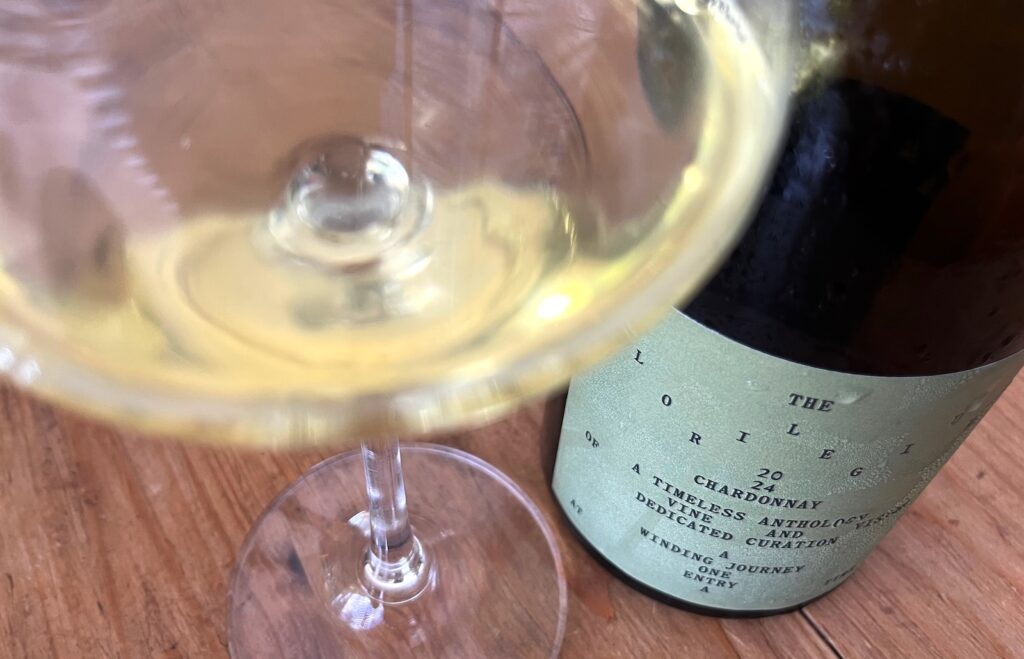
This is The Florilegium, and whilst the other two are single vineyard wines, the idea with this one was for it to be a barrel selection from the best of the components we’ve got. Make the best wine we could from any given season. One of the things we found during this process though was that by blending the two vineyards by any more than just a few percent of one into the other, it can quickly become muddy. A little bit can help and enhance, but you lose some clarity and purity if you go too far.
It’s an interesting process. The idea was to get away from that Burgundy model, with the vineyard as hero. To something more akin to Champagne and more about celebrating the art of the assemblage.
LS: We didn’t go into it knowing that. We sat with all of our samples and thought “How are we going to do this?” Then Chris was up all night blending this best possible wine that he could. I’d given up at 5 o’clock.
CS: But – the interesting thing about that is that whilst with the single vineyard wines there is a bit of a continuum from vintage to vintage and comparing the same site in different years. Here the wine was 95% off the Tukituki Valley vineyards and this year it is 92% off the Bridge Pa Triangle vineyard. So you’re not comparing apples with apples, but it’s still the best Chardonnay we think we can make in the season.
LS: And it’s how we ended up on the Florilegium name – meaning the Anthology, the Collective. This is our collection – the best that Chris can do.
WF: Is it a painful process? The blending and getting to the best?
CS: You end up tying yourself up in knots. I can see why people do it the other way around. Make your single vineyard and whatever is left – that’s your blend. With blending it is often the first, gut instinct, one that you tried. You have to go around in circles to come back to that point. Inevitably it’s got something to do with the sample bottle that’s got the least left in it. The ’24 Florilegium feels like it is a slightly more luxurious version of The Briny Wink. You can tell they came from the same place. One with brighter, plusher fruit and a little bit more new oak.
WF: And pricing? Because we’ve seen some interesting prices for new wines in recent years. So did you anguish over what to charge for them?
LS: It has cost us a lot of money to put this into bottle but we wanted to keep it under a hundred for the launch and I think we’ll keep it at that for a bit.
WF: I mean you don’t want to be in that congested $40-50 mark, but you also don’t people to point and laugh either.
LS: Part of the storytelling – and therefore the marketing – is that we want people to know that when they spend $80 or $100, to know that’s it is a quality wine. We know it’s expensive, and know it’s not money that people can part with easily. If you’re interested then you know it’s not the equivalent of Non vintage Champagne. This will be different every time you open a bottle.
CS: The 2026 are going to be different though. The acids on those are super low! We picked it at much lower brix because the acids were just dropping away so quickly. The flavour tasted great.
Right, let’s try some reds. This is the ’24 red blend. This one’s going to be called ‘The Folly’ and essentially the story behind that was my late Mum’s comment that if I ever had a winery I should call it ‘Scott’s Folly’. This was something she repeated to me about twenty times, probably. We thought it might be nice to have a little nod to that. And, plus it’s a non-traditional blend, so there’s a little bit of folly there as well.
We harvested a little bit of Syrah, a little bit of Cabernet and a little bit of Merlot, all off the same vineyard in Bridge Pa Triangle. Picked it thinking we would do a traditional Cabernet-dominant blend, and a Syrah. But when we came to blend it, we’d been kind of going through this thought process that was ‘Why do we always just follow the traditions of the Old World? Why don’t we just take a leaf out of the Super-Tuscans book and blend what grows best here?’
So we started with no pre-conceived idea of what the blend would be, and we included Syrah, Cabernet and Merlot in our decisions. We came up with our best Cab/Merlot blend and then our best ‘blend blend’. Laura had had enough and she just said “have you tried just blending it one third, one third, one third?” And I said no, so we tried that, and ended up coming down to two blends – the one that I’d sort of tied myself in knots over, and ‘the thirds’ – which we ended up going with.
WF: Well the Australians have been doing it successfully for a long time.
CS: We did split the Syrah out into a whole bunch ferment and a de-stemmed ferment, and one of the things that we found with the Cabernet and Merlot when doing the blend was that the de-stemmed Syrah worked really well. The whole bunch Syrah did not. They were just two different beasts and they did not play well together. So I’ve got one barrel of whole bunch Syrah, which we’re thinking we might just do a mailing release of it.
The blend is very plush and full-bodied, and the whole bunch Syrah is very much a Pinot version of Syrah. But so fragrant. It’s got that herb, spice and floral. It’s in a second fill barrel, so there’s no new oak about it.
LS: So now we’ve got to come up with another name, another label. I think we should do a sort of “Winemakers Special” so that it can be repurposed with whatever Chris has decided to do next.
CS: The fruit is from Bridge Pa Triangle. For Church Road we grow in the Gimblett Gravels and Bridge Pa. There’s lots of fruit available from Gimblett Gravels, and we could have gone down that track quite easily. But I still think that the best red wines we’ve made – although it is less consistent and in some vintages it is hard – are from Bridge Pa. When it’s good, it’s really good. We go back and look at historical, vertical tastings and the blends change between Gimblett Gravels and Bridge Pa – and it is the Bridge Pa wines that we love.
Generally it is still a matter of barrel selection. If you have three barrels from within your selection that you love, and you can pull those out and blend those. And because we fill directly to barrel, then every single barrel is a separate press cut. And you’ve got different ages of oak… so they do end up being very different.
Now – these are just some 2025 samples straight out of barrel. I haven’t blended them. Laura hasn’t even tasted these. Same vineyard, same blocks. 2025 Merlot on the left and 2025 Cabernet on the right.
WF: I don’t know how many years I’ve been saying this, but “Hawke’s Bay Merlot”! Must be into my second decade now of telling people this. Earthy, chocolatey, dark, rich and generous. And the Cabernet has that touch of green herbalness that is a character of the grape and people shouldn’t be afraid of. Before Parker and Rolland came along and made everything taste the same. And even when you pick the fruit and taste it in the vineyard – if there’s a touch of chocolate in the Cabernet then, you know it’s good fruit.
CS: The nose might lead you to assume you’re going to get something slightly astringent on the palate. But the palate has actually got quite a bit of plushness and solidity. And that chocolatey texture and aftertaste. 2025 was a strong vintage as well.
This will be a compare and contrast – now you’ve got the same block of Clone 470 Syrah, picked on the same day. One de-stemmed, one whole bunch. Obviously people have a different take on this. I’ve tended to find that the de-stemmed and the whole bunch personalities are so different that you want almost all of one, or of the other. And they just don’t co-exist very well.
For the whole bunch, we give it a stomp because we want to liberate some juice so that is in the bottom of the vat and starts fermenting – filling that up with CO2. The risk with whole bunch – particularly with Syrah where you’ve got quite loose, straggly bunches with lots of air gaps. And in those air gaps you can get bacteria start working, and VA – so you do always get a bit more VA on whole bunch. It’s sort of part of that aromatic lift. It is a fine line between aromatic lift and just obvious VA, and we’ve all got different thresholds. One person’s lift is another person’s fault.
WF: I’m sitting here hoping you don’t ask me which I prefer, because they’re both so different, and both so good!
CS: Yes, and that’s why they don’t blend. It’s actually better to just pick one. And it is better to not use new oak. You want the aromatics and it makes you want to pare it back. These are both so different but delicious. And that’s fruit picked on the same day, from the same block. You just look at it and go “that’s insane”.
Pinot Noir seems to work quite well to blend. And whether you de-stem or go whole bunch, it still looks like Pinot Noir.
Whereas if you de-stem Syrah it almost goes into a Bordeaux winemaking feel. Richer and rounder. this is what happened in the Rhône where you had the likes of Guigal where it was all about extraction, and long ageing and lots of new oak. And then you had someone like Jamet who were whole bunch. I’ve had really good examples of both, but you get a much wider separation with Syrah than you do with Pinot.
WF: You’ve got some choices ahead! To have these different expressions at your hands. What a good problem to have. Three Chardonnays is one thing, but then to look at this spectrum of reds. Those Syrahs are fabulous. And I’ve kept my Merlot in that glass.
CS: So that’s what we’ve been up to (laughs). And anecdotally, we’ve been getting feedback from on-premise trade that you’re getting more requests for right bank style reds. I’d love to get hold of some Cabernet Franc as well, because when that’s good, it’s very good.
LS: I have a feeling we’ll end up with a permanent whole bunch Syrah somehow. It’s Chris’ passion project, so it’s how he wants to go forward with it…