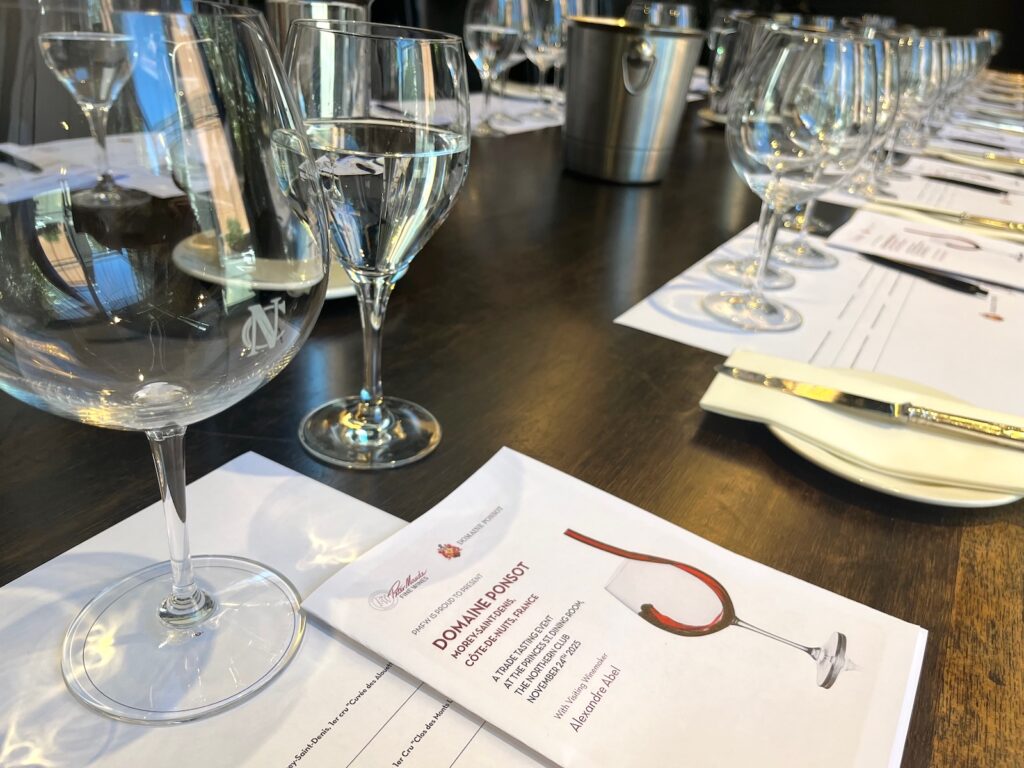
It has been 21 years since winemaker Alexandre Abel visited New Zealand, and it isn’t often that a label as renowned as Domaine Ponsot give a masterclass featuring the fabled Clos de la Roche Grand Cru wine to trade customers. Katharine Maude (from Peter Maude Fine Wines) was on hand to steer a select few through the afternoon session at The Northern Club, for a deep dive into the current releases.
Domaine Ponsot has a reputation stretching back generations, and is certainly one of the highlights of the appellation of Morey St-Denis, which itself suffers somewhat unfortunately from being in the shadow of its the neighbouring appellations of Chambolle-Musigny and Gevrey-Chambertin.
Established by William Ponsot in 1872, they have been family-run in all of their 125+ years. The only bump in the road was the (fairly recent) resignation of Laurent Ponsot in 2017, who left to start his own eponymous label, taking many of his crew with him. His sister Rose-Marie Ponsot continued to run the Estate, and hired Alexandre as Technical Director when her brother, Laurent, departed.
Much of the Clos de la Roche vineyard was replanted with massal selection in 1954, but, interestingly – and telling for showing the reputation and quality – it was cuttings from this vineyard which provided the source material for the original Dijon clones in the 1950s.
It is usual to assume that the majority of a label’s production is in the Villages bottlings, with smaller and more precious amounts of 1er Cru and then Grand Cru (if they have it) wine made in any year. At Domaine Ponsot, however, 50% of the wine made is Grand Cru, and only around 17% is Villages-level labels.
Records, which the Domaine hold going back to 1953, suggest that late-picking has always been a Ponsot preference. Laurent Ponsot has been known to remark that “he judged ripeness by counting 100 days from the ripening of the Turk’s cap lily, a plant found in the forest above the vineyards, rather than the vine itself” This usually gave him a late start compared to neighbours. Hand-picking, with stringent sorting from vineyard to winery, and then full de-stemming of fruit is a characteristic of the Domaine.
Oak has not been part of the signature of these wines – they use no new oak in their bottlings. There was also an evolution in the early 2000s when the habit of three punch-downs a day was reduced, and thermoregulation was introduced. A shift from cork to the very technical and distinctive ArdeaSeal closure in 2008 was further evidence of the push where excellence trumps tradition.
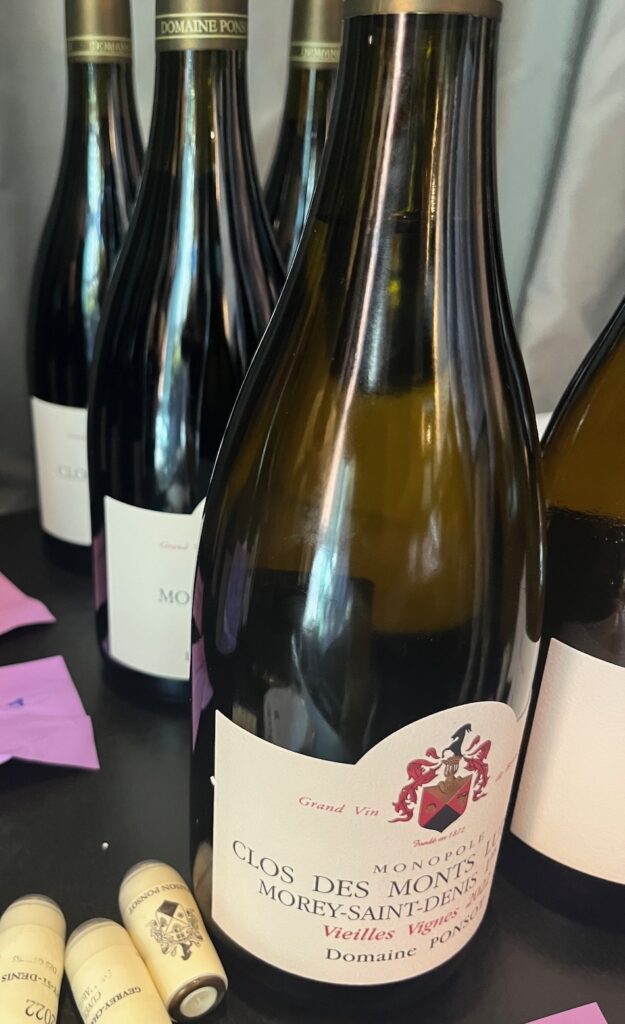
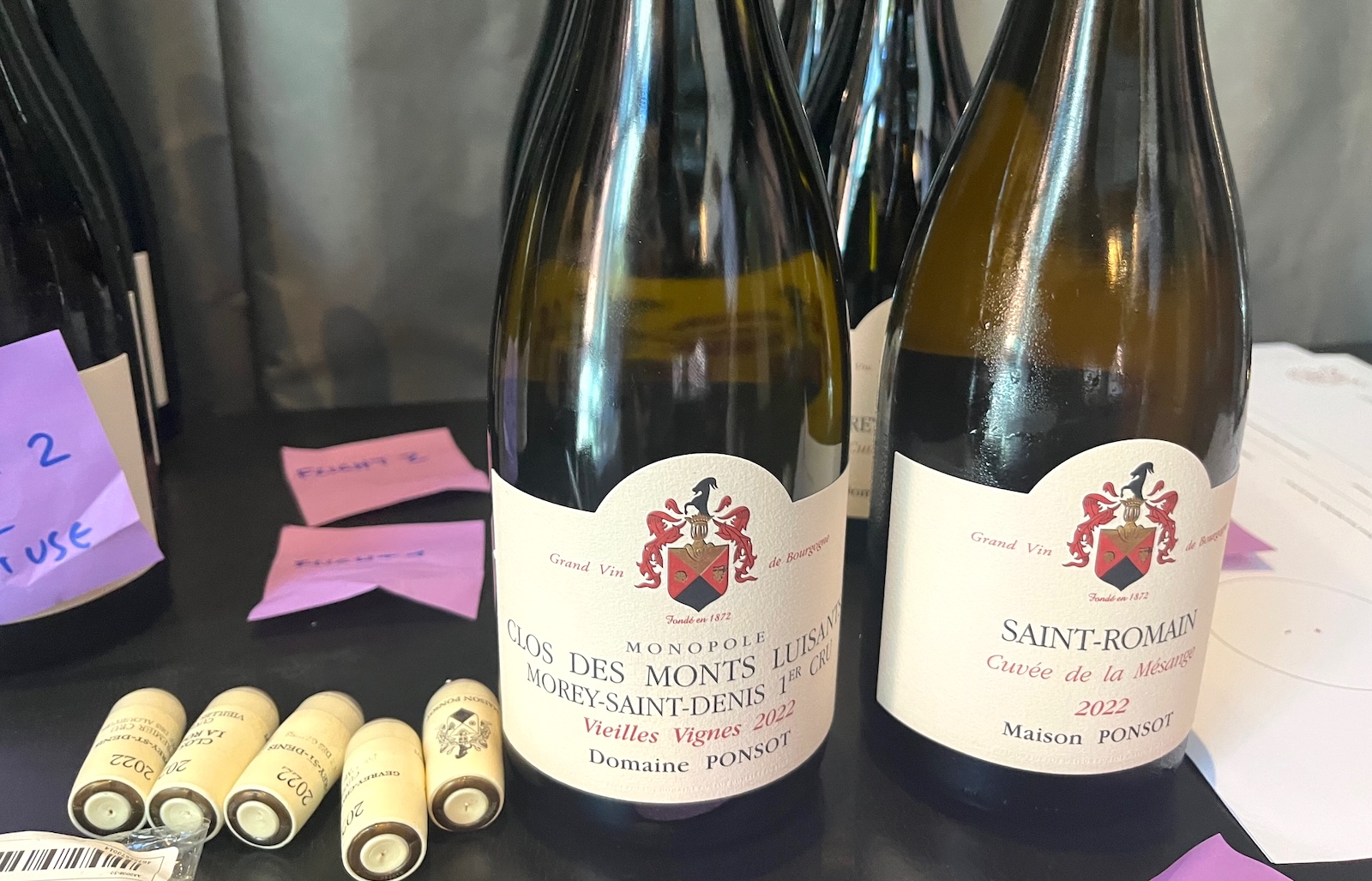
We start with a couple of whites – Maison Ponsot Saint Romain ‘Cuvée de la Mésange’ 2022 contains fruit from outside the Estate – around 15% of grapes are purchased. The bouquet is superb – very pretty, with fresh citrus and almond. Accessible and ready-to drink in the palate, with more orange fruit flavours, an oatmeal texture and a long, chalky finish. The Domaine Ponsot Morey-Saint-Denis 1er Cru ‘Clos des Monts Luisants’ Monopole 2002 is confounding. First, to taste, this is clearly a step up, and I also get a larger sense of oak – although there is no new oak used. Orange-fleshed fruits – apricot, quince and satsuma. Acidity is sharp and keen, and there’s a minerality highlighted by an absence of malolactic ferment. The confounding bit? It is 100% Aligote! Alexandre cleverly only tells the room the cépage after we’ve tasted. I’ve not had one of this quality before – and it is the only 1er Cru in Burgundy that is Aligote.
The tasting is three flights – whites, then Villages level reds, then the icon wines. Domaine Ponsot Gevrey-Chambertin ‘Cuvée Les Abeilles’ 2022 has a lovely dark-fruited perfume. Quite an intense purple colour, with cherry and plum in a broad, open palate. Crisp acidity suits this youthful, lively expression. With 5-10 years ageing capability, this is one to enjoy now and no need to cellar extensively. Domaine Ponsot Morey-Saint-Denis ‘Cuvée des Grives’ 2022 shows more savoury notes both on the nose and to taste. A complex palate has lots of toasty spice, and rich red fruits. This would benefit from up to ten years in the cellar, but shows very well today.
Domaine Ponsot Morey-Saint-Denis 1er Cru ‘Cuvée des Alouettes’ 2022 comes from the same area as the previous wine – the only difference is the position of these vines on the slope. Excellent depth and concentration, with a structure that suggests it will last at least 20 years in your cellar. A grip of tannin, striking acidity and savoury umami flavours. A herbal note – woody herbs – that I hadn’t seen in the other wines. Powerful and intense, with a well-balanced and lengthy finish.
The last wine is their iconic Domaine Ponsot Clos de la Roche Grand Cru ‘Cuvée Vielles Vignes’ 2022. There’s an exotic note to the perfume, with lilac, violet and orchid florals, then elderberry, cranberry and a hint of peaty earth. Dry to taste, but rich and rounded, with a voluptuous texture. Bright acidity gives great flow through the elegant but powerful palate. A peppery note to the finish. Obviously well-suited to cellaring, this is tasting fine, if quite serious and tight, today. Patience would be required to enjoy it at its best.
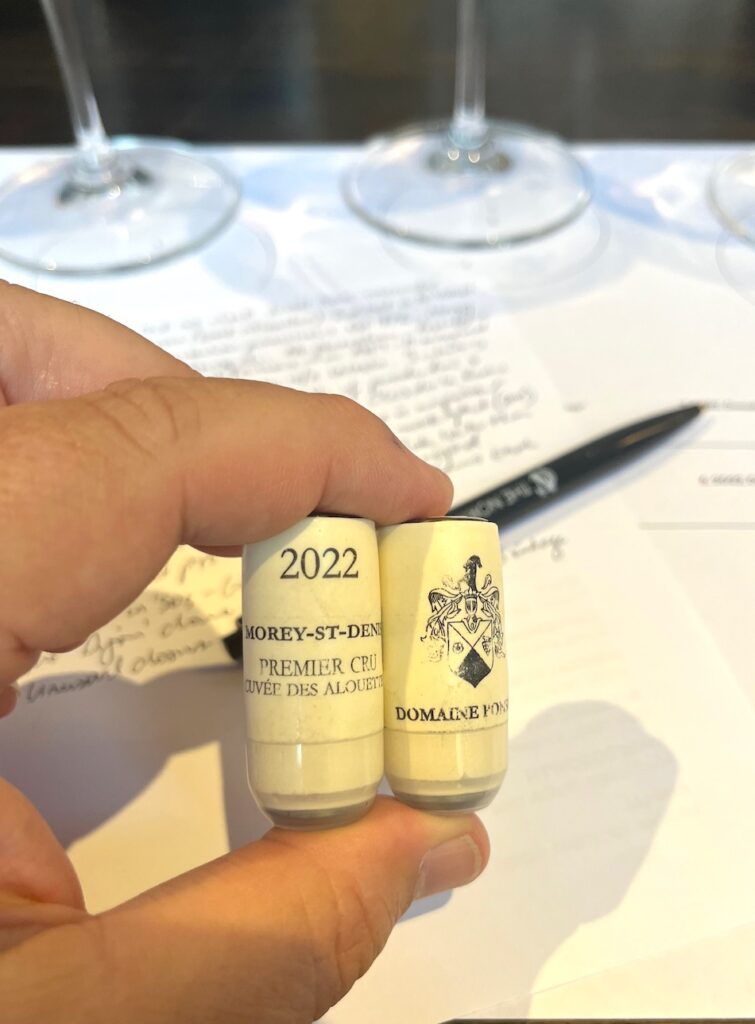
After the tasting, I get to look at those ArdeaSeal closures, as I’d not held one before. Alexandre explains that it is a multi-component wine closure designed as a reliable alternative to traditional corks. They moved to it to eliminate issues like cork taint and chemical interactions while providing consistent oxygen permeability for wine ageing. The stopper is still used with a traditional corkscrew and Domaine Ponsot have theirs in a particular colour with the wine name and their logo on them.
Here is a link to the Domaine Ponsot wines for sale > https://www.pmfw.co.nz/collections/domaine-ponsot