I’m talking to Mike Kush from Central Otago’s Shaky Bridge today, to hear about this label from the Alexandra sub-region, and their fiftieth year of producing wine. Mike tells me about some of the original vines on the property.
Mike Kush: As you can imagine, some of those original vines were a range of varietals that they decided to give a go. It wasn’t until the 1980s that the first Pinot Noir was planted. And it has not just been one vineyard, but we have farmed many vineyards throughout our history – but all in Alexandra. Our vineyards now are principally Pinot Noir, with a little Pinot Gris.
WineFolio: Yes, I came across your Pinot Gris at a Judge’s dinner of the NZIWS, and I see you got a Double Gold. I was actually reading through my notes, which I get to keep. Obviously at the time, I don’t know what the wine is, but I can cross-check with the codes once all the results are finalised. For this one wine “Yum, bright, commercial and fruit-led, with a spicy finish” was in my notes. I also just went to the Showcase evening where every Gold Medal winning wine is open for tasting, and I can confirm that I still like it!
Mike Kush: It is the case that although Central Otago champions Pinot Noir, I firmly believe that in Alexandra we’ve got a capacity to make a world class Pinot Gris. When you talk to Paul Pujol over at Prophet’s Rock, then the comparison that the region potentially has with Alsace… the Vosges mountains… and it can be this kind of Continental climate. We’ve got this capacity to get Pinot Gris ripe and that takes it out of the neutral spectrum. Not like Pinot Grigio, but we’re looking for a more expressive style with more aromatics.
But Alexandra in particular – it is those cold nights. Pinot Gris – as it ripens it loses that acidity, but we have the cold nights that help retain it. It was a pretty good growing season, and Pinot Gris comes in last from that particular vineyard, and you leave it out there hoping to gain some additional ripeness. I was inspired by Alsace Grand Cru – to get expressive and build texture, then have concentration of flavour on the palate.

But then there’s also risk. Whether rain or botrytis, that could have those grapes deteriorate. But that wasn’t the case. We pushed it and I knew I had something that was Grand Cru level by the time it got into the winery. And we do a couple of things. A little bit of skin contact overnight on a portion of it, to build some texture in. The majority is fermented in stainless steel to preserve those aromatics, but I do also ferment a portion of that in puncheon. Again, just to enhance that textural quality and complexity.
A couple of grams of residual sugar – just like in an Alsace Grand Cru. It’s ripe and if you were to ferment all of that out, maybe the wine would be a little bit too alcoholic? But it will balance with the concentration and acidity, and certainly aid in the ageability of the wine.
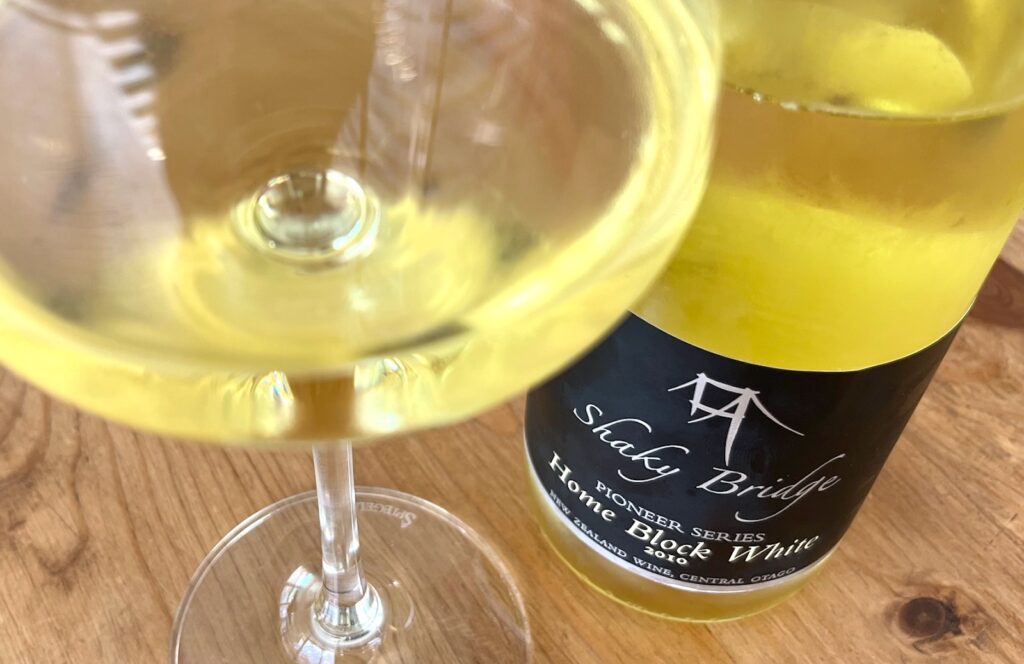
WineFolio: Ah! Well that’s good to hear. And speaking of ageability – I have the rather intriguing wine that you sent me, open here next to me. ‘Home Block White 2010’. And I have already tried it. I have in my notes “Very textural, with a well-balanced mixture of acidity and fruit. Ginger, floral (jasmine), almond, lemon curd and orange peel, with white pepper mid-palate, and not oily”. If I had to try it blind, I would perhaps plump for Grüner Veltliner, although it also reminds me of a Marcel Deiss Alsace blend. I love it when people put things together just because it works – not because the rulebook says it must be like this.
You mentioned earlier how Alexandra is gaining a reputation for being in the right spot. Is climate change playing into your hands a bit now, compared to fifty years ago, when it was presumably considered a borderline area for grape growing?
Mike Kush: Many elements of that are before my time, but when you talk to Dave and some of the other grape growers – and I’ve done this all over the world – then clearly climate is changing and it is getting warmer. In some corners of the wine world this change is very dramatic and worrying. All sorts of adaption is happening. Given New Zealand’s more cool-climate orientation for the most part – and certainly down here in Central – then potentially Alexandra is OK. Twenty years ago, in the Gibbston Valley some of the vintages were a bit marginal, and you didn’t quite get that level of ripeness.
In my experience of the years that I have been here, I don’t see us having a capacity to not ripen the grapes. In fact, we’re not one who want to have over ripeness. So we’re in a particularly good moment. That asset of those cool nights maintain that acidity that comes through in Central Otago wine. That precision on the palate gives Central Otago wines the ability to be world class. I think there is a global trend towards fresher wines. Burgundy, which is the home of Pinot Noir, has certainly seen climate change.
WineFolio: Definitely. I was at a presentation of wines from Bordeaux yesterday and there’s a move to wanting their wines to be drinkable earlier – inside that 5-10 year window. Looking at that – do you think Central Otago has grown up a bit with its wines? Not just doing what it could, and perhaps more of what it should?
Mike Kush: I’m well aware of the style that the region was perhaps originally known for. Back when I arrived in 2009 there was a diversity of style that was starting to emerge. If it is evolution, maturity, a new generation, influences from other corners of the world, or whatever… it’s still trying to be proudly and uniquely Central Otago. It is perhaps also, though, a Burgundy-alternative – with that acidity, some structure and savouriness. The different sub-regions all have the ability to express themselves. The best is yet to come from a region like ours.
WineFolio: Is that what you think defines a Central Otago wine? I’m often asked, for example, what is the difference between a Central Pinot and one from Martinborough?
Mike Kush: The evolution of style that is happening – not just in our region, but globally, makes it hard to answer that with precision. The different vineyards in different corners can all express themselves differently! What we’re trying to achieve is to focus on our vineyard and the best expression of that. That acidity, and clarity of fruit is a characteristic of our wines, but we do get richness and concentration. And good varietal character. Even, some of the savoury and some of the spice can come through. I think that positions us among the top Pinot Noir regions in the world.

In the winery there are always some elements of evolution. I was Dave’s Assistant Winemaker and gentle extraction was always a part of the winemaking. Along with attention to detail. Your terroir applies in the vineyards, but also applies in the winery. We use 100% French oak barrels and leave it in barrel for a full year. Our cellars are well insulated from the heat of the summer, but we also don’t warm the cellars during the winter. And our winters are particularly cold, as you know. Our malolactics are late… and if all these little things start to add up, then that is part of the wines.
WineFolio: Do you use any new-fangled technology in your winegrowing and making? Any A.I. or drones and sensors?
Mike Kush: I would say that we are far from that! (laughs). In my own personal winemaking, I certainly try to say up to date and well-read, and I find it all very interesting. Dave Grant and myself have been doing it for a long time, and I would say we’ve relied more upon our traditional techniques and experience. I use a minimal intervention type approach, with elements of ‘less is more’. We put a heavy emphasis on growing the best grapes that we can.
WineFolio: Is there anything else that you guys think could work down there?
Mike Kush: You never know in terms of some kind of experimentation. I think there’s a great capacity for Chardonnay. But we’re a small team and there’s enough to focus on with what we have in front of us. It’s not in our plans, for now.
WineFolio: What do think the consequences will be of the global trend for people to drink less?
Mike Kush: That’s quite topical, and no corner is immune from it. There are always trends, and that could well be the case. For us, as a producer, the overwhelming majority of our wines are sold here in New Zealand. We do export a little bit – we have had a long-term relationship in Australia, and we sell a little bit in America. And China as well – we’ve got a nice importer there. We find people very interested in high quality wine and Central Otago is well positioned to make that.
WineFolio: What is the Shaky Bridge definition of success? Is it just ‘we sold out all of the wine we made last year’ or do you have specific goals and targets? I’ve obviously seen that you win medals at shows too, but what does success look like for you?
Mike Kush: Gosh, that’s a good question. Dave’s obviously got the history – being from Alexandra and having his parents starting this. For us it’s all about the passion for doing this. That’s our motivation. It is a business, but for one, we want to be able to make wines that we enjoy. And say ‘yes, that’s an expression of us’. That is definitely a definition of success for us.

And then it would extend to our customers. I can’t tell you how many times the customers share with us just how much they appreciate it and the joy it brings. To me, that’s the kind of success that rewards our hard work.