

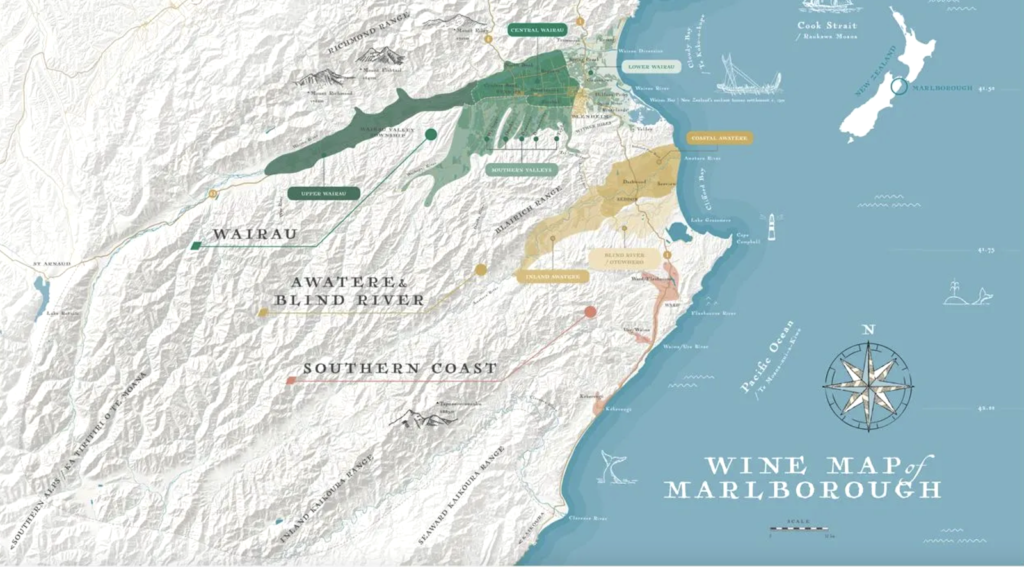
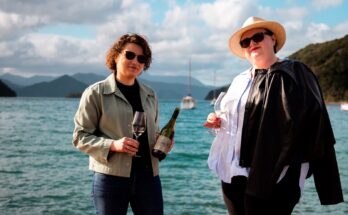
It’s March 2025, and I’m meeting with Michael Wentworth for the first time, after a few email conversations – mostly around the selection of a dozen Sauvignon Blanc wines that they release as an annual collection, but other pieces like the very cool map that they’ve developed, showing the sub-regionality across Marlborough. I ask him for the two minute version of how he got to be working for AMW?
Michael: The organisation has got to where it has through the hard work of many volunteers, we have now reached the critical scale to enable my role to come on board – someone to place more time and effort on our key priorities. I’ve been in this role just on a year now working alongside Sophie (our Chair), 8 committee members and our 50+ members.
The past year I’ve been setting the foundational stuff up. Making sure we are presenting a consistent message across all our members so they can go to market and talk about AMW consistently.
Before that I was with Yealands for sixteen years. I started off as Sales and Marketing. I was their second employee. When I joined in 2008, Peter was just building the winery and I was responsible for building the brand identity and positioning – and selling the wine of course.
The first three years I was on the road, including international markets – burning shoe leather. Ultimately I moved into sustainability, so drove their focus on sustainability and projects there. That was good and a massive learning experience. Prior to that I was with Montana – so Allied Domecq/Pernod for thirteen years. And prior to that I was at college learning winemaking – so I’m a failed winemaker basically. I did a couple of vintages before I realised that Sales was easier.
WineFolio: One thing that I look at AMW and wonder is this: How does the customer who likes a bottle of Savvy on a Friday night… care about what AMW stands for – what’s your message to them?

Michael: Like any successful industry, you are going attract people to the industry for a range of reasons – those that have established businesses, those living of the land, and those that see it as an opportunity to make money. With success has come scale – and unfortunately that has resulted in wines released to market that we believe do more harm to our hard earned industry reputation than good.
Our goal at AMW, is that when people see the AMW logo on a bottle, we call it the “Trust Mark” that they see it as a quality, authentic expression of the region. It’s a trust factor.
WineFolio: When I caught up with Sophie recently she talked about looking to have the logo positioned being quite prominently?
Michael: We call it a ‘banderol’. A strip label around the neck of the bottle. That’s the goal. AMW was set up in 2018 with the aim of ‘How do we enhance Marlborough’s reputation internationally?’ with the recognition that it was being eroded. The scourge of ‘bulk’ was affecting the prestige and reputation of the whole New Zealand wine industry. Never mind when it is blended with other regions. You end up on a shelf with a homogenous product. Unfortunately that’s a lot of the perception of people buying our wines.
Ivan Sutherland from Dog Point, John Forrest from Forrest, John Buchanan from Mt. Riley and James Healy founded AMW and attracted immediate interest from around 30 producers – almost like a collective. But now it is close on sixty wineries. So around 40% of the Marlborough wine industry. New Zealand Winegrowers lists 170 out of Marlborough.
WineFolio: I’d be confident of saying that most people think this is set up for Sauvignon Blanc – but it’s not just that is it?
Michael: It is dominant. We have approximately 150 wines that are certified across the membership from current vintage. And 100 of those are Sauvignon Blanc. It started with that variety as the key focus, but the demand grew with members saying that we should certify all varietals. Whilst Sauvignon Blanc is our flagship, the other varietals play a very important part upholding our quality reputation.
WineFolio: Assume I know nothing, and talk me through the certification process.
Michael: From a quality perspective – the fruit has to come from a designated vineyard that is 100% within Marlborough. That has to reach a minimum of 18 brix – with the exception of sparkling and low-alcohol wine. And that’s an absolute value – not an average across a blend. Every parcel of fruit that goes into the wine has to exceed 18 brix. It has to come from a sustainably-certified vineyard. It has to be bottled in New Zealand. Again, that’s the authenticity piece.
And, ultimately, it has to pass a blind, independent tasting. We run a tasting panel every week. Those who are on the panel – typically winemakers – can’t judge any of their own wines that come through the process. That’s essentially it. If you tick all those boxes and you meet the quality mark, then your wine can be certified.
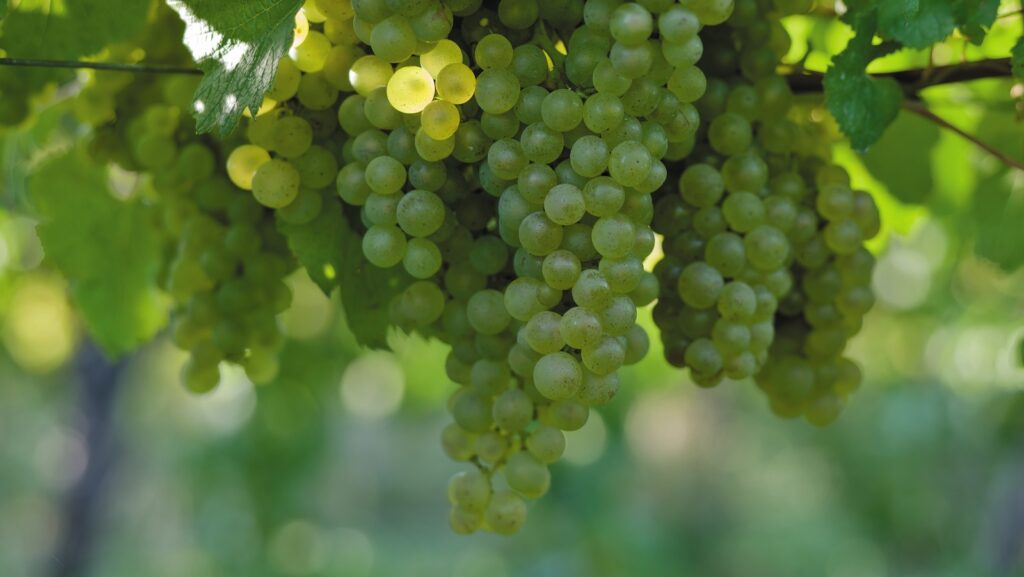
WineFolio: What about cropping levels?
Michael: Originally there was a yield cap. It was 15 tonnes per hectare for Sauvignon Blanc. We dropped that in favour of the minimum ripeness levels (brix), because the cropping level parameter didn’t recognise the microclimates within the region, or site specific vigor, or soil types… and therefore we replaced it with minimum brix two years ago. The brix is more aligned with what European Appellations are doing of course – particularly in Sancerre. Some may argue that it is a relatively low bar, but it’s a minimum a standard, aligns with grape physiological ripeness and with Sancerre which we believe was an appropriate level.
WineFolio: Apart from those blind assessments, how do you police it?
Michael: There is a level of trust but we do audit. We bring an external auditor in once a year and we’ll randomly audit a number of the wines. If people are trying to fudge the system, then they’re in the wrong organisation to be honest.
WineFolio: Are there some people who just have some of their wines in? And that’s acceptable?
Michael: Yes, and yes, and there are a range of reasons for this. Some producers have their own bottling lines off shore and therefore they don’t meet the bottled in NZ requirement. Some have vineyard holdings outside of Marlborough and may blend. Others may certify their upper echelon as a point of difference.
WineFolio: Is there not a sense of a customer trying to get their head around this, and they’ve seen the accreditation logo on the wine they’ve bought – but it isn’t on all of that brand’s wines? And not knowing why? But, then I suppose you can’t say to a company “You’re in this for life”
Michael: That’s why we certify the wines and not the organisation. So there’s no greenwashing. That’s why the AMW “Trust mark” is important for wine drinkers to look out for.
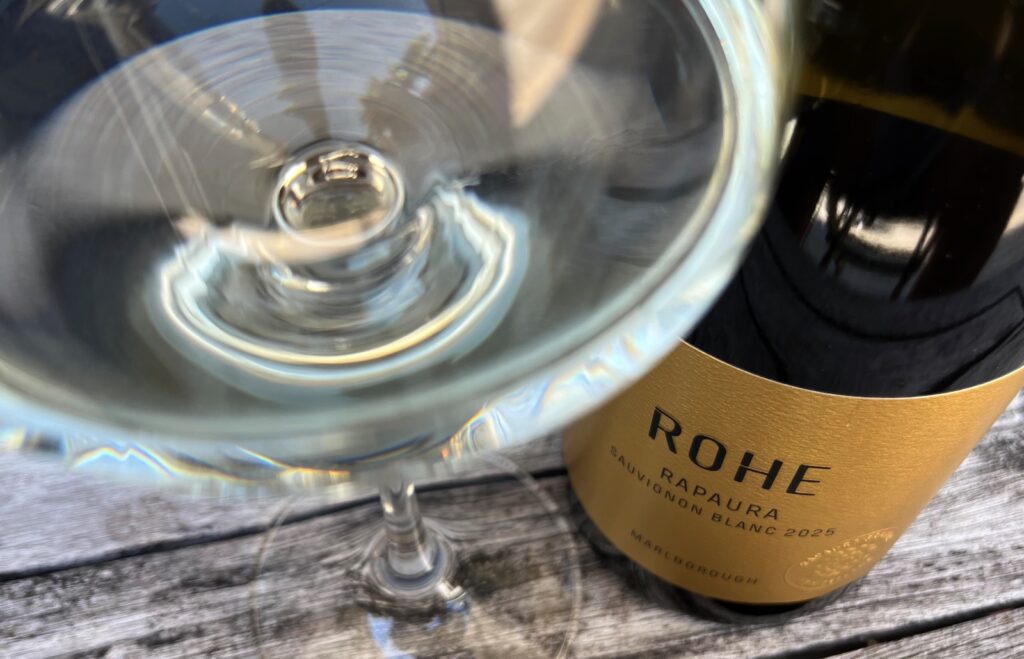
WineFolio: And the big trend I’m seeing is the labelling of those sub-regions quite prominently now. You see the words ‘Blind River’ or ‘Southern Valleys’ on the front label. I think that’s great for us who live in the world of wine, but I do have concerns that if someone went into a bar expecting a typical Sauvignon Blanc – and Marlborough would certainly be able to deliver that… but some of the sub-regional bottlings are NOT your typical, are they? Is it the Burgundy model – Grand Cru down to single appellations and then Village?
Michael: The challenge that we have with Marlborough Sauvignon Blanc is that there is a perception in some markets that it is a homogenous product where you know what you’re going to get. And that has positives and negatives.
In our more mature markets such as the UK and Australia, telling the sub regional story and the diversity of the region and the subsequent wines adds depth and interest to the category. Sure, its not for everyone – but that provides opportunity on wine lists and fine wine stores and those looking to broaden their knowledge.
WineFolio: I actually think that the sub-regional characters come out in a wine as much in Pinot Noir as in Sauvignon Blanc. With the right material, in the right places, with a bit of vine age – Marlborough Pinot is really looking good. Don’t get me wrong – I think I can tell the difference between a Sav from Rapaura and one from the Awatere, but I’m obsessed with wine.
Michael: Well, I hope you like the collection of Sauvignon Blanc when you get to have a look at it. It has a wide range of wines from across the sub-regions.
WineFolio: And that’s not by design is it? You’re not looking for ‘an expression of styles from across the region’? They were tasted blind and that spread is just how it came out? And do you change the people on the panel each time?

Michael: The goal of the Collection is to pick the 12 best wines that represent the region and the vintage. The focus is on quality and this year we are fortunate to get such a diverse spread across the sub regions. Our intention is to keep Stephen Wong in there as Chair so that there is a level of consistency, and swap out the other two judges each year. We’ll try to have one international judge, and one domestic judge as well. The beauty with Stephen is that he’s such a good guy. The way he brings people along.
WineFolio: I’m guessing that another vital part for AMW is around advocacy?
Michael: A lot of my role is speaking on behalf of AMW. In terms of trying to bring about change or legislation or otherwise. There’s two specific things that we are talking to at the moment. One is the existing Marlborough G.I. At the moment that goes south of Kaikoura, and we’re talking to Wine Marlborough about that. The litmus test is ‘Would you still put vines in the ground down there if you couldn’t put Marlborough on the label?’ Or are you taking advantage of the fact you’ll be classed as Marlborough?
There are huge tracts of land down that way that are entirely unsuitable for quality winegrowing. We’re working with Wine Marlborough to address that in terms of submissions and tighten the G.I. so that it reflects quality winemaking. And that’s a process we have to go through.
We’re also butting heads a little bit with New Zealand Winegrowers around their ‘voluntary bulk wine code’. Our argument is that a voluntary code is not going to address anything, so why do that – are you just saying that, so you’re seen to be doing something? We put in an application to say why make it voluntary, when, even if you had to lower the standard to get buy-in from everyone? We would settle for that if it was a compulsory code. Because all we’re asking for is the same level of protection that we have on wines bottled here in New Zealand.
Where we’re at is that they’ve had their Board meeting and have decided to keep it voluntary. One of the pieces I’m working on at the moment is ‘where do these board members stand with their respective companies, and have they taken a New Zealand industry approach or have they taken a personal approach?’ All we want are some guard rails in place for bulk wine production offshore.

WineFolio: Is it more important to have overseas recognition, or is your focus domestic?
Michael: Ultimately it is the international market that we’re after. A big focus next year will be raising awareness of AMW in our key global markets. Our primary targets are the key stakeholders being trade and wine media, education institutions and of course the wine buyer.
WineFolio: I had a story about how 30% of Central Otago was now certified organic – could that be that a part of the Marlborough story?
Michael: There is a really strong core of organic growers here, and getting an increasing share of voice. I think the structure of the industry here is quite different to Central Otago – particularly with the number of large producers here.
WineFolio: Looking at the strength of the appellation system somewhere like Europe – how strong do you think G.I’s – and voices like AMW – could be in New Zealand?
Michael: I think there’s massive potential – in offshore markets. There are other regional organisations looking at what we’re doing, and their opportunity in this space. The beauty of our model is that we’re not bound by a whole bunch of stakeholders or legislation. We can advocate on behalf of our members, and probably say and do things that other bodies can’t. The regional bodies such as Wine Marlborough are funded by Winegrowers, so their hands are tied a lot, in terms of what they can or can’t do. We don’t have those constraints.
WineFolio: Are there things that have happened in the last few years that haven’t helped? For example, the takeover of Villa Maria?
Michael: That’s probably one of the more visible changes that has occurred. Ultimately everyone plays a role and our focus is to encourage everyone to produce what they can sell. Quality is what the Marlborough reputation has been built on – and everyone needs to play a role in that.
WineFolio: Is investment still coming in – more vines going in the ground?
Michael: People are increasingly heading into marginal territory. Whether it be frost or otherwise. The interesting thing will be what climate change does over time. Does that make more land available for planting, or less? You look how far they go up into the Upper Wairau now. There’s a massive level of risk there – whether you get an early, or late, frost. With climate changing we are already seeing an increase in weather events. With that comes risk.
WineFolio: Another risk is that the world stops loving Marlborough Sauvignon Blanc.
Michael: We’re in a fortunate position in that New Zealand is just such a small producer in terms of the global stage. We represent bugger all of global production. So there’s an opportunity to say – imagine if we were able to build our distribution and awareness globally. Look at the opportunity within the USA for Marlborough Sauvignon Blanc. It’s still taking off.
WineFolio: What about this trend of not drinking – because alcohol is evil?
Michael: That is something we’re concerned about, because it is one side of the story that is being told. It seems that the press is very focussed on that angle, and there’s no-one telling the counter story. It is one thing we’ve been talking to other organisations about. Where’s the balance in reporting – because we’re certainly not getting that balance now.
WineFolio: In effect, the AMW story is very aligned with that ‘drink less, but drink better’ quality-focussed message. Wine isn’t really a ‘get drunk’ story – the european model certainly has wine on the dinner table, with friends and family.

Great story – good to see it being told.