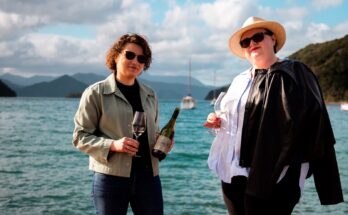
On a recent visit to the Nelson Tasman region, I made a couple of trips to the Gravity Winery in the Upper Moutere Hills. The first day I was there to have a chat with Brand Manager for Booster Group, Sammy Wilkinson. She looks after the brands, marketing and social media channels. Then I boomeranged back the next day to head down to the barrel hall and a go through the red wines with winemaker Brett Bermingham, who came to Gravity after 14 years at Nautilus over in Marlborough.
There’s no denying that it is an impressive building. It looks like no expense was spared in creating the four-storey winery prior to it opening back in 2006. The structure was cut into the side of a hill. One thing that is notable about this place is the sheer amount of concrete that was invested in when they were building – it is a serious piece of construction. Sammy tells me “I’m pretty sure they used all the concrete available in the South Island at the time”.
The history at ‘Gravity’ starts with a collaboration between a local man Philip Woollaston and an American couple Glenn and Renee Schaeffer. When it opened was originally it was known as ‘Woollaston Estates’. Their intention was to make the purest expressions of the regions wines with a focus on innovative winemaking techniques. In 2019 it was renamed as Gravity Winery, and now it is owned by Booster Wine Group and the name was fine-tuned to ‘Gravity Cellars’ in December 2023.

The history of Booster starts with a merger between the Awatere River and Waimea Estate labels. As the group expanded, with more brands, and the addition of the Gravity winery site, it morphed into Booster Wine Group. That is the B2B brand – customers just know the labels as before. Gravity is their showcase location, where the company can offer a multi-regional tasting from across the group’s brands. You have Central Otago with Bannock Brae, to LV and Awatere River from Marlborough, then Sileni from Hawke’s Bay and Waimea from Nelson/Tasman.
Sammy tells me that the group have sold the Waimea winery site, but were keeping all the vineyards. Tasman District Council have bought the building and I think they’re going to turn it into some sort of water/stormwater processing plant, to help with infrastructure in the area.
Therefore, there’s quite an expansion happening on-site at my visit. Previously it was just the fruit from the Bannock Brae range being processed here, but a big collection of machinery has come up from Waimea in recent months and contractors are on site pulling it all together. I’m introduced to Toby Schmid – one of the assistant winemakers, who explains “I just moved up from Waimea Estate along with 60 tanks, and we are in the middle of re-organising all of the winery and buildings. So it’s not a nice look at this stage”.
There are four levels, and the concept is working with gravity to move the liquids around, and therefore avoid using pumps. The process starts at the top where the grapes go into the presses with forklifts. For reds – onto a conveyer belt, sorted and then down they go straight into fermenters which can be heated and cooled. They have fourteen eight-tonne fermenters and then two-tonne ones too for smaller volumes and trials.
Above my head there is a pneumatic plunger system on a rail. Toby explains “sometimes we have to get a little bit more air in to the reds. If you’re too gentle with the grapes then that air isn’t there and the yeasts start to struggle, but we’ve got pulse air to pump air in to the wine. With our Pinot just a plunge is usually OK as we don’t want to over-extract”.

We walk down some stairs to Level Three. For the white wines, those come over from the press on the top level and go into tanks. Down here, they are settled and a day or two later yeast is added. After that is done, the crew attach a hose that goes another level down, and the fermentation begins, either in tank or barrel. Down one more set of stairs and we’re at that level where the whites will ferment. Here, they do have to use a pump to rack from one tank to another. And they have more small batch fermenters – from 1000 to 5000 litre; then 10,000-15,000 litre alongside.
Standing amongst the tanks, I get to taste an Albariño from the Waimea Plains. Very fresh with spiky acid and lots of wet stone texture. A Grüner Veltliner with a peppery edge, shows lots of character but is quite broad and textural. Pinot Gris from Waimea as well, shows a nudge of residual sugar and I get a hint of barrel ferment richness somewhere in there. Having been at Seifried the day before, there is definitely a minerality in the terroir that shows up as a signature in the whites from this sub-region. There is fresh acid but they seem well balanced.
The Gewürztraminer they make is the one that has the most small ferments going – spread over six batches, using different yeasts and different temperatures to create the blend. Of course, this piques my interest. There is skin contact, using whole berries, and a certain level of oxidative winemaking going on. You could call it an ‘orange wine’ with a lovely textural, phenolic quality. It has a typical aroma of turkish delight and spices, and an off-dry palate which I think accents the style. It’s delicious.
Down on the bottom level is the barrel hall, but also a bottling line that makes them self-sufficient. There are masses of red wines maturing in french oak barrels down here – something to look forward to with my next visit. Part of it is a superb space that could be used for functions and events. Apparently King Charles and Camilla visited the winery in 2015, and stood on a small balcony giving a royal wave! A beautiful Library Room has a bundle of treasured stock bottles from older vintages.

As Sammy goes off to organise wines to taste, I have a peruse of the Wine Club offerings available. One of the first jobs Sammy did when she started here three years ago was to pull all the separate offerings together into one place where you could see everything from across the group. Subscribers now have a choice of nine variants, which change every quarter – it can be a mix of whites and reds across the tiers. If a customer wanted to skip a case, they can – all through the website.
As someone who has worked a lot in membership, it does look like a very slick offering. In fact it is along the lines of something I’d wanted to set up at a previous job, but couldn’t get across the line. I see that the special ocean-aged Louis Vavasour Méthode (see here > https://winefolio.co.nz/?p=11853) was offered first to the Wine Club. Having that sort of thing as an exclusive to them must be a great incentive to a potential punter.

There are two Méthodes available today. At $35 a bottle, the Awatere River would be a great buy at your local supermarket. The blend is Chardonnay 52%, Pinot Noir 43% and Pinot Meunier 5%. The base wine is matured for 6 months before blending, then it sees 15 months on lees in the bottle. At the cheap end of things, Champagne is usually not great – not that I’m particularly a fan of spending $250 on a bottle either. So to see an affordable alternative is great news. It is clean, bright and not overly complicated… and certainly not difficult to like!
The LV Méthode Traditionnelle uses Mendoza-clone Chardonnay at 40%, and Clone 115 Pinot Noir at 60%. If you were to pick this up to head off to a celebration it would set you back just under $60.
Using the heart of the pressed juice – just the first 500 litres per tonne from the press – it then sees two and a half years on lees, before being disgorged and 9 grams dosage added. The zesty, driven acidity that you get from Marlborough makes a lovely wine for bubbles. This is the wine that the company put a few bottles in the sea to make the Ocean-Aged version I mentioned above.
A wide range of white wines is open for tasting. The labels are attractive too, with re-branding happening under Sammy’s guidance across the ranges. The winemaking doesn’t (generally) have anything weird and wonderful to it – fruit is de-stemmed, crushed, and fermented in stainless steel to retain freshness. Think of cool temperature ferments of different batches from different places, which are then ready to be blended.
As I said down in the tanks, the alluvial soils of the Waimea Plains seem well-suited to aromatic whites. The Albariño is sharply acidic, as it should be – but textural and broad, with plush stonefruit flavours. I get a lovely minerality, heightened by the salinity and energy of the acidity. Look for a tight phenolic grip to the finish too. Other high-acid varietals like Sauvignon Gris and a Waimea Sauvignon Blanc 2022 (from a good vintage) thrive. The Sav Blanc is very polished, with the acidity quite integrated and with a softer mouthfeel. Still linear and direct, but rounder and without that gooseberry, herbaceous style to it compared to a typical example from Marlborough.

I hear that the major markets for these wines are domestic, but also the UK. Waimea Pinot Gris 2023 – from another good year – has an element of Moutere Hills fruit in it. Perhaps that is what gives it a really balanced palate weight and plushness. The brightness of the fruit is certainly there, with both acidity and a spicy texture. A Gewürztraminer has plenty of varietal typicity, but with a focus on citrus – in particular an appealing line of juicy satsuma. After visits to neighbouring properties, I’m getting the sense that the aromatic whites from this sub-region really are something special.
Whilst I’m here, I try a couple of wines that come from Sileni – the Hawke’s Bay representative in the group. An Albariño – Sileni Advocate 2024 is quite different from the Waimea one. A zesty palate is also juicy, with around 7 grams of residual sugar and bags of stonefruit – almost a canned peach edge to it. A pleasant and reasonably-priced ‘local’ version of Albariño.
Another Bridge Pa wine – Sileni Pacemaker Cabernet Franc 2019 has the distinctive smokiness of the grape varietal on show. A little bit of savoury forest floor amongst the lovely red fruit flavours and a subtle note of sweet vanilla oak at the rounded finish. I’m a sucker for a good Hawke’s Bay Merlot as well, and the Sileni Triangle Grand Reserve Merlot 2018 is a classic. To me, nothing shows off some sweet French oak like juicy Hawke’s Bay Merlot, with that spiciness framing the plush plummy fruit. The tannin here is wonderfully supple and lengthy.
It is a wonderful summer morning, and the restaurant is filling up – with sixty booked in. Not bad for a Wednesday lunchtime. I’m due back again tomorrow to go through the rest of the reds, and the Pinot in particular. If I was on holiday here though I’d certainly be hard pushed to drag myself from a shady table with that view, and the selection of wines on offer. However, I’m on to my next appointment – and if you check back to WineFolio on another day you’ll find my talk with Brett and some enthusiastic blending of Pinot listed in the near future.
You’ll find Gravity Cellars online at https://gravitycellars.co.nz/ and if you are in the area, at 243 Old Coach Road, Mahana. The Cellar Door has a range of Tasting Options you can choose, or pop in for lunch. They’re open in Summer ( December and January) every day except Monday.